1 The adjoint method - Stanford Computer Science
2 PDE-constrained optimization problems Partial di erential equations are used to model physical processes. Optimiza-tion over a PDE arises in at least two broad contexts: determining parameters of a PDE-based model so that the eld values match observations (an inverse problem); and design optimization: for example, of an airplane wing.
Download 1 The adjoint method - Stanford Computer Science

Information
Domain:
Source:
Link to this page:
Documents from same domain

EPIGENETICS COURSERA CLASS: LECTURE WEEK 1
cs.stanford.eduepigenetics coursera class: lecture week 2 Acetylation or Methylation (among other things) can happen at Nterminal tails of histones. Various molecules can bind to histones, some suggest there is a “histone code”, as these all

KAREL THE ROBOT - Stanford Computer Science
cs.stanford.eduthe word Karel in a Karel program represents the entire class of robots that know how to respond to the move() , turnLeft() , pickBeeper() , and putBeeper() commands. Whenever you have an actual robot in the world, that robot is an object that represents a
Designing Fast Absorbing Markov Chains - Stanford University
cs.stanford.eduMarkov Chains and Absorption Times A discrete Markov chain (Grinstead and Snell 1997) Mis a stochastic process defined on a finite set Xof states.
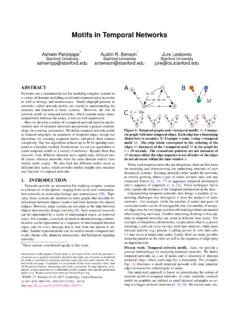
Motifs in Temporal Networks - Stanford University
cs.stanford.edumotifs defined by a constant number of temporal edges between 2 nodes, this general algorithm is optimal up to constant factors—it runs in O(m) time, where mis the number of temporal edges.
Statement of Purpose - Stanford University
cs.stanford.eduStatement of Purpose Jacob Steinhardt December 31, 2011 1 Career Goals The advent of the computer, together with Turing’s theory of universal computation, has revo-

Deep Visual-Semantic Alignments for Generating Image ...
cs.stanford.eduFigure 2. Overview of our approach. A dataset of images and their sentence descriptions is the input to our model (left). Our model first infers the correspondences (middle, Section3.1) and then learns to generate novel descriptions (right, Section3.2).
Distributed Representations of Sentences and Documents
cs.stanford.eduunique vector, represented by a column in matrix W. The paragraph vector and word vectors are averaged or concate-nated to predict the next word in a context. In the experi-ments, we use concatenation as the method to combine the vectors. More formally, the only change in this model compared to the word vector framework is in equation 1, where h is

Proof Techniques - Stanford Computer Science
cs.stanford.edu32 = 9, while disproving the statement would require showing that none of the odd numbers have squares that are odd.) 1.0.1 Proving something is true for all members of a group If we want to prove something is true for all odd numbers (for example, that the square of any odd number is odd), we can pick an arbitrary odd number x, and try to ...
Twitter Sentiment Classification using Distant Supervision
cs.stanford.edu1.2 Characteristics of Tweets Twitter messages have many unique attributes, which dif-ferentiates our research from previous research: Length The maximum length of a Twitter message is 140 characters. From our training set, we calculate that the average length of a tweet is 14 words or 78 characters. This

Guide to the MSCS Program Sheet
cs.stanford.edustatistics can usually be satisfied by any course in probability taught from a rigorous mathematical perspective. Courses in statistics designed for social scientists generally do not have the necessary sophistication. A useful rule of thumb is that courses satisfying this requirement must have a calculus prerequisite. 3.
Related documents
Constrained Optimization: Kuhn-Tucker conditions
amber.feld.cvut.czConstrained Optimization: Kuhn-Tucker conditions Brian Wallace, Economics dept b.wallace@rhul.ac.uk September 23, 2004 Abstract In this document, we set out the constrained optimisation with inequality constraints and state the Kuhn-Tucker necessary conditions for a solution; after an example, we state the Kuhn-Tucker sufficient conditions for ...

USING EXCEL SOLVER IN OPTIMIZATION PROBLEMS
archives.math.utk.eduExample Two (Nonlinear model): Network Flow Problem This example illustrates how to find the optimal path to transport hazardous material ( Ragsdale, 2011, p.367) Safety Trans is a trucking company that specializes transporting extremely valuable and extremely hazardous materials. Due to the nature of the business, the company places
CS 229, Autumn 2009 The Simplified SMO Algorithm
cs229.stanford.eduThis document describes a simplified version of the Sequential Minimal Optimization (SMO) algorithm for training support vector machines that you will implement for problem set #2. The full algorithm is described in John Platt’s paper1 [1], and much of …

The Solver Add In
faculty.washington.eduThis optimization problem can also be easily solved using the solver with matrix algebra functions. The screenshot below shows how to set‐up this optimization problem in Excel where the target expected return is the expected return on Microsoft (4.27%).

Convex Optimization — Boyd & Vandenberghe 4. Convex ...
web.stanford.eduthe standard form optimization problem has an implicit constraint x ∈ D = \m i=0 domfi ∩ \p i=1 domhi, • we call D the domain of the problem • the constraints fi(x) ≤ 0, hi(x) = 0 are the explicit constraints • a problem is unconstrained if it has no explicit constraints (m = p = 0) example: minimize f 0(x) = − Pk i=1log(bi −a T ...

Non-convex optimization
www.cs.ubc.caNon-convex optimization Strategy 1: Local non-convex optimization Convexity convergence rates apply Escape saddle points using, for example, cubic regularization and saddle-free newton update Strategy 2: Relaxing the non-convex problem to a convex problem Convex neural networks Strategy 3: Global non-convex optimization