
14.01 Fall 2010 Problem Set 4 Solutions
Problem Set 4 Solutions 1. (27 points) For each of the following production functions, sketch a representative isoquant (2 points). Calculate the marginal product for each input, and indicate whether each marginal product is diminish ing, constant, or increasing (3 points). Also calculate the marginal rate of technical substitution for each
Download 14.01 Fall 2010 Problem Set 4 Solutions

Information
Domain:
Source:
Link to this page:
Documents from same domain
Wireless Communications - MIT OpenCourseWare
ocw.mit.eduWireless Communications Wireless telephony Wireless LANs Location-based services 1 The Technology: ... Cellular Phone Networks Frequency reuse
SYSTEMS ENGINEERING FUNDAMENTALS - MIT …
ocw.mit.eduSystems Engineering Fundamentals Introduction iv PREFACE This book provides a basic, conceptual-level description of engineering management disciplines that
Fundamentals of Chemical Reactions - MIT …
ocw.mit.edu10.37 Chemical and Biological Reaction Engineering, Spring 2007 Prof. William H. Green Lecture 4: Reaction Mechanisms and Rate Laws Fundamentals of Chemical Reactions
The Heart of a Vampire - MIT OpenCourseWare
ocw.mit.eduThe Heart of a Vampire ... Interview with the Vampire might not have convinced me that vampires could be sexy until I read a fantasy book on the subject, ...
Heijunka Product & Production Leveling
ocw.mit.eduHeijunka Product & Production Leveling Module 9.3 Mark Graban, LFM Class of ’99, Internal Lean Consultant, Honeywell Presentation for: Summer 2004
15.501/516 Final Examination December 18, 2002
ocw.mit.edu15.501/516 Final Examination December 18, 2002 ... accounting, used for many years ... Metro Area Inc. was in severe financial difficulty and threatened to
Sloan School of Management Massachusetts …
ocw.mit.eduSloan School of Management Massachusetts Institute of Technology ... Managerial Accounting ... Financial accounting information facilitates the

USS Vincennes Incident - MIT OpenCourseWare
ocw.mit.eduOverview • Introduction and Historical Context • Incident Description • Aegis System Description • Human Factors Analysis • Recommendations
Stochastic Processes and Brownian Motion
ocw.mit.eduChapter 1. Stochastic Processes and Brownian Motion 2 1.1 Markov Processes 1.1.1 Probability Distributions and Transitions Suppose …
Stochastic Processes I - MIT OpenCourseWare
ocw.mit.eduLecture 5 : Stochastic Processes I 1 Stochastic process A stochastic process is a collection of random variables indexed by time. An alternate view is that it is a probability distribution over a space
Related documents

Lecture 18 Solving Shortest Path Problem: Dijkstra’s Algorithm
www.ifp.illinois.eduLecture 18 Algorithms Solving the Problem • Dijkstra’s algorithm • Solves only the problems with nonnegative costs, i.e., c ij ≥ 0 for all (i,j) ∈ E • Bellman-Ford algorithm • Applicable to problems with arbitrary costs • Floyd-Warshall algorithm • Applicable to problems with arbitrary costs • Solves a more general all-to-all shortest path problem ...

Chapter 5: Activity-Based Costing (ABC) & Activity-Based ...
www.csus.eduppproducts or services . . . this problem arises when reported costs of products do not equal their actual costs 15 Learning Objective 2: Present three guidelines for refining a costing system . . . classif yy,p more costs as direct costs , ex pand the number of indirect-cost pools, and identify cost drivers True or False

The Three-Point Problem
www.csun.eduThe Three-Point Problem: Computational Solutions Let's look at the original problem in a Cartesian reference frame (x,y,z). If you are not given this info in the original format, you can easily convert using sines and cosines.
Skills Worksheet Problem Solving - School of Arts & Sciences
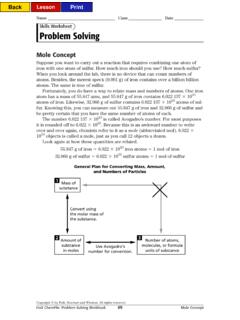
www.sas.upenn.eduHolt ChemFile: Problem-Solving Workbook 49 Mole Concept Name Class Date Problem Solving continued PROBLEMS INVOLVING ATOMS AND ELEMENTS Sample Problem 1 A chemist has a jar containing 388.2 g of iron filings. How many moles of iron does the jar contain? Solution ANALYZE What is given in the problem? mass of iron in grams

18.06 Problem Set 7 - Solutions
web.mit.eduProblem 5: (10=5+5) (a) If A (an n × n matrix) has n nonnegative eigenvalues λ k and independent eigenvectors x k, and if we define “ √ A” as the matrix with eigenvalues √ λ k and the same eigenvectors, show that (√ A)2 = A. Solution We can decompose A into A = SΛS−1, where S is the matrix consists of eigenvectors of A, and Λ = λ