
18.04 Complex analysis with applications
2 Complex algebra and the complex plane We will start with a review of the basic algebra and geometry of complex numbers. Most likely you have encountered this previously in 18.03 or elsewhere. 2.1 Motivation The equation x2 = 1 has no real solutions, yet we know that this equation arises naturally and we want to use its roots.
Download 18.04 Complex analysis with applications

Information
Domain:
Source:
Link to this page:
Documents from same domain
Introduction to Linear Algebra, 5th Edition
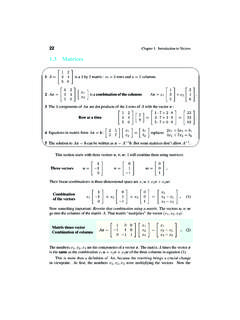
math.mit.edu1.3 Matrices 1 A = ... Linear Equations One more change in viewpoint is crucial. Up to now, the numbers x 1,x 2,x 3 were known. The right hand side b was not known. We found that vector of differences by multiplying A times x. Now we think of b as known and we look for x.
Eigenvalues and Eigenvectors
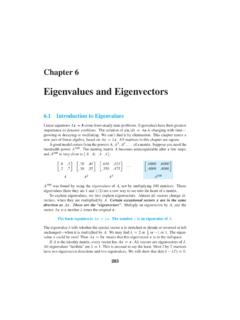
math.mit.eduSpecial properties of a matrix lead to special eigenvalues and eigenvectors. That is a major theme of this chapter (it is captured in a table at the very end). 286 Chapter 6.
Eigenvalues and Eigenvectors - MIT Mathematics
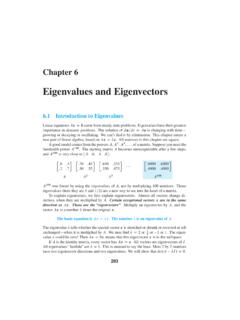
math.mit.edu6.1. Introduction to Eigenvalues 287 Eigenvalues The number is an eigenvalue of Aif and only if I is singular: det.A I/ D 0: (3) This “characteristic equation” det.A I/ D 0 involves only , not x. When A is n by n,
4 Cauchy’s integral formula - MIT Mathematics
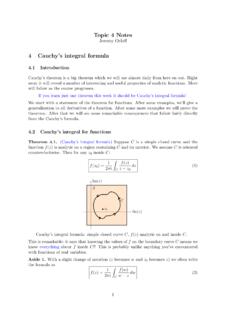
math.mit.edu4 Cauchy’s integral formula 4.1 Introduction ... 4 CAUCHY’S INTEGRAL FORMULA 4 4.3.1 Another approach to some basic examples Suppose Cis a simple closed curve around 0. We have seen that Z C 1 z ... Since an integral is basically a sum, this translates to the triangle inequality for integrals.
A FRIENDLY INTRODUCTION TO GROUP THEORY
math.mit.eduA FRIENDLY INTRODUCTION TO GROUP THEORY 3 A good way to check your understanding of the above de nitions is to make sure you understand why the following equation is correct: jhgij= o(g): (1) De nition 5: A group Gis called abelian (or commutative) if gh = hg for all g;h2G. A group is called cyclic if it is generated by a single element, that is,
4.3 Least Squares Approximations
math.mit.edu4.3. Least Squares Approximations 221 Figure 4.7: The projection p DAbx is closest to b,sobxminimizes E Dkb Axk2. In this section the situation is just the opposite. There are no solutions to Ax Db. Instead of splitting up x we are splitting up b. Figure 4.3 shows the big picture for least squares. Instead of Ax Db we solve Abx Dp.

Linear programming 1 Basics - MIT Mathematics
math.mit.edu2 subject to: 5x 1 + 7x 2 8 4x 1 + 2x 2 15 2x 1 + x 2 3 x 1 0;x 2 0: Some more terminology. A solution x= (x 1;x 2) is said to be feasible with respect to the above linear program if it satis es all the above constraints. The set of feasible solutions is called the feasible space or feasible region. A feasible solution is optimal if its ...
Square Roots via Newton’s Method
math.mit.eduSquare Roots via Newton’s Method S. G. Johnson, MIT Course 18.335 February 4, 2015 1 Overview ...
V7. Laplace’s Equation and Harmonic Functions
math.mit.eduA. Existence. Does there exist a φ(x,y) harmonic in some region containing Cand its interior R, and taking on the prescribed boundary values? B. Uniqueness. If it exists, is there only one such φ(x,y)? C. Solving. If there is a unique φ(x,y), determine it by some explicit formula, or approximate it by some numerical method.
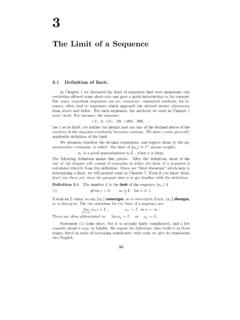
The Limit of a Sequence - MIT Mathematics
math.mit.edu“obvious” using the definition of limit we started with in Chapter 1, but we are committed now and for the rest of the book to using the newer Definition 3.1 of limit, and therefore the theorem requires proof. Theorem 3.2B {an} increasing, L = liman ⇒ an ≤ L for all n; {an} decreasing, L = liman ⇒ an ≥ L for all n. Proof.
Related documents
REAL ANALYSIS
www.cmat.edu.uyBeginning in the spring of 2000, a series of four one-semester courses ... ear algebra. This makes these books accessible to students interested in such diverse disciplines as mathematics, physics, engineering, and ... aspects of the lectures, such as transparencies, notes, and the manuscript.
A Course on Number Theory - QMUL Maths
www.maths.qmul.ac.ukThese are the notes of the course MTH6128, Number Theory, which I taught at Queen Mary, University of London, in the spring semester of 2009. There is nothing original to me in the notes. The course was designed by Su-san McKay, and developed by Stephen Donkin, Ian Chiswell, Charles Leedham-

Spectral and Algebraic Graph Theory - Yale University
cs-www.cs.yale.eduOne must introduce necessary linear algebra and show some interesting interpretations of graph eigenvalues. One must derive the eigenvalues of some example graphs to ground the theory. I nd that one has to do all these at once. For this reason my rst few lectures jump between developing theory and examining particular graphs.
Introduction to Operations Research
www.cs.toronto.edu5 Linear Algebra Review 27 ... These lecture notes were written during the Fall/Spring 2013/14 semesters to accompany lectures of the course IEOR 4004: Introduction to Operations Research - Deterministic Models. The notes were meant to provide a succint
Differential Equations - Hong Kong University of Science ...
www.math.hkust.edu.hkinto their production, and the video lectures have better video quality than the ones prepared for these notes. You can click on the links below to explore these courses. If you want to learn differential equations, have a look at Differential Equations for Engineers If your interests are matrices and elementary linear algebra, try
Linear Algebra in Twenty Five Lectures
www.math.ucdavis.eduThese linear algebra lecture notes are designed to be presented as twenty ve, fty minute lectures suitable for sophomores likely to use the material for applications but still requiring a solid foundation in this fundamental branch

Brownian Motion - University of California, Berkeley
www.stat.berkeley.eduThis book grew out of lectures given by Yuval Peres at the Statistics Department, University of California, Berkeley in Spring 1998. We are grateful to the students who attended the course and wrote the flrst draft of the notes: Diego Garcia, Yoram Gat, Diogo A. Gomes, Charles