2. Basic Organization of a Computer
2. Basic Organization of a Computer 2.1 The block diagram Most of the computers available today on the market are the so calledvon Neumann computers, simply because their main building parts, CPU or processor, memory, and I/O are interconnected the way von Neumann suggested. Figure 2.1 presents the basic building blocks of today’s
Download 2. Basic Organization of a Computer

Information
Domain:
Source:
Link to this page:
Documents from same domain

Exceptions in MIPS
www.cs.iit.eduAn interrupt is an asynchronous exception. Synchronous exceptions, resulting directly from the execution of the program, are called traps. When an exception happens, the control is transferred to a different program named exception handler , writ-ten explicitly for the purpose of …

Software Testing Strategies Chapter 18
www.cs.iit.eduSoftware Testing Strategies • Characteristics of testing strategies: – Testing begins at the component level, for OO at the class or object level, and works outward toward the integration of the entire system. – Different testing techniques, such as white-box and black-box, are appropriate at different times in the testing process.
PowerPoint Use in Teaching
www.cs.iit.edulectures by outlining the class schedule. Presentations break down lectures into layers and thereby giving it a structure. By displaying all the key points in the concept, note-taking becomes easy for the students. ... Teaching Effectiveness’, Interdisciplinary Journal of Information, Knowledge and Management, Volume 6, 2011.

1. Fundamentals of Computer Design
www.cs.iit.edu1.3 What Drives the Work of a Computer Designer Designing a computer is a challenging task. It involves software (at least at the level of designing the instruction set), and hardware as well at all levels: functional organization, logic design, implementation. Implementation itself deals with designing/specifying ICs, packaging,
Related documents
Computer Organization and Architecture Characteristics of ...
aturing.umcs.maine.eduCache Memory Computer Organization and Architecture Note: Appendix 4A will not be covered in class, but the material is interesting reading and may be used in some homework problems. Characteristics of Memory Systems Location • CPU —Registers and control unit memory • …
Computer Organization and Architecture 9th - USTC
staff.ustc.edu.cn17.6 Nonuniform Memory Access 640 17.7 Vector Computation 644 17.8 Recommended Reading 656 17.9 Key Terms, Review Questions, and Problems 657 Chapter 18 Multicore Computers 664 18.1 Hardware Performance Issues 665 18.2 Software Performance Issues 669 18.3 Multicore Organization 674 18.4 Intel x86 Multicore Organization 676 18.5 ARM11 MPCore 679
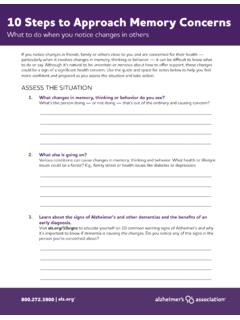
10 Steps to Approach Memory Concerns
alz.orgparticularly when it involves changes in memory, thinking or behavior — it can be difficult to know what to do or say. Although it’s natural to be uncertain or nervous about how to offer support, these changes could be a sign of a significant health concern. Use the guide and space for notes below to help you feel

C S Chapter 7- Memory System Design DA 2/e
classes.engineering.wustl.edu•Chip organization •Timing •Commercial RAM products" SDRAM and DDR RAM •ROM–Read only memory •Memory Boards •Arrays of chips give more addresses and/or wider words •2-D and 3-D chip arrays • Memory Modules •Large systems can benefit by partitioning memory for •separate access by system components •fast access to multiple ...
Schema Theory and College English Reading Teaching
files.eric.ed.govdiscoursed, and textual organization that guide expectations in our attempts to understand a meaningful piece of language” (Carrell, 1983). It is the knowledge of different text genres and their respective structural organization, ... knowledge models are stored in one's memory. And by the application of the stored knowledge structures, one
9 Types of Mnemonics for Better Memory - UCF
sarconline.sdes.ucf.eduJul 09, 2017 · Note Organization Mnemonics The way textbook and lecture notes are organized can inhibit learning and recall or promote it. In the sense that the organization of notes can promote recall, it is a memory device. Three examples of organizing note formats that promote recall are as follows: a. Notecards i.
WALC 10 Memory - Therapists for Armenia
therapistsforarmenia.orgMemory has been written to add some structure to that challenge and to reduce possible factors which may interfere with your client’s attempts to reestablish her skills. There are two main factors underlying all the exercises in WALC 10. 1. To initially make all of the processes involved with memory highly intentional.
Memory Impairment Screen (MIS) - Alzheimer's Association
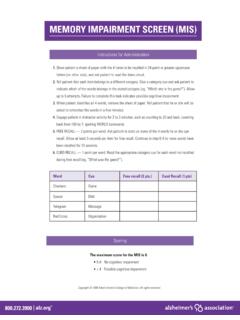
www.alz.orgMEMORY IMPAIRMENT SCREEN (MIS) Instructions for Administration Word Cue Free recall (2 pts.) Cued Recall (1 pts) Checkers Game Saucer Dish Telegram Message Red Cross Organization Scoring The maximum score for the MIS is 8. • 5-8 No cognitive impairment • ≤ 4 Possible cognitive impairment
Cisco UCS C220/C240/B200 M5 Memory Guide Spec Sheet
www.cisco.comMemory is organized with six memory channels per CPU, with up to two memory devices per channel, as shown in Figure 1. Figure 1 C220, C240, B200 M5 Memory Organization CPU 2 24 DIMMS 6 memory channels per CPU, up to 2 DIMMs per channel A1 A2 B1 B2 E1 E2 Chan B Chan C Chan D Chan A Chan E Chan F Chan H Chan J Chan L Chan M F1 F2 CPU 1 Slot 1 ...