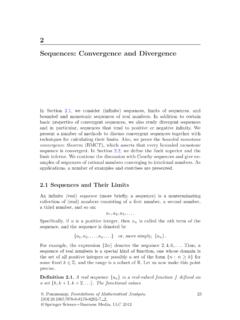
2 Sequences: Convergence and Divergence
Sep 23, 2016 · Sequences: Convergence and Divergence In Section 2.1, we consider (infinite) sequences, limits of sequences, and bounded and monotonic sequences of real numbers. In addition to certain basic properties of convergent sequences, we also study divergent sequences and in particular, sequences that tend to positive or negative infinity. We
Download 2 Sequences: Convergence and Divergence

Information
Domain:
Source:
Link to this page:
Documents from same domain

Lecture notes Math 4377/6308 { Advanced Linear …
www.math.uh.eduLecture notes Math 4377/6308 { Advanced Linear Algebra I Vaughn Climenhaga October 7, 2013

Lecture notes Math 4377/6308 { Advanced Linear …
www.math.uh.eduLecture notes Math 4377/6308 { Advanced Linear Algebra I Vaughn Climenhaga December 3, 2013

Section 3.2 Solving Systems of Linear Equations Using Matrices
www.math.uh.eduSection 3.2 – Solving Systems of Linear Equations Using Matrices 1. Section 3.2 Solving Systems of Linear Equations Using Matrices . In Section 1.3 we solved 2X2 systems of linear equations using either the substitution or

Test 2 Review - UH
www.math.uh.eduJiwen He, University of Houston Math 1431 – Section 24076, Test 2 Review October 28, 2008 32 / 69 Section 4.7 Vertical Aymptotes: Rational Function The line x = 4 is a vertical asymptote for

1 Definition and Properties of the Exp Function - UH
www.math.uh.edu1 Definition and Properties of the Exp Function 1.1 Definition of the Exp Function Number e Definition 1. The number e is defined by ... ∀x > 0, E L = elnx = x. • ∀x > 0, y = lnx ⇔ ey = x. • graph(ex) is the reflection of graph(lnx) by line y = x. ... eudu = eu +C = eg(x) +C.

Jiwen He 1.1 Geometric Series and Variations
www.math.uh.eduVariations on the Geometric Series (II) Closed forms for many power series can be found by relating the series to the geometric series Examples 2.
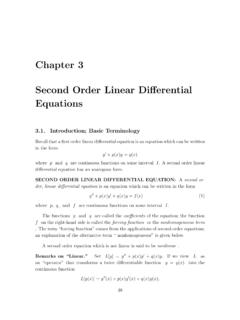
Chapter 3 Second Order Linear Differential Equations
www.math.uh.edusecond order linear differential equation: a second or- der, linear differential equation is an equation which can be written in the form y 00 + p ( x ) y 0 + q ( x ) y = f ( x ) (1)
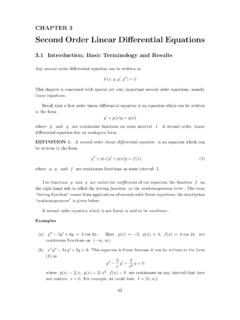
Second Order Linear Differential Equations - UH
www.math.uh.eduSecond Order Linear Differential Equations ... This chapter is concerned with special yet very important second order equations, namely linear equations. Recall that a first order linear differential equation is an equation which can be written in the form y0 + p(x)y= q(x)

Introduction to Real Analysis Fall 2014 Lecture Notes
www.math.uh.eduChapter 1 Metric Spaces These notes accompany the Fall 2011 Introduction to Real Analysis course 1.1 De nition and Examples De nition 1.1. Given a set X a metric on X is a function d: X X!R

Introduction to Real Analysis Spring 2014 Lecture Notes
www.math.uh.eduChapter 1 Sequences and Series of Functions In this chapter we introduce di erent notions of convergence for sequence and series of functions and then examine how integrals and derivatives be-
Related documents

Lecture 2 : Convergence of a Sequence, Monotone sequences
home.iitk.ac.inthe sequence (( 1)n) is a bounded sequence but it does not converge. One naturally asks the following question: Question : Boundedness + (??) )Convergence. We now nd a condition on a bounded sequence which ensures the convergence of the sequence. Monotone Sequences De nition : We say that a sequence (x n) is increasing if x n x
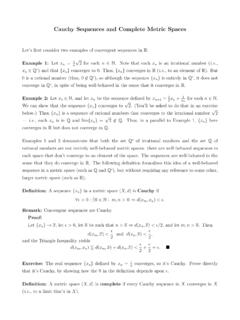
Cauchy Sequences and Complete Metric Spaces
www.u.arizona.eduknow that the sequences in question actually do converge. For that you might want to use the Monotone Convergence Theorem. Sequences de ned recursively, like the sequence in the above exercise, are important in economics. We’ll see sequences like this later in this course when we study xed point theorems and their
Lecture 2 : Convergence of a Sequence, Monotone sequences
home.iitk.ac.inthe sequence (( 1)n) is a bounded sequence but it does not converge. One naturally asks the following question: Question : Boundedness + (??) )Convergence. We now nd a condition on a bounded sequence which ensures the convergence of the sequence. Monotone Sequences De nition : We say that a sequence (x n) is increasing if x n x

Proof.
math.montana.edu2.1.2(k) The sequence a n = (1 if n is odd 1/n if n is even diverges. Proof. Assume not. Then the sequence converges to some limit A ∈ R. By definition of convergence (with = 1/4) ... We know that monotone bounded sequences converge, so there exists some limit A ∈ R. We can pass to the limit in the recursive equation to get
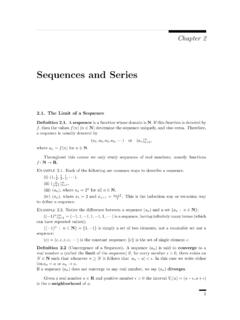
Sequences and Series
users.math.msu.edu2.3. The Monotone Convergence Theorem and a First Look at In nite Series 5 2.3. The Monotone Convergence Theorem and a First Look at In nite Series De nition 2.4. A sequence (a n) is called increasing if a n a n+1 for all n2N and decreasing if a n a n+1 for all n2N:A sequence is said to be monotone if it is either increasing or decreasing.
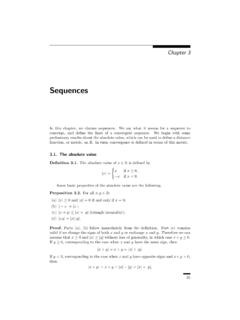
Sequences - math.ucdavis.edu
www.math.ucdavis.eduSequences In this chapter, we discuss sequences. We say what it means for a sequence to converge, and de ne the limit of a convergent sequence. We begin with some preliminary results about the absolute value, which can be used to de ne a distance function, or metric, on R. In turn, convergence is de ned in terms of this metric. 3.1. The ...

Series - math.ucdavis.edu
www.math.ucdavis.eduA condition for the convergence of series with positive terms follows immedi-ately from the condition for the convergence of monotone sequences. Proposition 4.6. A series P a nwith positive terms a n 0 converges if and only if its partial sums Xn k=1 a k M are bounded from above, otherwise it diverges to 1. Proof. The partial sums S n= P n k=1 a
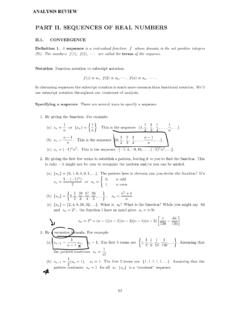
PART II. SEQUENCES OF REAL NUMBERS
www.math.uh.eduPART II. SEQUENCES OF REAL NUMBERS II.1. CONVERGENCE Definition 1. A sequence is a real-valued function f whose domain is the set positive integers (N).The numbers f(1),f(2), ··· are called the terms of the sequence. Notation Function notation vs subscript notation: f(1) ≡ s1,f(2) ≡ s2,···,f(n) ≡ sn, ···. In discussing sequences the subscript notationis much more common than ...
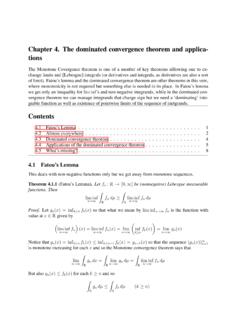
Chapter 4. The dominated convergence theorem and applica ...
www.maths.tcd.ieThis also shows that the Monotone Convergence Theorem is not true without ‘Monotone’. 4.2 Almost everywhere Definition 4.2.1. We say that a property about real numbers xholds almost everywhere (with respect to Lebesgue measure ) if the set of xwhere it fails to be true has measure 0. Proposition 4.2.2.