7. ANALYTICAL METHODS
7.2 ENVIRONMENTAL SAMPLES Water and waste water samples can be analyzed for ammonia by EPA Test Methods 1689 (EPA 2001a), 1690 (EPA 2001b), and 349.0 (EPA 1997).
Download 7. ANALYTICAL METHODS

Information
Domain:
Source:
Link to this page:
Documents from same domain
3. CHEMICAL AND PHYSICAL INFORMATION 3.1 …
www.atsdr.cdc.govFUEL OILS 105 3. CHEMICAL AND PHYSICAL INFORMATION 3.1 CHEMICAL IDENTITY Information regarding the chemical identity of fuel oils is located in Table 3-l.
Toxicological Profile for Styrene
www.atsdr.cdc.govTOXICOLOGICAL PROFILE FOR STYRENE. U.S. DEPARTMENT OF HEALTH AND HUMAN SERVICES Public Health Service Agency for Toxic Substances and Disease Registry
APPENDIX A. ATSDR MINIMAL RISK LEVELS AND …
www.atsdr.cdc.govTUNGSTEN A-1 APPENDIX A. ATSDR MINIMAL RISK LEVELS AND WORKSHEETS . The Comprehensive Environmental Response, …
Draft Toxicological Profile for Antimony and …
www.atsdr.cdc.govANTIMONY AND COMPOUNDS . 190 . 9. REFERENCES *Alvarez M, Malecot CO, Gannier F, et al. 2005. Antimony-induced cardiomyopathy …
5. PRODUCTION, IMPORT/EXPORT, USE, AND …
www.atsdr.cdc.govPERCHLORATES 155 5. PRODUCTION, IMPORT/EXPORT, USE, AND DISPOSAL EPA’s website, there were 63 Federal agency facilities and 168 non-Federal facilities in the United States
4. CHEMICAL, PHYSICAL, AND RADIOLOGICAL …
www.atsdr.cdc.govCHEMICAL, PHYSICAL, AND RADIOLOGICAL INFORMATION ... 4. CHEMICAL, PHYSICAL, AND RADIOLOGICAL INFORMATION . Table 4-1. Chemical Identity of Iodine and Iodine Compounds ... Property Iodine Hydrogen iodide Sodium iodide Potassium iodide . Molecular weight, g/mole Color Physical state . Melting point …
5. POTENTIAL FOR HUMAN EXPOSURE 5.1 …
www.atsdr.cdc.gov65 5. POTENTIAL FOR HUMAN EXPOSURE 5.1 OVERVIEW 2-Butanone may be released to the atmosphere in fugitive emissions during its production, transport, and use.
8. REGULATIONS, ADVISORIES, AND GUIDELINES
www.atsdr.cdc.govCHLORINE 185 8. REGULATIONS, ADVISORIES, AND GUIDELINES. MRLs are substance specific estimates, which are intended to serve as screening levels, are used by
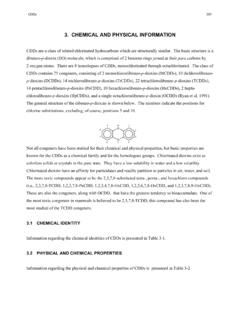
3. CHEMICAL AND PHYSICAL INFORMATION
www.atsdr.cdc.gov3. CHEMICAL AND PHYSICAL INFORMATION. CDDs are a class of related chlorinated hydrocarbons which are structurally similar. The basic structure is a ... Not all congeners have been studied for their chemical and physical properties, but basic properties are known for the CDDs as a chemical family and for the homologous groups. Chlorinated ...
4. CHEMICAL AND PHYSICAL INFORMATION
www.atsdr.cdc.gov4. CHEMICAL AND PHYSICAL INFORMATION . 4.1 . CHEMICAL IDENTITY . Boron appears in Group 13 (IIIA) of the periodic table and is the only nonmetal of this group (Jansen ... Table 4-2 lists important physical and chemical properties of boron and selected compounds. BORON 120 4. CHEMICAL AND PHYSICAL INFORMATION .
Related documents
HYDROCARBONS, BP 36°-216 °C 1500
www.cdc.govSorbent tubes were spiked at appr oximatel y 100 µg and store d in a drawer f or 7 day s, then transferr ed to a refrigerator at 5° C. Samples were anal yzed after 7, 14, and 30 days. All analytes had acceptable recoveries (>90%), except cyclohexene, which had a 30 day ...

KETONES I 1300
www.cdc.govfront sorbent section with a microliter syringe. c. Cap the tube. Allow to stand overnight. d. Desorb (steps 5 through 7) and analyze together with working standards (steps 11 and 12). e. Prepare a graph of DE vs. mg analyte recovered. 10. Analyze three quality control blind spikes and three analyst spikes to insure that the calibration
Why and when to replace your 3M Filters!
multimedia.3m.comThese filters rely on sorbent material to “soak up” the gas and vapour molecules. Typically the sorbent is carbon grain, which has been specifically treated. Depending on the chemical treatment of the carbon surface, this material will absorb different types of gases or vapours. AS/NZS1716 uses a classification system to identify the

Capturing Carbon Dioxide From Air - Basic Knowledge 101
basicknowledge101.comsorbent recovery and not in the capture process. Air extraction is an appealing concept, because it separates the source from disposal. One could collect CO2 after the fact and from any source. Air extraction could reduce atmospheric CO2 levels without making the existing energy or transportation infrastructure obsolete. There

Health and Safety Executive Volatile organic compounds in air
www.hse.gov.uksorbent tube containing appropriate sorbent, specifically selected for the compound or mixture to be sampled. The collected vapour is then thermally desorbed in an inert carrier gas into a gas chromatograph fitted with a suitable capillary column and detector. 6 Method 2 (diffusive sampling; thermal desorption) is suitable for samples of