7. ANALYTICAL METHODS
distillation, aeration, ion-exchange chromatography, microdiffusion, or deproteinization (Huizenga et al. 1994). Deproteinization methods involve treatment of blood or plasma fluids with trichloroacetic acid (or perchloric acid or tungstate-sulfuric acid), followed by centrifugation. The protein-free supernatant can
Download 7. ANALYTICAL METHODS

Information
Domain:
Source:
Link to this page:
Documents from same domain
3. CHEMICAL AND PHYSICAL INFORMATION 3.1 …
www.atsdr.cdc.govFUEL OILS 105 3. CHEMICAL AND PHYSICAL INFORMATION 3.1 CHEMICAL IDENTITY Information regarding the chemical identity of fuel oils is located in Table 3-l.
Toxicological Profile for Styrene
www.atsdr.cdc.govTOXICOLOGICAL PROFILE FOR STYRENE. U.S. DEPARTMENT OF HEALTH AND HUMAN SERVICES Public Health Service Agency for Toxic Substances and Disease Registry
APPENDIX A. ATSDR MINIMAL RISK LEVELS AND …
www.atsdr.cdc.govTUNGSTEN A-1 APPENDIX A. ATSDR MINIMAL RISK LEVELS AND WORKSHEETS . The Comprehensive Environmental Response, …
Draft Toxicological Profile for Antimony and …
www.atsdr.cdc.govANTIMONY AND COMPOUNDS . 190 . 9. REFERENCES *Alvarez M, Malecot CO, Gannier F, et al. 2005. Antimony-induced cardiomyopathy …
5. PRODUCTION, IMPORT/EXPORT, USE, AND …
www.atsdr.cdc.govPERCHLORATES 155 5. PRODUCTION, IMPORT/EXPORT, USE, AND DISPOSAL EPA’s website, there were 63 Federal agency facilities and 168 non-Federal facilities in the United States
4. CHEMICAL, PHYSICAL, AND RADIOLOGICAL …
www.atsdr.cdc.govCHEMICAL, PHYSICAL, AND RADIOLOGICAL INFORMATION ... 4. CHEMICAL, PHYSICAL, AND RADIOLOGICAL INFORMATION . Table 4-1. Chemical Identity of Iodine and Iodine Compounds ... Property Iodine Hydrogen iodide Sodium iodide Potassium iodide . Molecular weight, g/mole Color Physical state . Melting point …
5. POTENTIAL FOR HUMAN EXPOSURE 5.1 …
www.atsdr.cdc.gov65 5. POTENTIAL FOR HUMAN EXPOSURE 5.1 OVERVIEW 2-Butanone may be released to the atmosphere in fugitive emissions during its production, transport, and use.
8. REGULATIONS, ADVISORIES, AND GUIDELINES
www.atsdr.cdc.govCHLORINE 185 8. REGULATIONS, ADVISORIES, AND GUIDELINES. MRLs are substance specific estimates, which are intended to serve as screening levels, are used by
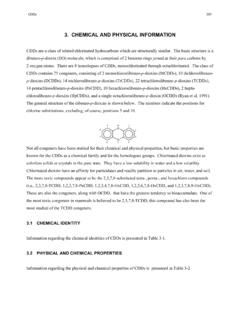
3. CHEMICAL AND PHYSICAL INFORMATION
www.atsdr.cdc.gov3. CHEMICAL AND PHYSICAL INFORMATION. CDDs are a class of related chlorinated hydrocarbons which are structurally similar. The basic structure is a ... Not all congeners have been studied for their chemical and physical properties, but basic properties are known for the CDDs as a chemical family and for the homologous groups. Chlorinated ...
4. CHEMICAL AND PHYSICAL INFORMATION
www.atsdr.cdc.gov4. CHEMICAL AND PHYSICAL INFORMATION . 4.1 . CHEMICAL IDENTITY . Boron appears in Group 13 (IIIA) of the periodic table and is the only nonmetal of this group (Jansen ... Table 4-2 lists important physical and chemical properties of boron and selected compounds. BORON 120 4. CHEMICAL AND PHYSICAL INFORMATION .
Related documents
The Easy Guide to: Inductively Coupled Plasma- Mass ...
www.ecs.umass.eduliquid chromatography. Because gas and supercritical fluid chromatography separates samples in the gas phase, the eluents produced after column separation can be directly swept into the ICP-MS torch. However, liquid chromatography elutes, being in a liquid phase, require nebulization similar to that of standard liquid sample introduction. Torch

Gas Chromatography-Mass Spectroscopy
cires1.colorado.eduGas Chromatography In general, chromatography is used to separate mixtures of chemicals into individual components. Once isolated, the components can be evaluated individually. In all chromatography, separation occurs when the sample mixture is introduced (injected) into a mobile phase. In liquid chromatography (LC), the mobile phase is a solvent.
ICH HARMONISED GUIDELINE
database.ich.org116 (LBAs) and chromatographic methods such as liquid chromatography (LC) or gas 117 chromatography (GC), which are typically used in combination with mass spectrometry (MS) 118 . detection and occasionally with other detectors. 119 For studies that are subject to Good Laboratory Practice (GLP) or Good Clinical Practice (GCP) 120

METHOD 5021A VOLATILE ORGANIC COMPOUNDS IN …
www.epa.govmatrix modifier (Sec. 7.7) is generally recommended to be used with this method. The matrix modifier is a water soluble salt solution that is added to each sample and standard vial prior to analysis. The matrix modifier solution acts to increase the VOCs mass transfer into the headspace of the vial.
ACQUITY UPLC H-Class System Guide - Waters Corporation
www.waters.comWhen calibrating mass spectrometers, consult the calibration section of the ... To minimize these matrix effects, Waters recommends you adopt the following measures: ... UltraPerformance liquid chromatography uses columns packed with 1.7 μm-diameter, round particles and operating pressures up to 15,000 psi.

Guide to achieving reliable quantitative LC-MS measurements
www.rsc.orgLiquid chromatography-mass spectrometry (LC-MS) is the combination of two selective techniques that allows the analyte(s) of interest in highly complex mixtures to be isolated and measured. LC differentiates compounds by their physico-chemical properties and MS differentiates compounds by mass (specifically their mass-to-charge ratio).
Affinity Chromatography: Principles and Applications
cdn.intechopen.comreversed phase affinity chromatography with mass spectrometry has ultimately aided in discovery of protein biomarkers. 3. Fundamental principles of affinity chromatography Separation of a desired protein using affinity chromatography relies on the reversible interactions between the protein to be purified and the affinity ligand coupled to
A. Food Laws and Standards of India and International Food ...
www.developindiagroup.co.indimensional) Partition, Thin layer chromatography, HPTLC, size exclusion and ion exchange chromatography. Applications in food analysis. VIII. High Performance Liquid Chromatography (HPLC): Basics of liquid chromatography, HPLC columns and Stationary phases (solid, liquid) – Bonded phase supports, mobile
MOSH/MOAH – QUESTIONS AND ANSWERS
www.sgsgroup.dematrix, this can be followed by a purification process (e.g. with activated aluminium oxide, epoxidation). The MOSH and MOAH fractions are separa-ted by means of chromatographic solid phase extraction. The quantitative analysis method used is GC-FID (gas chromatography-flame ionisation detection) with large volume on-column injection.