A Guide for Practicing Engineers - NEHRP
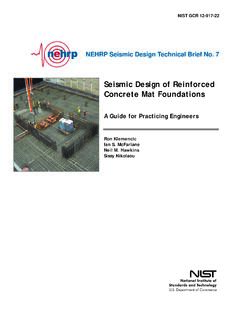
Seismic Design of Reinforced Concrete Mat Foundations: A Guide for Practicing Engineers Seismic design of reinforced concrete mat foundations has advanced significantly in the last twenty years. As analytical capabilities have improved, primarily in the form of finite element analysis, the mathematical modeling of
Download A Guide for Practicing Engineers - NEHRP

Information
Domain:
Source:
Link to this page:
Documents from same domain
Nonlinear Structural Analysis For Seismic Design
www.nehrp.govmind. Typical instances where nonlinear analysis is applied in structural earthquake engineering practice are to: (1) assess and design seismic …

Archived NIST Technical Series Publication
www.nehrp.govArchived NIST Technical Series Publication The attached publication has been archived (withdrawn), and is provided solely for historical purposes.
NEHRP Workshop on Meeting the Challenges of Existing …
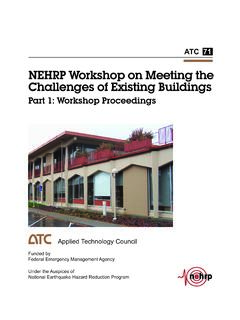
www.nehrp.govATC-73 Report, NEHRP Workshop on Meeting the Challenges of Existing Buildings, Prioritized Research for Reducing the Seismic Hazards of Existing Buildings (ATC, 2007). Guidance for FEMA’s future activities related to the creation, update, and maintenance of seismic evaluation and rehabilitation

June 2012 SeismicWaves - NEHRP - National Earthquake ...
www.nehrp.gov4 SeismicWaves June 2012 Page 2 Based on Conceptual Advances The MCER ground motion maps are used by structural designers in the same manner as the maximum consid-ered earthquake (MCE) maps included in previous edi-
Evaluation of the FEMA P-695 Methodology for ...
www.nehrp.govNIST GCR 10-917-8 Evaluation of the FEMA P-695 Methodology for Quantification of Building Seismic Performance Factors Prepared for U.S. Department of Commerce
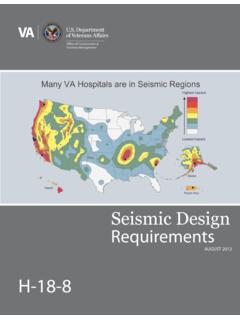
Seismic Design Requirements, H-18-8 - NEHRP
www.nehrp.gov4 1.0 DEFINITIONS 1.1 ASCE/SEI 41–06: Seismic Rehabilitation of Existing Buildings, American Society of Civil Engineers. 1.2 AISC 341: Seismic Provisions for Structural Steel Buildings, including Supplement No. 1 dated 2006, American Institute of Steel Construction. 1.3 ASCE 7: Minimum Design Loads for Buildings and Other Structures, American
Seismic Design of Steel Special Concentrically ... - NEHRP
www.nehrp.govSEAOC Structural/Seismic Design Manual (SEAOC 2013). This Guide is intended to aid the reader in identifying significant aspects of seismic design and behavior and to identify resources that are useful for design and for understanding braced frame behavior and performance. It is not intended to repeat detailed design guidance found elsewhere. It
EVOLUTION OF CODES IN THE USA - NEHRP
www.nehrp.govbuilding code groups and government agencies to develop uniformity among the codes in their technical provisions, format and use of standards. All government jurisdictions and agencies, federal, state and local are encouraged to adopt codes promulgated by one of the three model code groups -BOCA, ICBO and SBCCI- without technical modification.

Indian Ocean Earthquake/Tsunami of December 26, 2004 - …
www.nehrp.govDec 26, 2004 · engineering, social and behavioral data, including the use of remote sensing technologies to quantify damage to large geographic areas and provide reconnaissance information where access to affected areas is difficult. ... international partnerships and cooperation. • Enhancing regional cooperation and multi-lateral information sharing ...
Related documents
An Introduction to the Boundary Element Method (BEM)
yijunliu.comThe Boundary Element Method (BEM) n. n. n • Boundary element method applies surface elements on the boundary of a 3-D domain and line elements on the boundary of a 2- D domain. The number of elements is O(n2) as compared to O(n3) in other domain based methods (n = number of elements needed per dimension ).

THE STRUT-AND-TIE MODEL - WPMU DEV
cpb-us-e1.wpmucdn.comElastic Analysis Approach Procedures 1. Isolate D-regions 2. Complete the internal stresses on the boundaries of the element 3. Subdivide the boundary and compute the force resultants on each sub -length 4. Draw a truss to transmit the forces from boundary to boundary of the D-region 5. Check the stresses in the individual members in the truss

CHAPTER 6 UNRESTRAINED SHORING SYSTEMS
dot.ca.govA soldier pile could also be a cast in place reinforced concrete pile. Lagging is placed between soldier pile vertical elements and could be treated timber, reinforced shotcrete, reinforced . 6-1 . ... (SSI) analysis using a p-y approach or a finite element method shall be performed. The SSI method of analysis is beyond the scope of this Manual and

Design and Analysis of Slabs - colincaprani.com
www.colincaprani.comYield line analysis is an analysis approach for determining the ultimate load capacity of reinforced concrete slabs and was pioneered by K.W. Johansen in the 1940s. It is closely related to the plastic collapse or limit analysis of steel frames, and is …

Technical Manual 1 Design of Monopole Bases
www.towernx.comStiff Plate Approach Thicker, stiffer, base plates are capable of approaching a linear strain distribution and the base plate is assumed to behave in a manner similar to reinforced concrete columns(8). N A N' D P M T fc f Fig 1- 9 Stiff base plate force distribution The following basic equations define the static forces as shown in Fig 1-9. c ...