
A TUTORIAL INTRODUCTION TO STOCHASTIC ANALYSIS …
A TUTORIAL INTRODUCTION TO STOCHASTIC ANALYSIS AND ITS APPLICATIONS by IOANNIS KARATZAS Department of Statistics Columbia University New York, N.Y. 10027 September 1988 Synopsis We present in these lectures, in an informal manner, the very basic ideas and results of stochastic calculus, including its chain rule, the fundamental theorems on …
Download A TUTORIAL INTRODUCTION TO STOCHASTIC ANALYSIS …

Information
Domain:
Source:
Link to this page:
Documents from same domain

Quantum Theory, Groups and Representations: An ...
www.math.columbia.eduQuantum Theory, Groups and Representations: An Introduction (Final draft version) Peter Woit Department of Mathematics, Columbia University woit@math.columbia.edu

2 Complex Functions and the Cauchy-Riemann …
www.math.columbia.edu2 Complex Functions and the Cauchy-Riemann Equations 2.1 Complex functions In one-variable calculus, we study functions f(x) of a real variable x.

Strategy for Testing Series: Solutions - Columbia University
www.math.columbia.eduSolutions: page 5 of 7 MAT V1102 – 004 for n ≥ 3. Since P √1 2n2 converges (it’s a p-series with p = 2 > 1), the comparison test implies that

An introduction to the topology of the moduli space of ...
www.math.columbia.eduthe moduli space in the special case of rank 2 and degree 1. In fact, two moduli spaces become involved: the original moduli space Mg, and the subspace Ng consisting of bundles ... Grothendieck [25], there exists a projective variety, the so-called Quot scheme, parametrizing
Quantum Theory, Groups and Representations: An ...
www.math.columbia.eduQuantum Theory, Groups and Representations: An Introduction (Final draft version) Peter Woit Department of Mathematics, Columbia University woit@math.columbia.edu

Unifying Foundations for Physics and Mathematics
www.math.columbia.eduCartan (1913), Weyl (1929): spinor geometry Actually want quantization of the above. Peter Woit (Columbia University Mathematics Department)Unifying Foundations for Physics and Mathematics October 20214/13. Uni cation in Physics The problem with the uni ed theory
2 Complex Functions and the Cauchy-Riemann Equations
www.math.columbia.eduask that the usual di erence quotient exists. De nition A function f(z) is complex di erentiable at cif lim z!c f(z) f(c) z c exists. In this case, the limit is denoted by f0(c). Making the change of variable z= c+h, f(z) is complex di erentiable at cif and only if the limit lim h!0 h = = 1:

Euler’s Formula and Trigonometry - Columbia University
www.math.columbia.edumulas. One can do this by showing that multiplication of a point z= x+ iy in the complex plane by ei rotates the point about the origin by a counter-clockwise angle . It then follows that multiplication by the product of ei 1 and ei 2 will be counterclockwise rotation by an angle 1 + 2, implying the correct exponential property ei 1ei 2 = ei( 1+ 2)

Calculus III: Practice Final - Columbia University
www.math.columbia.eduCalculus III: Practice Final Name: Circle one: Section 6 Section 7 . Read the problems carefully. Show your work unless asked otherwise. Partial credit will be given for incomplete work. ... tan x = sec 2 x (5) d dx cot x = csc 2 x (6) d dx sec x = sec x tan x (7) d dx csc x = csc x cot x (8) d dx ex = ex (9) d dx ln jx j = 1 x (10) d dx arcsin ...
3 Contour integrals and Cauchy’s Theorem
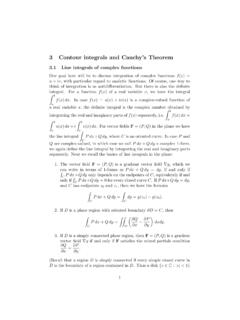
www.math.columbia.edu3 Contour integrals and Cauchy’s Theorem 3.1 Line integrals of complex functions Our goal here will be to discuss integration of complex functions f(z) = u+ iv, with particular regard to analytic functions. Of course, one way to think of integration is as antidi erentiation. But there is also the de nite integral.
Related documents
Probability, Statistics, and Stochastic Processes
ramanujan.math.trinity.edu4.1 Introduction 271 4.2 The Law of Large Numbers 272 4.3 The Central Limit Theorem 276 4.3.1 The Delta Method 281 4.4 Convergence in Distribution 283 4.4.1 Discrete Limits 283 4.4.2 Continuous Limits 285 5 Simulation 289 5.1 Introduction 289 5.2 Random-Number Generation 290 5.3 Simulation of Discrete Distributions 291

Stochastic Processes - Stanford University
statweb.stanford.edustochastic processes. Chapter 4 deals with filtrations, the mathematical notion of information pro-gression in time, and with the associated collection of stochastic processes called martingales. We treat both discrete and continuous time settings, emphasizing the importance of right-continuity of the sample path and filtration in the latter ...

An Introduction to Stochastic Processes in Continuous Time
www.math.leidenuniv.nlStochastic Processes 1.1 Introduction Loosely speaking, a stochastic process is a phenomenon that can be thought of as evolving in time in a random manner. Common examples are the location of a particle in a physical system, the price of stock in a nancial market, interest rates, mobile phone networks, internet tra c, etcetc.

An introduction to Markov chains
web.math.ku.dkIntroduction Motivation and some examples of Markov chains When my first child started in daycare, I started to register the out-come of a stochastic variable with two possible outcomes ill: meaning that the child is not ready for daycare ok: meaning that the child is ready for daycare Consecutive recordings of the health state of a child made ...