
Academic Resource Center
Crystal structure: the manner in which atoms, ions, or molecules are spatially arranged. Unit cell: small repeating entity of the atomic structure. The basic building block of the crystal structure. It defines the entire crystal structure with the atom positions within. Lattice: 3D array of points coinciding with atom positions (center of spheres)
Download Academic Resource Center

Information
Domain:
Source:
Link to this page:
Documents from same domain

ILLINOIS INSTITUTE OF TECHNOLOGY GRADUATE …
web.iit.eduStyle Manual for Guidance in the Preparation of ... IEEE Editorial Style Manual http://www.ieee.org/conferences_events /conferences/publishing/style_references

AMPERE’S LAW - Illinois Institute of Technology
web.iit.eduAMPERE’S LAW. Introduction •A useful law that relates the net magnetic field along a closed loop to the electric current passing through the loop. •First discovered by André-Marie Ampère in 1826 . Definition •The integral around a closed path of the component of the magnetic field tangent to the ...

Mechanical Properties of Biomaterials
web.iit.eduMechanical Properties •Tensile and Shear properties •Bending properties •Time dependent properties . Tensile and Shear properties •Types of forces that can be applied to material: a) Tensile b) Compressive c) Shear d) Torsion . Tensile Testing •Force applied as tensile, compressive, or shear.
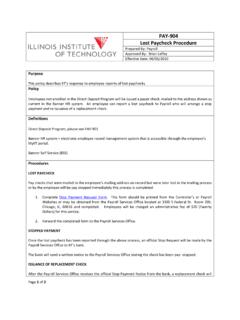
PAY-904 Lost Paycheck Procedure - web.iit.edu
web.iit.edulost paycheck Pay checks that were mailed to the employee’s mailing address on record but were later lost in the mailing process or by the employee will be pay stopped immediately this process is …
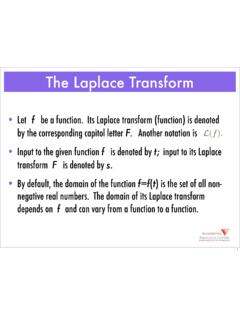
The Laplace Transform - Illinois Institute of Technology
web.iit.edu• Let f be a function.Its Laplace transform (function) is denoted by the corresponding capitol letter F.Another notation is • Input to the given function f is denoted by t; input to its Laplace transform F is denoted by s. • By default, the domain of the function f=f(t) is the set of all non- negative real numbers.
MLA and APA Citation Formats in LATEX
web.iit.edu5. For more information, refer to the biblatex-mla documentation available with the package. Note that sample .tex flles are also available. 2.2 Usage In order to use this citation style, place the following code in the preamble: nusepackage[american]fbabelg nusepackagefcsquotesg nusepackage[style=mla]fbiblatexg nbibliographyf<bibfile>g

Cross Product - Illinois Institute of Technology
web.iit.eduCross Product Definition: If a = <a 1, a 2, a 3 > and b = <b 1, b 2, b 3 >, then the cross product of a and b is the vector, a x b = <a 2 b 3 – a 3 b 2,a 3 b 1 ...

Lagrange Multipliers - Illinois Institute of Technology
web.iit.eduAcademic Resource Center . In This Presentation.. •We will give a definition •Discuss some of the lagrange multipliers •Learn how to use it •Do example problems . ... •Calculus – Stewart 6th Edition •Section 15.8 “Lagrange Multipliers” Thank you! Enjoy those lagrange multipliers…! Title: Lagrange Multipliers

An Overview of Magnetic Resonance Imaging (MRI)
web.iit.edu•A medical imaging technique that records changing magnetic fields •Also called Nuclear Magnetic Resonance (NMR) •Can give different kinds of images based on the pulse sequence (will talk about later) •Capable of complete body scans, but commonly used for brain

Inverse Trigonometric Functions
web.iit.eduInverse Trigonometric Functions: •The domains of the trigonometric functions are restricted so that they become one-to-one and their inverse can be determined. •Since the definition of an inverse function says that -f 1(x)=y => f(y)=x We have the inverse sine function, -sin 1x=y - π=> sin y=x and π/ 2 <=y<= / 2
Related documents
Basic Electronics - New York University
engineering.nyu.edu• In the crystalline lattice structure of Si, the valence electrons of every Si atom are locked up in covalent bonds with the valence electrons of four neighboring Si atoms. – In pure form, Si wafer does not contain any free charge carriers. – An applied voltage across pure …

Atomic Structure and Electron Configurations Multiple ...
content.njctl.orgAtomic Structure and Electron Configurations Multiple Choice PSI Chemistry Name:_____ 1. Rutherford’s Nuclear Model of the atom A. is the currently accepted atomic model. B. explains the unique emission spectra of different elements. C. does not account for the stability of most atoms since accelerating electrons

VIRUSES - Introduction, structure and classification
www.virologyresearch.unsw.edu.auHelical viral structure IIHelical viral structure II • Plant virus with this structure are rod shaped and non-enveloped, while animal viruses tend to be long and flexible • TMV, 2130 capsomers assemble into a helx, 6kb of RNA genome fits into a groove formed on assembly. Examples Ebola Lassa Mumps/Measles Rabies SARS
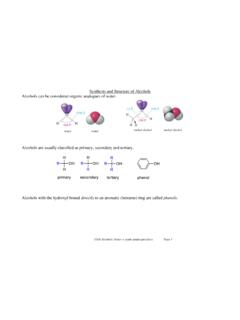
Synthesis and Structure of Alcohols
crab.rutgers.eduCyclohexanol and phenol are similar in structure, yet their acidities are very different. Phenol is 108 more acidic. K The phenoxide ion has resonance stabilization since the negative charge can be delocalised over 4 atoms (3 carbons and 1 oxygen), making it more stable. Phenols are more acidic than related alcohols. O -H + H 2 O O-+ H 3 O + a ...

Protein Structure
dasher.wustl.edu• The structure, function and general properties of a protein are all determined by the sequence of amino acids that make up its primary sequence. Primary Structure ... ATOM 13 CA PRO 2 34.976 13.367 -9.840 1.00 14.99... atom no. atom type residue name residue no. x y …
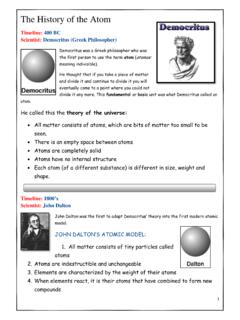
The History of the Atom - Socorro Independent School ...
www.sisd.netatom. He called this the theory of the universe: All matter consists of atoms, which are bits of matter too small to be seen. There is an empty space between atoms Atoms are completely solid Atoms have no internal structure Each atom (of a different substance) is different in size, weight and shape. Timeline: 1800’s Scientist: John Dalton