Activated Sludge Microbiology Problems and Their Control
real "heart" of the activated sludge system is the development and maintenance of a mixed microbial culture (activated sludge) that treats wastewater and which can be managed. One definition of a wastewater treatment plant operator is a "bug farmer", one who controls the aeration basin environment to favor good microbiology.
Download Activated Sludge Microbiology Problems and Their Control

Information
Domain:
Source:
Link to this page:
Documents from same domain
NEW YORK Freshwater FISHING
www.dec.ny.govMessage from the Commissioner This year’s fishing guide from the New York State Department of Environmental Conser-vation (DEC) highlights the outstanding fish-
THE SEQR HANDBOOK - New York State …
www.dec.ny.govThe SEQR Handbook - What is it? The SEQR Handbook provides agencies, project sponsors, and the public with a practical reference guide to the procedures prescribed by the State Environmental Quality Review Act
1. PERMIT APPLICANT INFORMATION
www.dec.ny.govnew york state department of environmental conservation (dec) division of materials management - bureau of pest management application for a permit to use a pesticide
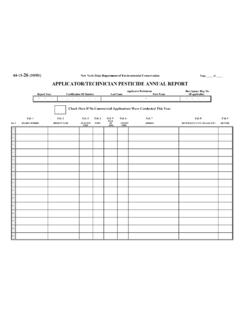
APPLICATOR/TECHNICIAN PESTICIDE ANNUAL …
www.dec.ny.govNew York State Department of Environmental Conservation INSTRUCTIONS FOR APPLICATOR/TECHNICIAN PESTICIDE ANNUAL REPORT Please …
Everything You Have Always Wanted to Know About …
www.dec.ny.govNew York State Department of Environmental Conservation EVERYTHING YOU HAVE ALWAYS WANTED TO KNOW ABOUT HOME COMPOSTING... But Were Afraid to …
STANDARD AND SPECIFICATIONS FOR RIPRAP …
www.dec.ny.govAugust 2005 Page 5B.57 New York Standards and Specifications For Erosion and Sediment Control STANDARD AND SPECIFICATIONS
Stormwater Guidance Manual for Local Officials
www.dec.ny.govStormwater Management Guidance Manual for Local Officials Construction and Post-Construction Stormwater Runoff Management September 2004 The Stormwater Guidance Manual for Local Officialswas prepared by the New York State Department of Environmental Conservation and New York State
DEC Program Policy
www.dec.ny.govConsistent with existing laws, including Environmental Conservation Law (ECL) Articles 1 and 3, regulations, DEC policy and with the growing national trend, this policy establishes an expectation (Section
New York State Municipalities with a Population of …
www.dec.ny.govElectronic Equipment Recycling and Reuse Act New York State Municipalities with a Population of 10,000+ Municipality 2013 Population Estimate Cortland city 19,059
Pesticide Business Registration Application
www.dec.ny.govNew York State Pesticide Business Registration Application Page 2 of 3 6. Pesticide, Equipment, and Records Storage. Does your business store pesticides, application equipment, or records at a location different than box 4?
Related documents

CHAPTER 6: DESIGN AND CONSTRUCTION OF SLUDGE …
www.cpheeo.gov.insludge moisture content, retention time, etc., and is based on the solids balance of the entire sludge treatment facility. The solids balance considers the reduction due to gasification, return load from each facility and the increase due to addition of …

Sludge Volume - Weight Relationships - University of Guelph
www.soe.uoguelph.casludge _volume. wpd Page 1 of 2 Sludge Volume - Weight Relationships The volume of sludge depends on two items: # water content # solids content Furthermore, the solid content is a function of fixed and volatile soils. Therefore, the specific gravity of all the solid matter is described by: where M s = mass of solids, kg S s = overall specific ...
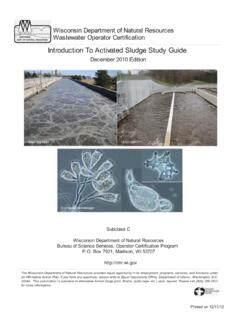
Introduction To Activated Sludge Study Guide
dnr.wi.govSludge age is the theoretical length of time a particle of activated sludge stays in the treatment plant, measured in days. In an activated sludge plant, sludge age is the amount (lbs) of mixed liquor suspended solids divided by the suspended solids, or excess cell mass, withdrawn from the system per day (lbs per day of waste activated sludge).
SLUDGE DEWATERING - SNF Holding Company
us.snf.comThe sludge resulting from this process represents the next challenge for the water treatment industry, in particular the minimizing of its volume. This Sludge Dewatering handbook will present the key parameters to take into account in order to optimi-ze sludge treatment with SNF Floerger’s organic polymers.

Activated Sludge Treatment Process Concept and System …
www.ijedr.orgActivated sludge is a sludge particles reduced in wastewater by the growth of organisms in aeration tanks. The term ‘activated’ comes from the fact that the particles teem with bacteria, fungi, and protozoa and is different from primary sludge in the sense that
Troubleshooting Activated Sludge Processes Introduction
www.maine.govOld sludge conditions usually cause a dark brown, thick, scummy foam. It is usually caused by the growth of Nocardia or Microthrix parvicella, both of which grow at the high MCRT/low F/M condition associated with old sludge. A treatment pressure is required to decrease the total sludge units in the system.