
Active Thermal Control System (ATCS) Overview
excess heat from the Electrical Power System (EPS) components in the Integrated Equipment Assembly (IEA) on P4 and eventually S4 and transport this heat to the PV radiators (located on P4, P6, S4 and S6) where it is rejected to space. The PVTCS consist of ammonia coolant, eleven
Download Active Thermal Control System (ATCS) Overview

Information
Domain:
Source:
Link to this page:
Documents from same domain

Q: What do you do on the International Space …
www.nasa.govQ: What do you do on the International Space Station (ISS)? A: Astronauts and cosmonauts on the space station stay busy.There’s lots of work to operate the many science experiments on board.
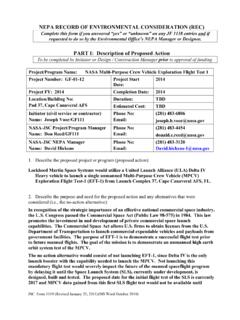
NEPA RECORD OF ENVIRONMENTAL …
www.nasa.govDec 13, 2012 · JSC Form 1119 (Revised January 25, 2011)(MS Word October 2010) NEPA RECORD OF ENVIRONMENTAL CONSIDERATION (REC) Complete this form if you answered “yes” or “unknown” on any JF 1138 entries and if
Use of XSLT to transform the output of multiple …
www.nasa.govNASA IV&V International Workshop 2014 1 Use of XSLT to transform the output of multiple Static Code Analysis tools into a consistent analysis spreadsheet format
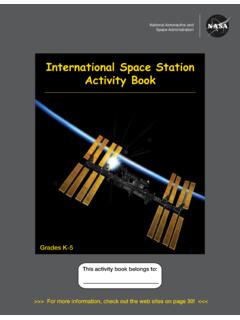
International Space Station Activity Book
www.nasa.govNational Aeronautics and Space Administration . Grades K-5 . This activity book belongs to: International Space Station Activity Book >>> For more information, check out the web sites on page 30!
Gravity, Who Needs It
www.nasa.govGravity, Who Needs It? ... six months on the space station versus three years on a Mars mission? No. ... human, being more isolated ...
Glide Slope Ratio
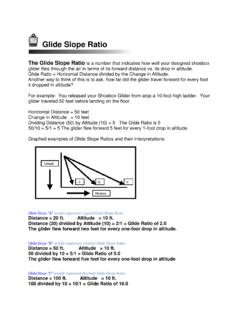
www.nasa.govGlide Slope Ratio The Glide Slope Ratio is a number that indicates how well your designed shoebox glider flies through the air in terms of its forward distance vs. its drop in altitude. Glide Ratio = Horizontal Distance divided by the Change in Altitude.
Modeling, SiMulation, inforMation technology & …
www.nasa.govTA11-1 exeCuTive Summary Figure 1 is an initial draft strategic roadmap for the Modeling, Simulation, Information Technol-ogy and Processing Technology Area.
NASA Technology Roadmaps
www.nasa.gov2015 NASA Technology Roadmaps TA 11: Modeling, Simulation, Information Technology, and Processing TA 11- 2 July 2015 Foreword NASA is leading the way with a balanced program of space exploration, aeronautics, and science research.

A Journey to Inspire, Innovate, and Discover
www.nasa.govReport of the President’s Commission on 2 Implementation of United States Space Exploration Policy Transmittal Letter June 4, 2004 The Honorable George W. Bush
National Aeronautics and Space Administration Headquarters
www.nasa.govGEMS is a Category 3 project (less than $250M) in Phase B, and was requesting transition from Formulation to Implementation (Phase C) where the official Agency baseline is established and external commitments are made
Related documents

Waste Heat Recovery - Energy
www1.eere.energy.govTable 7 Options for Heat Recovery via Power Generation 25 Table 8 Comparison of Heat Recovery Technologies 30 Table 9 Status of Waste Heat Recovery Technologies in Selected Applications 31 Gases in Glass Melting 35 ... heat, 2) a recovery technology, and 3) a …

Hydrogen Fuel - Energy
www1.eere.energy.govciency than heat engines. Heat engines, such as internal combustion engines and turbines, convert chemical en-ergy into heat by way of combustion and use that heat to do useful work. The optimum (or “Carnot”) thermody-namic efficiency of a heat engine is known to be: This formula indicates that the higher the temperature of

Water-side Heat Recovery - Trane
www.trane.comrecover heat, there must be simultaneous heating and cooling loads. Rather than paying to reject heat, building owners can recover heat. This gives a double benefit: Recovered heat reduces purchased heat (and cost) and also reduces the ancillary power necessary to reject the heat. There are also non-economic reasons for utilizing heat recovery.

Motor Calculations - University of Alabama
www.me.ua.eduPhysically, power is defined as the rate of doing work. For linear motion, power is the product of force multiplied by the distance per unit time. In the case of rotational motion, the analogous calculation for power is the product of torque multiplied by the rotational distance per unit time. P rot = M ×w Where: P rot = rotational mechanical ...

RANKINE POWER GENERATION CYCLE
civil.colorado.edu3. Heat transfer in the ideal Rankine Cycle relies on phase change, a very efficient way to store and release energy. The working fluid is usually water/steam. During the cycle, the properties of the working fluid change as below with associated heat/work exchanges. h (kJ/kg) P (kPa) T (oC) s (kJ/kg-k) q or w (kJ/kg) 1Æ2 Small increase h1 = hf ...

Learning Thermostat Installation Guide - Google Nest
nest.com2. Connect to power and the control circuit Check the heating system’s wiring to determine what type it is. Remove the Heat Link cover and connect the L (live) and N (neutral) terminals on the Heat Link to the L and N circuit on the boiler or junction box. This will power the Heat Link. Connect the heating control circuit to the Heat Link 1

ELECTRICITY - A Secondary Energy Source
ei.lehigh.eduthe fuel is burned in a furnace to heat water in a boiler to produce steam. Coal, petroleum (oil), and natural gas are burned in large furnaces to heat water to make steam that in turn pushes on the blades of a turbine. Did you know that most electricity generated in the United State comes from burning coal? In 2007, nearly half (48.5%) of the ...

Solar thermal power plants
www.solarpaces.orgA solar power plant is a similar large-scale project to a conventional steam power plant. However, the planning and construction of the solar part with the mirror system and heat receiver and its connection to the steam cycle require specialist expertise.