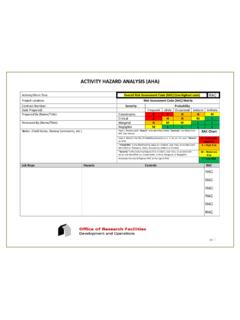
ACTIVITY HAZARD ANALYSIS (AHA)
Hazard" on AHA. E = Extremely High Risk " Probability" is the likelihood to cause an incident, near miss, or accident and identified as: Frequent, Likely, Occasional, Seldom or Unlikely . H = High Risk " Severity" is the outcome/degree if an incident, near miss, or accident did
Download ACTIVITY HAZARD ANALYSIS (AHA)

Information
Domain:
Source:
Link to this page:
Documents from same domain
HVAC Duct Cleaning - National Institutes of Health
ors.od.nih.govDivision of Occupational Health and Safety . The dirty filter/vent above indicate a cleaning is needed and should be performed by a professional . DOHS Fact Sheet on . HVAC Duct Cleaning . National Institutes of Health • Office of Research Services (ORS) • Division of Occupational Health and Safety (DOHS) • Technical Assistance Branch (TAB)
Contractor Health and Safety Requirements
ors.od.nih.gova. Contractor Safety Program Assessment: The NIH is committed to providing a safe environment for its employees, guests, and patients. Safety, as demonstrated during previous contracts, may be used in the past performance evaluation of a Contractor. Contractors are required to enroll in the Contractor Safety Assessment Program (CSAP).
Guidance for the Selection of Laboratory Coats
ors.od.nih.govThis reference document provides a general overview for selection of laboratory coats. It does not alter or determine compliance responsibilities in OSHA standards or NIH’s Manual Chapter 1340. Because interpretations and policy may change over time, you should your consult with your Institute's Safety and Health Specialist.
Protocol for Use and Maintenance of Oxygen Monitoring …
ors.od.nih.govdisplacement of oxygen. At a minimum, the following factors should be used in determining if a device should be installed: manufacturer (e.g., magnet) guidance, volume of gas used, location of gas, and air changes/hour in the room/area. The 2008 NIH DRM notes that both ‘carbon dioxide manifold rooms…
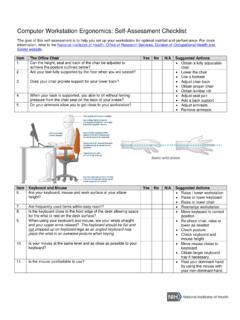
Computer Workstation Ergonomics: Self-Assessment Checklist
ors.od.nih.govSelf Assessment Computer Workstation Ergonomics: Self-Assessment Checklist . The goal of this self-assessment is to help you set up your workstation for optimal comfort and performance. For more information, refer to the . National Institutes of Health, Office of Research Services, Division of Occupational Health and Safety website.
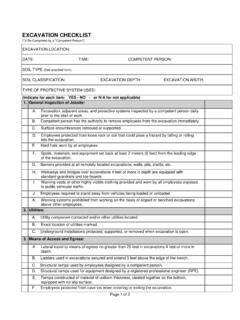
EXCAVATION CHK LST
ors.od.nih.govinto the excavation. rolling E. Hard hats worn by all employees. F. Spoils, materials, and equipment set back at least of the excavation. 2 meters (6 feet) from the leading edge G. Barriers provided at all remotely located excavations, wells, pits, shafts, etc. H. Walkways and bridges over excavations 4 feet or more in depth are equipped
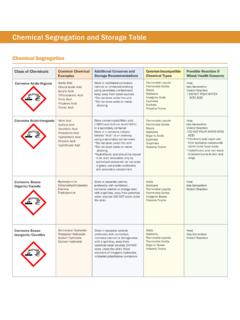
Chemical Segregation Table
ors.od.nih.govChemical Segregation. Common Chemical Additional Concerns and Common Incompatible Possible Reaction if Examples Storage Recommendations Chemicals Types Mixed/Health Concerns . Class of Chemicals . Flammable Liquids . Ethanol, Ethyl Acetate, Methanol, Acetone, Benzene, Xylene, Toluene Diethyl Ether Tetrahydrofuran Acetonitrile Glacial Acetic Acid
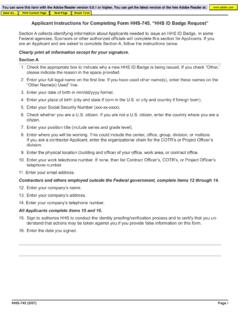
Applicant Instructions for Completing Form HHS-745, “HHS ...
ors.od.nih.govApplicant Instructions for Completing Form HHS-745, “HHS ID Badge Request” Section A collects identifying information about Applicants needed to issue an HHS ID Badge. In some Federal agencies, Sponsors or other authorized offi cials will complete this section for Applicants. If …
NIH Chemical Hygiene Plan
ors.od.nih.govBSC Biological Safety Cabinets CFH Chemical Fume Hood CFR Code of Federal Regulations CHO Chemical Hygiene Officer ... eyes, or mucus membranes. Physical hazards include, but are not limited to, chemicals which are explosive, flammable, or corrosive. (Definition listed in . Appendix F “Glossary of Terms.”) III.

Safety and Health Program Audit Tool
ors.od.nih.govImplemented Evidence of Implementation . A mechanism is established to exchange information about hazards present in the workplace and measures in place to prevent or control them. for all contractors to use to report injuries, hazards, and concerns. Host employers include any safety - related specifications and qualifications requirements for
Related documents
Survival Distributions, Hazard Functions, Cumulative Hazards
web.stanford.eduhazard function h(t) to be increasing in t; that is, the conditional probabil-ity of a serious engine problem in the next month, given no problem so far, will increase with the life of the car. In contrast, if one were studying infant mortality in a region of the world where there was poor nutrition, one might

Hazard Mitigation for Natural Disasters
www.epa.govHazard Mitigation Join Local Mitigation Efforts Develop Mitigation Projects Implement and Fund Project Mitigation Case Study Step 1. Understand the Threat Posed by the Hazard. How serious is the natural hazard event that you face? For . example, determine how high the floodwaters could be . based on historical flood data (frequency and severity) of
Hazard Mapping - Home | Occupational Safety and Health ...
www.osha.gov1. Using Hazard Mapping to IdentifyPossible Risks A Hazard Map is a visual representation of the workplace where there are hazards that could cause injuries or illness. The Hazard Mapping method draws on what workers know from on the job experience. The Hazard Mapping approach works best when conducted with a small group of workers with some

Chapter 18 Estimating the Hazard Ratio What is the hazard?
www.u.arizona.eduThe hazard at each moment is determined by the values that were taken by the causes of death at baseline. Figure 1. Hypothetical hazard-of-death function Hours h(t) 0 0.5 1 1.5 2 2.5 3 3.5 0 5 10 15. DRAFT: June 2015 2 Cox regression Cox regression is a regression model that enables us to estimate the hazard ratio (hazard rate

Job Hazard Analysis - Occupational Safety and Health ...
www.osha.gova hazard often is associated with a condition or activity that, if left uncontrolled, can result in an injury or illness. See Appendix 2 for a list of common hazards and descriptions. Identifying hazards and eliminating or controlling them as early as …
Hazard Assessment and Risk Analysis - Fermilab
uspas.fnal.gov•Risk – is the hazard level combined with (1) the likelihood of the hazard leading to an accident (sometimes called danger) and (2) hazard exposure or duration (sometimes called latency). –Correct way to combine all elements of risk is unknown –Parameter values …

HAZARD COMMUNICATIONS (HAZCOM) SYMBOLS
udallas.eduhazard, red for flammability, orange for a physical hazard, and white for Personal Protection. The number ratings range from 0-4. Blue/Health The Health section conveys the health hazards of the material. In the latest version of HMIS, the blue Health bar has two spaces, one for an asterisk and one for a numeric hazard rating. If present,

SEISMIC HAZARD ANALYSIS - Memphis
www.ce.memphis.edu“The earthquake hazard for the site is a peak ground acceleration of 0.28g with a 2 percent probability of being exceeded in a 50-year period.” There are two basic approaches to seismic hazard analysis. Both use the same basic body of information to determine what the “design earthquake” should be.

SPRINKLER PROTECTION BASICS: HAZARD CLASSIFICATION
buildingcoderesourcelibrary.com-Laboratories (hazard classification will depend upon the amounts of flammable and combustible liquids used and stored in the laboratories C Ordinary Hazard, Group 2-Storage rooms (ceiling height 12 feet or less)1-Soiled linen rooms 1 Meeting the criteria for quantity/combustibility of contents for an ordinary, group 1