ACUTE ONCOLOGY INITIAL MANAGEMENT GUIDELINES
Guideline 11 Nausea P.19 Guideline 12 Neutropenic Sepsis P.20-21 Guideline 13 Skin Rash P.22-23 Guideline 14 Skin Toxicities- Targeted Therapy Related P.24 Guideline 15 Skin Rash – Radiotherapy Reactions P.25 Guideline 16 Palmar Plantar Erythrodysesthesia (Hand Foot) P.26 Guideline 17 Vomiting P.27
Download ACUTE ONCOLOGY INITIAL MANAGEMENT GUIDELINES

Information
Domain:
Source:
Link to this page:
Documents from same domain

Acute Oncology Knowledge and Skills Guidance
www.ukons.org4 Acute Oncology Knowledge and Skills Guidance www.ukons.org The Skills Framework This framework is descriptive and details four levels of role-specific skill and expertise for general / non- specialist and specialist healthcare workers involved in …

Oncology/Haematology 24 Hour Triage
www.ukons.org3.4 The Triage Assessment Process and Tool 6 3.4.1 Key points 6 3.4.2 Risk assessment 6 4.0 The Triage Log Sheet 12 5.0 Training and competency 13 5.1 The competency assessment 13 5.2 Competency assessment record 15 References 18 Review Group 20 Consultation Group 21 Appendix 1 – Table of Changes 23 Appendix 2 – Skills for Health information 24
Version 2.0. 26.03.2018. Review date: 01.03.2020 © UKONS ...
www.ukons.org(Eastern Cooperative Oncology Group1 or Karnofsky Performance Status2) • It is important to ask about all SACT related toxicities/problems in addition to the initial complaint, as several occurring together elevate risk and need closer management.

Systemic Anti-Cancer Therapy (SACT) Competency Passport
www.ukons.orgSACT, the management of medium and longer-term toxicities, and more detailed knowledge on drug modalities of action. The following are not covered in this document: Specialised / less common routes of administration, e.g. inhalation, isolated limb perfusion, intravesical, topical, and participating in the checking of intrathecal chemotherapy.
Systemic Anti-Cancer Therapy (SACT) Competency Passport
www.ukons.orgSystemic Anticancer Therapy refers to all drugs, irrespective of their route of administration, with direct anti-tumour activity, including traditional cytotoxic chemotherapy such as cyclophosphamide, hydroxycarbamide, small molecule/antibody treatments such as imatinib, rituximab, immunotherapies such as nivolumab, ipilimumab
Related documents
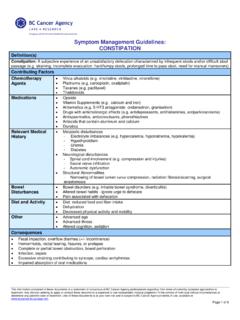
Symptom Management Guidelines: CONSTIPATION
www.bccancer.bc.caAssessment and management of contributing factors. If opioid related, See opioid-induced Constipation: Special Considerations below * Avoid suppositories, enemas, disimpaction, or rectal exams if patient neutropenic or has low platelets Pharmacological Management
Symptom Management Guidelines: Nausea and Vomiting
www.bccancer.bc.caSCNAUSEA –Guidelines for preventing and treatment of Chemotherapy-Induced Nausea and Vomiting in Adults The information contained in these documents is a statement of consensus of BC Cancer professionals regarding their views of currently accepted approaches to treatment.

Policies and Procedures for Outpatient Surgery
hcmarketplace.com-Opioid analgesics are added to nonopioids to manage acute pain and chronic cancer-related pain that does not respond to nonopioids alone. -Sedation, constipation, nausea and vomiting, itching, and respiratory depression are the most com-mon side effects of opioids. Recommend a stool softener to each patient to prevent constipation.
DRUG NAME: Oxaliplatin - BC Cancer
www.bccancer.bc.ca(grades 3-4) diarrhea, nausea and vomiting, and neurotoxicity are more common with combination ... is cumulative, dose-related and usually reversible a few months after ... Symptom onset may be delayed relative to treatment, with cases

Management of Nausea in Patients with Chronic Kidney …
www.bcrenal.caactivation is thought to be the cause of CKD related nausea/vomiting, for which ... Chronic Kidney Disease Symptom Management Resource References 1. BC Heart Failure Network. Nausea and Vomiting Heart Failure Symptom Management Guideline. January 2015. 2. Cancer Care Ontario. Nausea and Vomiting in Adults with Cancer: Screening and Assessment. ...
Hypersensitivity & Infusion Reaction Management
intranet.stephensoncancercenter.orgFeb 21, 2019 · Mild to moderate infusion reactions (ie, National Cancer Institute [NCI] Grade 1, Grade 2) and infusion reactions that do not involve symptoms of anaphylaxis can usually be managed with temporary interruption of the infusion and symptom management. All the necessary medications are in the infusion reaction bags; these are available on each

Guidelines for Hospice Eligibility
www.agrace.orgUncontrolled pain, shortness of breath, nausea/vomiting, anxiety 9. Multiple, recurrent infections 10. Patient appears to be “giving up” physically and emotionally Agrace is available 24/7 to assist in identifying whether a patient may be eligible for hospice services. *See Appendix 2 for Palliative Performance Scale 1
ACG and CAG Clinical Guideline: Management of Dyspepsia
www.cag-acg.orgCost-eff ective management of dyspepsia can reduce its health and economic burdens, but it is over 10 years since either the American College of Gastroenterology (ACG) ( 10 ) or Canadian Association of Gastroenterology (CAG) ( 11 ) published guidelines on dyspepsia. We have therefore updated previous systematic

NCCN.org/patients/survey NCCN Guidelines for Patients ...
www.nccn.orgNCCN Guidelines for Patients® 3 Nausea and Vomiting, Version 1.2016 Contents 4 How to use this book 5 Part 1 Nausea and vomiting Learn about nausea and vomiting and how it is related to cancer treatment. 11 Part 2 Causes Find out what cancer treatments can cause nausea and vomiting. 17 Part 3 Preventing and treating