
Adolescence Visits
experiment. Brain research demonstrates that the neurologic structures that underlie the functions of controlling impulses and making decisions are still maturing during adolescence. 7-9 Discretion and decision-making is further inhibited under the influence of alcohol or drugs. As a social creature, the adolescent enjoys being with his friends ...
Download Adolescence Visits

Information
Domain:
Source:
Link to this page:
Documents from same domain

AActActiivity Bookvity B o ok LLibro de ALibro de ...
brightfutures.aap.orgT he Bri g h t F ut u res Activity B ook T h e Br ig ht Fu tur es Act ivity Bo ok is a gre at way to teach yo ur yo ung c h ild abo ut hea lth and saf ety.
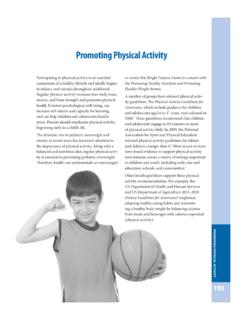
Promoting Physical Activity - Bright Futures
brightfutures.aap.orgAssociation for Sport and Physical Education ... Many organizations (eg, American Physical Therapy Association, Disabled Sports USA, and National Sports Center for the Disabled) provide informa-tion on appropriate physical activities and potential ... Promoting Physical Activity: A.
ADOLESCENT ALCOHOL AND SUBSTANCE USE AND ABUSE
brightfutures.aap.orgWhy Is It Important to Screen for Adolescent Alcohol and Substance Use? Alcohol and substance use is associated with deaths, injuries, and health problems among US teenagers.
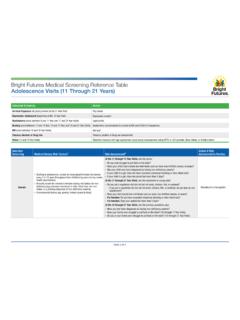
right utures edical creening eference Tale Adolescence ...
brightfutures.aap.orgright utures edical creening eference Tale PAGE 1 OF 5 Adolescence Visits (11 Through 21 Years) Universal Screening Action Cervical Dysplasia (all young women at the 21 Year Visit) Pap smear Depression: Adolescent (beginning at the 12 Year Visit) Depression screena Dyslipidemia (once between 9 and 11 Year and 17 and 21 Year Visits) Lipid profile Hearing (once between 11 and 14 Year, 15 and …
Bright Futures Health Supervision Visits
brightfutures.aap.org259 INTRODCTION TO THE BRIGHT FTRES HEATH SPERISION ISITS Introduction to the Bright Futures Health Supervision Visits Health supervision visits are an important oppor -
Promoting Mental Health - Bright Futures
brightfutures.aap.orgPromoting m E nt AL HEAL t H Promoting Mental Health care professional, therefore, is challenged to promote mental health through activities that are aimed at prevention, risk assessment, and

Infancy Visits - Bright Futures
brightfutures.aap.orgBreastfeeding promotion is a key aspect of this visit, in particular ... a practice may use alternative strategies to obtain information once the parents have decided to use ... or drugs, family support of breastfeeding, formula-feeding guidance, financial resources for

Early Childhood Visits - Bright Futures
brightfutures.aap.orgBright Futures Guidelines for Health Supervision of Infants, Children, and Adolescents 505 EARL CHILDHOOD 12 MONTH VISIT The Bright Futures Tool and Resource Kit contains Previsit Questionnaires to assist the health care profes- sional in taking a history, conducting developmental surveillance, and performing medical screening.
Evidence and Rationale - Bright Futures
brightfutures.aap.orgBright Futures Guidelines for Health Supervision of nfants, Children, and Adolescents 278 EVDENCE AND RATONALE Anemia The USPSTF has concluded that current evidence is insufficient to recommend for or against screening
Nutrition Supervision - Bright Futures
brightfutures.aap.orgFUTURES 21 BRIGHT FUTURES: NUTRITION Infancy Infancy CONTEXT Infancy is a period marked by the most rapid growth and physical development experi-enced throughout life. Infancy is divided into several stages, each of which is unique in terms of growth, developmental achievements, nutrition needs, and feeding patterns. The
Related documents
The Adolescent Brain –Learning Strategies & Teaching Tips
spots.wustl.eduThe adolescent brain is still developing and therefore requires different brain compatible strategies for learning. This section describes the adolescent brain, details specific learning strategies in “Things to Know 1-5” and “Brain Compatible Strategies for Increasing Learning,” and offers practical tips for teaching teenagers in
The Impact of Substance Use on the Developing Brain
fsph.iupui.eduof the adolescent brain is reflected in the greater propensity of adolescents to take part in risky ac-tivities such as unprotected sexual activity, reck-less driving, and substance use, than at any other point in their lives [10-14]. Another important change noted in the ad-olescent brain is an increase in the activity of nu-

Adolescent Psychosocial, Social, and Cognitive Development
siecus.orgJul 01, 2018 · development in adolescents. Unlike in the adult brain, where both the limbic area of the brain (emotion center) and the prefrontal cortex (judgment and reasoning cen-ter) are enhanced when viewing images that expressed fear,intheadolescentbrain,afterseeingthesameimages, the limbic area is enhanced, with almost …
Understanding the Effects of Maltreatment on Brain …
www.childwelfare.govAdolescent Brain Development. Studies using MRI techniques show that the brain continues to grow and develop into young adulthood (at least to the midtwenties). White matter, or brain tissue, volume has been shown to increase in adults as old as 32 (Lebel & Beaulieu, 2011). Right before puberty, adolescent

The Adolescent Brain: A second window of opportunity
www.unicef-irc.orgThe Adolescent Brain: A second window of opportunity HIV/AIDS, road injuries, drowning and other negative outcomes (Mokdad, 2016). It is a time when mental illness and the incidence of suicide sharply increases (Petroni, Patel and Patton, 2016) and when experiences of bullying, inter-personal violence