Adolescent Screening Instruments
Certified Programs . Introduction: OASAS requires that all patients admitted to Certified Programs be screened for co-occurring mental health disorders in specified domains. The following pages provide tables with the names of and links to the recommended screening instruments for required and non-required mental health domains.
Download Adolescent Screening Instruments

Information
Domain:
Source:
Link to this page:
Documents from same domain
OASAS APG Medicaid Billing Guidance
oasas.ny.gov3 APG Policy and Medicaid Billing Guidance February 2018 Section One Introduction The Ambulatory Patient Group (APG) billing process was implemented in July 2011 as a step-in
SCREENING FOR CO-OCCURRING DISORDERS USING THE
oasas.ny.govWHAT IS THE PURPOSE OF SCREENING FOR CO-OCCURRING DISORDERS? The purpose of a screening instrument—such as the Modified Mini Screen—in chemical dependency treatment settings is to identify patients with a high

14 NYCRR Part 800, as amended March 29, 2019, is amended ...
oasas.ny.govfor controlled substances. (d) 42 Code of Federal Regulations Part 2, et. seq. regarding confidentiality of patient ... public health education including prevention and harm reduction; ... “Prescribing professional” is any medical professional appropriately licensed under New
Peer Advocate Services in OASAS Certified Programs Settings
oasas.ny.govand connecting patients to community based recovery supports consistent with treatment/recovery and discharge plans.”1 Peer support services must be delivered by a Certified Recovery Peer Advocate (CRPA) or CRPA-Provisional (CRPA-P). Peer support services target recovery outcomes such as improved health and wellness; an increased sense
A New York State Office of Alcoholism and Substance Abuse ...
oasas.ny.gov3 As a result, a workgroup was formed to create a tool that met the following goals: • User-friendly: The ability to be completed in minutes using a modern, intuitive web- based platform; • Patient-centered: Based on an individualized clinical assessment; • Recovery-oriented: Inclusion of recovery concepts and encourage the use of community and family supports;
AMENDED PART 822 EFFECTIVE AUGUST 2, 2021: PART 822 ...
oasas.ny.gov(p) “Intensive outpatient services” (IOS) is an outpatient treatment service provided by a team of clinical staff for patients who require a time-limited, multi-faceted array of services, structure, and support to achieve and sustain recovery. Programs that offer intensive outpatient treatment
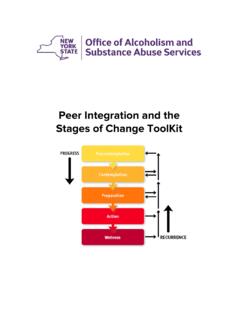
Peer Integration and the Stages of Change ToolKit
oasas.ny.govtom hill table of contents statement from arlene gonzÁlez -sÁnchez, m.s., l.m.s.w. commissioner 4 thank you to toolkit sponsors and contributers 5 peer integration and the stages of change 8 pre-contemplation 8 the history and case for peer-to-peer services 8 health care in new york state 11 peer services = better care, better health and lower costs 10 evidence-based research …

Part 822 Side by Side - NYS Office of Alcoholism and ...
oasas.ny.govmore medical treatment protocols as defined in this Part, known as an Opioid Treatment Program. This term encompasses medical and comprehensive support services including counseling, educational and vocational rehabilitation. The term also includes the Narcotic Treatment Program (NTP) as defined by the federal Drug Enforcement Agency
Credentialed Alcoholism and Substance Abuse Counselor ...
oasas.ny.govThe New York State Office of Addiction Services and Supports (OASAS) is committed to enhancing the quality of services in New York State through the professional development of the s ubstance use disorder (SUD) services workfor ce. ... Advanced Counselor prior to issuance of your credential.
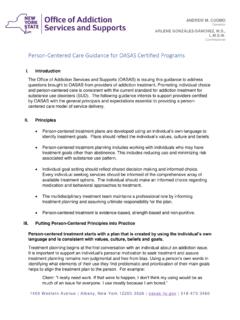
Person-Centered Care Guidance - Office of Addiction ...
oasas.ny.govARLENE GONZÁLEZ-SÁNCHEZ, M.S., L.M.S.W. Commissioner. and continue to move toward healthier behaviors and improvement in functioning. Individuals who are affected by a someone’s addiction are also welcomed to treatment, even if the person who is suffering from addiction is not willing or able to attend treatment.
Related documents

Eating Disorders Programs Referral Form Provincial …
mentalhealth.providencehealthcare.orgReferral Form Page 1 of 2 Provincial Specialized Eating Disorders Programs Referring Professional: Are you>>> GP/Family Doctor Pediatrician Psychologist Psychiatrist a Regional Program Other – specify: _____ Your MSP BILLING #: Are you>>>
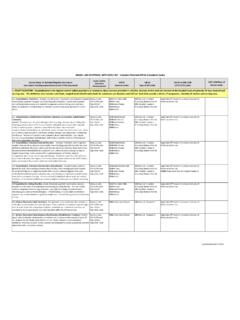
1. HOSPITALIZATION - Hospitalization is the highest level ...
www.magellanprovider.comJun 12, 2019 · 1.5 Hospitalization, Eating Disorders. Acute behavioral, psychiatric and medical services provided in a discreet unit to individuals experiencing an eating disorder. Services include medical management/monitoring, evaluation, psychopharmacology, structured meals, individual, group and nutritional therapies.
FIMS Position Statement: June 2000
www.fims.orgFÈDÈRATION INTERNATIONALE DE MÈDECINE DU SPORT / THE INTERNATIONAL FEDERATION OF SPORTS MEDICINE Available on the FIMS web site: http://www.fims.org
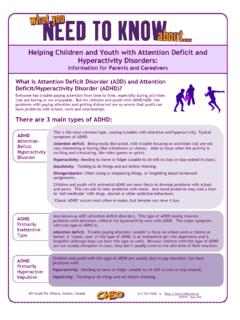
Helping Children and Youth with Attention Deficit and ...
www.cheo.on.ca401 Smyth Rd, Ottawa, Ontario, Canada 613-737-7600 http://www.cheo.on.ca Common questions about medications Stimulant medications will stimulate the focus and impulse ...

Virtual Recovery Resources - SAMHSA
www.samhsa.govSTAYING CONNECTED IS IMPORTANT: VIRTUAL RECOVERY RESOURCES INTRODUCTION In an infectious disease outbreak, when social . …
Substance Use Disorder Treatment for People With Co ...
store.samhsa.govto co-occur with addiction include depressive disorders, bipolar I disorder, posttraumatic stress disorder (PTSD), personality disorders (PDs), anxiety disorders, schizophrenia and other psychotic disorders, ADHD, and eating and feeding disorders. Serious gaps exist between the treatment and service needs of people with CODs and the actual care

Teaching Students with Autism Spectrum Disorders
files.eric.ed.govDisorders and/or Mental Illnesses (2000) Book 8 takes a comprehensive look at six emotional disorders or mental illnesses: eating disorders, anxiety disorders, depression, schizophrenia, oppositional defiant disorder and conduct disorder. It describes the characteristics, symptoms and risk
Disruptive, impulse-control, and conduct disorders
www.instituteforchildsuccess.orgOBJECTIVES • To familiarize yourself with Disruptive, Impulse-Control, and Conduct Disorders in the DSM-5 • To understand the prevalence and demographics of these disorders • To discuss diagnostic features, associated features, and development and course of these disorders • To discuss risk and prognostic factors of each disorder • To discuss differential diagnosis and …

Co-Occurring Disorders Workbook - Recovery SI
treatmentandrecoverysystems.comRECOVERY PROGRAMS ©Recovery Systems Institute 2012 | WWW.RECOVERYSI.COM 2 TOOL (continued) Co-Occurring Disorders Workbook A. When I arrived in treatment I was feeling these emotional and mood symptoms: B. I have now been drug and alcohol free for _____ days. C. Since arrival, my mood and emotional state has (Check one) Improved

EDA Big Book Step Workshop Preparation for Step One
eatingdisordersanonymous.orgtreatment programs (list when ... Step One: We admitted we were powerless over our eating disorders – that our lives had become unmanageable. Keep it short, simple, and honest! List examples of how you have been powerless over your eating disorder—times you knew