AERATION - MRWA
dioxide) and oxidizes dissolved metals such as iron, hydrogen sulfide, and volatile organic chemicals (VOCs). Aeration is often the first major process at the treatment plant. During aeration, constituents are removed or modified bee with the treatment fore they can interfer processes.
Download AERATION - MRWA

Information
Domain:
Source:
Link to this page:
Documents from same domain

Lime-Soda Ash Softening - MRWA.com
www.mrwa.comLime Softening 1 Lime Softening . Chemical precipitation is one of the more common methods used to soften water. Chemicals normally used are lime (calcium …
Filtration - MRWA.com
www.mrwa.comFiltration 1 Filtration . Filtration plays an important role in the natural treatment of groundwater as it percolates through the soil. It is also a …
Filtration - MRWA
www.mrwa.comFiltration 1 Filtration . Filtration plays an important role in the natural treatment of groundwater as it percolates through the soil. It is also a …
Membrane Filtration - MRWA
www.mrwa.comMembrane Filtration 1 Membrane Filtration . A membrane is a thin layer of semi-permeable material that separates substances when a driving force is applied across the membrane.
Corrosion - MRWA
www.mrwa.comCorrosion 1 Corrosion . Corrosion causes gradual decay and deterioration of pipes, both internally and externally. It can reduce the life of a pipe …
Lime-Soda Ash Softening - MRWA.com
www.mrwa.comLime Softening 1 Lime Softening . Chemical precipitation is one of the more common methods used to soften water. Chemicals normally used …

Iron and Manganese Removal - MRWA
www.mrwa.comIron and Manganese 1 Iron and Manganese . Iron and manganese control is the most common type of municipal water treatment in Minnesota. Iron and manganese occur naturally in groundwater.

Class D Study Guide - MRWA.com
www.mrwa.comClass D Study Guide . This study guide is designed for operators taking the Class D water operator . certification exam and is a condensed version of the Minnesota Water Works Operations Manual. This tool, along with your operating experience and
Iron and Manganese Removal - MRWA.com
www.mrwa.comRemoval by Iron and Manganese Filtration Removing iron and manganese from drinking water instead of sequestration it is recommended if the water contains over 0.3 ppm of iron or 0.05 ppm of manganese.

Financing Your Community Projects - mrwa.com
www.mrwa.comFinancing Your Clean Water and Drinking Water Municipal Infrastructure Projects With State Loan and Grant Funds Find out about the financing process when using the Clean Water and Drinking Water Revolving Funds, WIF, and Legacy Funds. Becky Sabie, Minnesota Public Facilities Authority
Related documents
Analysis of Cyanide (Total, Weak Acid Dissociable, and ...
www2.gov.bc.caWeak Acid Dissociable (WAD) Cyanide: ... forming volatile carbonyl sulfide, which is converted to sulfide upon absorption in an alkaline liquid. For manual total cyanide distillation analysis use the BC MOE HCl-HH method (Ref. 13) to mitigate thiocyanate interference. To mitigate thiocyanate interference on flow systems (CFA or FIA), the
Anaerobic Digestion Fundamentals
www.wef.orgHydrogen sulfide, when combined with water vapor, forms a weak acid that may damage biogas piping or equipment. Passing biogas through wood chips impregnated with iron sponge, biological scrubbers, or activated carbon help remove hydrogen sulfide from biogas. Liquid phase oxidation is an alternative removal method.
SAFETY DATA SHEET - EnerSys
www.enersys.comSulfuric Acid: Sulfur trioxide, carbon monoxide, sulfuric acid mist, sulfur dioxide, and hydrogen sulfide. Lead Compounds: High temperatures likely to produce toxic metal fume, vapor, or dust; contact with strong acid or base or presence of nascent hydrogen may generate highly toxic arsine gas. Hazardous Polymerization: Will not occur XI.
Chemical Segregation Table - National Institutes of Health
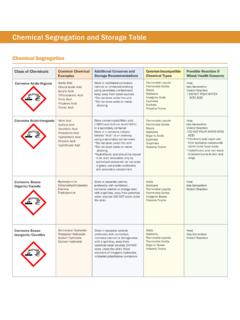
ors.od.nih.govAcid - Hydrofluoric Acid is a highly acute poison Acrylamide Ethidium Bromide Sodium Azide Store non-volatile liquid poisons in a refrigerator or cabinet; amounts less than 1 liter can be stored in a cabinet above bench level, ONLY if the cabinet has sliding doors (not swinging) (DEP) for assistance *Hydrofluoric Acid should be stored in an area
RULE 102 DEFINITIONS Volatile Organic Compounds (VOC)
www3.epa.govVolatile Organic Compounds (VOC) Any chemical substance which contains compound of carbon, excluding carbon monoxide, carbon dioxide, carbonic acid, metallic carbides or carbonates, and ammonium carbonate, determined to have photochemical reactivity. ... Carbonyl sulfide 463581 Catechol 120809 Chloramben 133904 Chlordane 57749 ...
A Guide To Kjeldahl Nitrogen Determination Methods and ...
www.expotechusa.comdigestion, volatile nitrogen compounds may be lost to the atmosphere. Remember that as acid is gradually consumed during the digestion process, for the various reasons mentioned above, the salt acid ratio of the digest gradually rises. This means that the hottest solution temperatures are attained at the end of the digestion.
Physical and Chemical Properties of Solid Waste - uap-bd.edu
www.uap-bd.eduVolatile solids (VS), determined by ignition at 550˚C,is often used as a measure of the biodegradability of the organic fraction of MSW. Some of the organic constituents of MSW are highly volatile but low in biodegradability (e.g. Newsprint) due to lignin content. The rate at which the various components can be degraded varies markedly.

DR/890 COLORIMETER PROCEDURES MANUAL
www.equipcoservices.comPHOSPHORUS, ACID HYDROLYZABLE, Hydrolysis to Orthophosphate Method..... 511 PHOSPHORUS, ACID HYDROLYZABLE, PhosVer 3 with Acid Hydrolysis..... 515 PHOSPHORUS, TOTAL, (Also called Organic and Acid Hydrolyzable) Acid Persulfate