
Alcohol and Medication Interactions
Alcohol and Medication Interactions Ron Weathermon, Pharm.D., and David W. Crabb, M.D. Many medications can interact with alcohol, thereby altering the metabolism or effects of
Download Alcohol and Medication Interactions

Information
Domain:
Source:
Link to this page:
Documents from same domain
Alcohol and your health - National Institutes of …
pubs.niaaa.nih.gov“It emphasized that drinking is not bad in and of itself—it’s how much you’re doing it and how it’s affecting your life.”
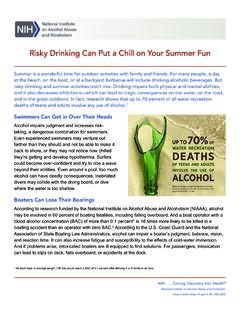
Risky Drinking Can Put a Chill on Your Summer Fun
pubs.niaaa.nih.govSummer is a wonderful time for outdoor activities with family and friends. For many people, a day at the beach, on the boat, or at a backyard barbecue will include drinking alcoholic beverages.
The Role of Nurses in Care - National Institutes of …
pubs.niaaa.nih.govThe Role of Nurses in Primary Care Managing AlcoholAbusing Patients E LEANOR J. S ULLIVAN, P H ... Information on the patient’s combined characteristics forms the basis of ... ing client education, screening, and refer ral if needed (Shenk in press).
The Neurobiology of Addiction
pubs.niaaa.nih.govneurobiology. The Neurobiology of Addiction An Overview AMANDA J. ROBERTS, PH.D., AND GEORGE F. KOOB, PH.D. Addiction can be defined in part as a compulsion to use alcohol or other drugs and the occurrence of withdrawal symptoms when long-term consumption ceases. In
Neurobiology of Alcohol Dependence
pubs.niaaa.nih.govNeurobiology of Alcohol Dependence greater than 0.08 percent within a 2 hour period, may be associated with dependence (NIAAA 2004 b). Models
Stages of Change Readiness and Treatment Eagerness …
pubs.niaaa.nih.govEagerness Scale (SOCRATES) BRIEF DESCRIPTION The SOCRATES is a 19-item, self-administered instrument designed to assess client motivation to change drinking-related behavior.
Alcohol Alert Number 86 - National Institutes of Health
pubs.niaaa.nih.govAlcohol Alert Number 86 ch e human genetic makeup (the genome) decoded and genetic testing ... The altered epigenetics caused by alcohol may play a role in alcohol-induced fatty liver and the progression of liver cancer, and may contribute to widespreadchanges in other organs.
Focus on: Epigenetics and Fetal Alcohol Syndrome
pubs.niaaa.nih.govFOCUS ON: EPIGENETICS AND FETAL ALCOHOL SPECTRUM DISORDERS homocysteine cycle, methionine is activated to SAM, ultimately resulting in the formation of homocysteine.
Cognitive-Behavioral Coping-Skills Therapy for Alcohol ...
pubs.niaaa.nih.govCognitive-Behavioral Coping-Skills Therapy for Alcohol Dependence Current Status and Future Directions Richard Longabaugh, Ed.D., and Jon Morgenstern, Ph.D. Cognitive-behavioral coping-skills training (CBST) is an alcoholism treatment approach aimed

Semi-Structured Assessment for the Genetics of Alcoholism ...
pubs.niaaa.nih.govSemi-Structured Assessment for the Genetics of Alcoholism (SSAGA-II) BRIEF DESCRIPTION TARGET POPULATION The SSAGA-II was designed to assess the physical, psychological, and social manifestations of alcohol abuse or dependence and other psychiatric disorders. It is is a polydiagnostic instrument that assesses somatization
Related documents
HIGHLIGHTS OF PRESCRIBING INFORMATION ...
pi.lilly.com5.1 Schedule-Dependent Toxicity 5.2 Myelosuppression 5.3 Pulmonary Toxicity and Respiratory Failure 5.4 HemolyticUremic Syndrome 5.5 Hepatic Toxicity 5.6 Embryo-Fetal Toxicity 5.7 Exacerbation of Radiation Therapy Toxicity 5.8 Capillary Leak Syndrome 5.9 Posterior Reversible Encephalopathy Syndrome 6 ADVERSE REACTIONS 6.1 Clinical Trials Experience

National Cancer Institute – Common Toxicity Criteria (NCI ...
www.jcog.jpNational Cancer Institute – Common Toxicity Criteria (NCI-CTC Version 2.0, April 30, 1999) ~日本語訳JCOG 版-第2 版~ 初版1999 年4 月 第1 回改訂2001 年9 月 Japan Clinical Oncology Group 日本臨床腫瘍研究グループ 厚生労働省がん研究助成金指定研究班
R32 Common Questions - AIRAH
www.airah.org.audeprivation safety limit. Furthermore, a 14% concentration is well above the acute toxicity exposure limit for common historical refrigerants like R22 (5.9%) and R134a (5%). 2. The second requirement is that the flammable gas mixture must have a velocity lower than 3 to 4 times its burning velocity (6.7 cm / secfor R32).

Hydrocodone (Trade Names: Vicodin , Lortab , Lorcet-HD ...
www.deadiversion.usdoj.govwith acetaminophen carries an additional risk of liver toxicity when high, acute doses are consumed. Some individuals who abuse very high doses of acetaminophencontaining hydrocodone - products may be spared this liver toxicity if they have been chronically taking these products and have escalated their dose slowly over a long period of time.

Garden plants poisonous to people
www.dpi.nsw.gov.auTable 1. Toxicity rating for Tables 2−7. Rating Toxicity * Mildly toxic. Mild symptoms may occur if large quantities are eaten. ** Toxic. Causes discomfort and irritation but not dangerous to life. *** Highly toxic. Capable of causing serious illness or death. NO v e M B e r 2 0 0 6 P r i M e F a C t 3 5 9 ( r e P l a C e S a g F a C t P 7 . 1 .

Fact Sheet: Human Health Toxicity Assessment for GenX ...
www.epa.govtoxicity assessment along with exposure information and other important considerations to determine if, and ... one common characteristic i s that they break down very slowly and can accumulate over time in people, animals, and the environment. Because of their persistence, PFAS are sometimes referred to as “forever chemicals.”

HIGHLIGHTS OF PRESCRIBING INFORMATION ...
www.rxabbvie.comThe most common adverse reactions (incidence at least 4% and greater than placebo) are nausea, constipation, and fatigue. Table 2 summarizes the adverse reactions that occurred during Study 1 and Study 2. Table 2: Adverse Reactions Occurring with an Incidence of At Least 2% for QULIPTA and Greater than Placebo in Studies 1 and 2 Placebo (N= 408) %

REVIEW OF N-ACETYLCYSTEINE FOR THE TREATMENT OF ...
www.who.intAcetaminophen (paracetamol) toxicity is a common cause of drug-induced hepatotoxicity in children and adults. N-acetylcysteine (NAC) has been used for several decades and has proven to be the antidote of choice in treating acetaminophen-induced hepatotoxicity. There is significant clinical evidence to support that oral and intravenous