
alloy X-750
Figure 2. High-temperature fatigue strength (108 cycles) of bar. Rotating-beam tests (3450 rpm). ess, ksi Stress, ksi Time, hr Temperature, °F The results of two series of tests of high-temperature tensile properties are shown in Tables 7 and 8. Relaxation data are in Figure 1. Fatigue strength of equalized plus precipitation-treated
Download alloy X-750

Information
Domain:
Source:
Link to this page:
Documents from same domain
INCONEL alloy 625 - Special Metals Corporation
www.specialmetals.com1 INCONEL ® alloy 625 www.specialmetals.com INCONEL® nickel-chromium alloy 625 (UNS N06625/W.Nr. 2.4856) is used for its high strength, excellent …
800H & HT Web - Special Metals Company
www.specialmetals.comINCOLOY ® ® alloy 800H & 800HT www.specialmetals.com The story of the “INCOLOY® alloys series,” from 800, through 800H, 800HT® The INCOLOY® 800 series of alloys, invented by the Special Metals Corporation Group of Companies, is the
Inconel alloy 718 (Sept 07) Web - Special Metals …
www.specialmetals.comINCONEL® alloy 718 2 HEAT TREATING AND MECHANICAL PROPERTIES For most applications, INCONEL alloy 718 is specified as: solution annealed and …
Inconel alloy 600 Web - Revised Sept 2008
www.specialmetals.comINCONEL ® alloy 600 www.specialmetals.com INCONEL® (nickel-chromium-iron) alloy 600 (UNS N06600/W.Nr. 2.4816) is a standard engineering material for applications which require resistance to
www.specialmetals
www.specialmetals.comINCOLOY® alloy 825 3 Corrosion Resistance The outstanding attribute of INCOLOY alloy 825 is its high level of corrosion resistance. In both reducing and oxidize

alloy X-750 - Special Metals Company
www.specialmetals.comINCONEL® alloy X-750 4 Figure 1. High-temperature relaxation of hot-rolled bar equalized and precipitation-treated (1625°F/24 hr, A.C.,+ 1300°F/20 hr, A.C.) Figure 2.
THE ALLOY SPECIALISTS - Special Metals Corporation
www.specialmetals.comTHE ALLOY SPECIALISTS. ALLOY HANDBOOK 2 ALLOY HANDBOOK 3 LEVERAGING A NETWORK OF Expertise The properties of our specialty metal offerings are unmatched, but as part of Precision Castparts ... Pipe, tube, sheet, strip, plate, round bar, flat bar, forging stock, hexagon and wire.
QUICK REFERENCE GUIDE - Special Metals Corporation
www.specialmetals.comQUICK REFERENCE GUIDE 2 QUICK REFERENCE GUIDE 3 SOLUTIONS TO MATERIALS PROBLEMS Special Metals is a world leader in the development and production of nickel-based and
fm82 - Special Metals Corporation
www.specialmetals.comNi-Cr Filler Metal INCONEL Filler Metal 82 24 INCONEL Filler Metal 82 is used for gas-tungsten-arc, gas-metal-arc and submerged-arc welding of INCONEL alloys 600, …
www.specialmetals
www.specialmetals.comINCOLOY ® alloy 825 www.specialmetals.com INCOLOY® alloy 825 (UNS N08825/W.Nr. 2.4858) is a nickel-iron-chromium alloy with additions of molybdenum, copper, and titanium. The alloy’s chemical composition, given in Table 1, is designed to
Related documents
Thermal insulation materials made of rigid polyurethane foam
highperformanceinsulation.eu2.1.2.3 Influence of temperature 2.1.2.4 Influence of water absorption after ... (compressive creep) 2.5 Tensile strength perpendicular to faces σ ... giving them structural and constructional design properties that offer a high level of security, both in the processing stages and in the finished building.
Standard Test Method for Tensile Properties of Plastics1
www.dept.aoe.vt.eduNOTE 4—For tensile properties of resin-matrix composites reinforced with oriented continuous or discontinuous high modulus >20-GPa (>3.0 × 10⁶-psi) fibers, tests shall be made in accordance with Test Method D3039/D3039M. 1.4 Test data obtained by this test method have been found to be useful in engineering design. However, it is important to
Engineering Properties of Polyethylene
www.awwa.orgneering properties established at the standard temperature of 73°F (23°C) and then employ industry established temperature compensating multipliers to provide for the service condition temperatures. Tensile Strength Tensile strength is a short-term property that provides a …

Kapton® Summary of Properties - DuPont
www.dupont.comproperties as tensile strength and modulus are inversely proportional to temperature, whereas elongation reaches a maximum value at about 300°C (570°F). Other factors, such as humidity, film thickness, and tensile elongation rates, were found to have only a negligible effect on the shape of the 23°C (73°F) curve. Figure 1.
Poly(methyl methacrylate) (PMMA)
alokrj.weebly.comTensile Creep Modulus, 1 h 1800 ‐ 2700 MPa Tensile Creep Modulus, 1000 h 1200 ‐ 1800 MPa The low water absorption capacity of PMMA makes it very suitable for electrical engineering purposes. Its dielectric properties are very good, but polystyrene and LDPE are superior to it.

Lecture notes on Structure and Properties of Engineering ...
www.wright.edu• Mechanical properties of polymers change dramatically with temperature, going from glass-like brittle behavior at low temperatures to a rubber-like behavior at high temperatures. • Polymers are also very sensitive to the rate of deformation (strain rate). Decreasing rate of deformation has the same effect as increasing temperature (T).
HIGH-TEMPERATURE CHARACTERISTICS OF STAINLESS STEELS
nickelinstitute.orgtemperature is related to time at temperature. Allowable Deformation Another factor to consider in designing for high-temperature service is the amount of deformation that can be permitted during the total service life. This factor determines which of two high-temperature strength properties should be given priority; creep or
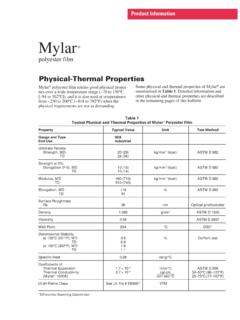
Mylar Physical Properties - DuPont Teijin Films
usa.dupontteijinfilms.comTemperature affects the tensile properties of Mylar®; data on a typical sample are shown in Figure 2. When considering the use of Mylar® at high temperatures, reference should be made to the last five pages of this bulletin. Figure 2. Tensile Properties vs. Temperature Compressive Properties Compression tests provide information about the

HAYNES 230 alloy
www.haynesintl.comCreep and Rupture Properties HAYNES® 230® alloy is a solid-solution-strengthened material which combines excellent high-temperature strength with good fabricability at room temperature. It is particularly effective for very long-term applications at temperatures of 1200°F (650°C) or more, and is