and Incheon Declaration Framework for Action
Incheon Declaration and Framework for Action for the implementation of Sustainable Development Goal 4 Ensure inclusive and equitable quality education and promote lifelong learning opportunities for all Education 2030 Incheon Declaration and Framework for Action 1380_FfA_Cover_8a.indd 1-3 30/08/2016 10:39
Download and Incheon Declaration Framework for Action

Information
Domain:
Source:
Link to this page:
Documents from same domain
One in Five Children, Adolescents and Youth is Out of School
uis.unesco.orgchildren and youth has declined by little more than 1 million per year since 2012. Some 63 million, or 24% of the total, are children of primary school age (about 6 to 11 years old); 61 million, or 23% of the total, are adolescents of lower secondary
Provisional Agenda - UNESCO UIS
uis.unesco.orgProvisional Agenda Day 1 – Sunday, 4 December 2016 Bilateral meetings The meetings will be held with the representatives of each country to review the outcomes of UIS education surveys. Specifically, the objectives of bilateral meetings are to: ... Advanced charts in Excel

Communications and Stakeholder Engagement Guide
uis.unesco.org2 Communications and Stakeholder Engagement Guide . Introduction . The Global Alliance to Monitor Learning (GAML) is an institutional platform to coordinate efforts
Principles of Good Practice in Learning Assessment
uis.unesco.orgThe ACER Centre for Global Education Monitoring Principles of Good Practice in Learning Assessment 3 At the national level, this involves the development of national strategies for large-scale
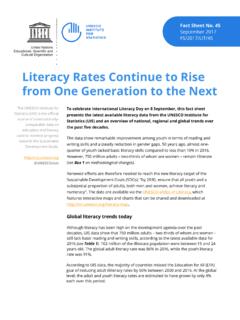
Literacy Rates Continue to Rise from One Generation to the ...
uis.unesco.orgFact Sheet No. 45 September 2017 FS/2017/LIT/45 Literacy Rates Continue to Rise from One Generation to the Next To celebrate International Literacy Day on 8 September, this fact sheet
Information and Communication Technology ICT in Education ...
uis.unesco.orgof ICT in education and how it is integrated across national education systems must be a priority for all countries. 1. Why do we measure ICT in education? The UNESCO Institute for Statistics (UIS) is mandated to administer international data collections on the availability, use and impact of ICT in education. Through the establishment of
INFORMATION AND COMMUNICATION TECHNOLOGY …
uis.unesco.org1. Why do we measure ICT in education? The UNESCO Institute for Statistics (UIS), which is the United Nation’s repository for statistics on education, science and technology, and culture and communication, is mandated to administer international data collections on the availability, use and impact of ICT in education.

Introduction to financing Education - s financial flows
uis.unesco.orgs Typical Sources of Education Financing – multiple actors • Government/Public – often the largest contributor to the education sector and/or most sectors of the economy; • Income generated by schools; • External (grants or loans channelled …
Children Out of School - UNESCO
uis.unesco.orgout of school are counted, but they are also needed to provide a more detailed picture of these children. The global count is important for monitoring progress. Yet at the same time, it is essential to view the child and household as units of analysis in order to reassess or
New Methodology Shows that 258 Million Children ...
uis.unesco.org2008, reaching 8% in 2018, and the lower secondary out-of-school rate has been at 16% since 2012. The upper secondary out-of-school rate, which was initially at much higher levels than the primary and lower secondary out-of-school rates, has …
Related documents

THE SYSTEM DEVELOPMENT LIFE CYCLE (SDLC)
csrc.nist.govThe system development life cycle is the overall process of developing, implementing, and retiring information systems through a multistep process from initiation, analysis, design, implementation, and maintenance to disposal.
OSEP QA 21-06 RETURN TO SCHOOL ROADMAP
sites.ed.govSep 30, 2021 · RETURN TO SCHOOL ROADMAP: DEVELOPMENT AND IMPLEMENTATION OF IEPS 2 . that come with in-person learning. 4 Therefore, reopening schools safely is of utmost importance. State educational agencies (SEAs) and local educational agencies (LEAs)5 should put in place layered prevention strategies, including promoting vaccination and universal and …
UNITED NATIONS
sustainabledevelopment.un.organd Development,3 including, inter alia, the principle of common but dif-ferentiated responsibilities, as set out in principle 7 thereof. 16. We rea"rm our commitment to fully implement the Rio Declaration, Agenda$21,4 the Programme for the Further Implementation of Agenda$21,5 the Plan of Implementation of the World Summit on Sustainable Devel-
Thriving places - england.nhs.uk
www.england.nhs.uk1 | Thriving places: Guidance on the development of place-based partnerships ICS implementation guidance Integrated care systems (ICSs) are partnerships of health and care organisations that come together to plan and deliver joined-up …
DISASTER RISK REDUCTION AND RESILIENCE IN THE 2030 …
www.unisdr.orgprevious development frameworks such the Millennium Development Goals which largely overlooked the importance of reducing the impacts of disasters on society and economy. A key part of the success of the 2030 Agenda for Sustainable Development will, in part, be measured by progress in implementation of disaster risk reduction. The focus on