and Incheon Declaration Framework for Action - UNESCO
profession, youth and the private sector, have gathered in May 2015 at the invitation of the Director-General of UNESCO in Incheon, Republic of Korea, for the World Education Forum 2015 (WEF 2015). We thank the Government and the people of the Republic of Korea for having hosted this important event as well as UNICEF, the World Bank,
Download and Incheon Declaration Framework for Action - UNESCO

Information
Domain:
Source:
Link to this page:
Documents from same domain
One in Five Children, Adolescents and Youth is Out of School
uis.unesco.orgchildren and youth has declined by little more than 1 million per year since 2012. Some 63 million, or 24% of the total, are children of primary school age (about 6 to 11 years old); 61 million, or 23% of the total, are adolescents of lower secondary
Provisional Agenda - UNESCO UIS
uis.unesco.orgProvisional Agenda Day 1 – Sunday, 4 December 2016 Bilateral meetings The meetings will be held with the representatives of each country to review the outcomes of UIS education surveys. Specifically, the objectives of bilateral meetings are to: ... Advanced charts in Excel

Communications and Stakeholder Engagement Guide
uis.unesco.org2 Communications and Stakeholder Engagement Guide . Introduction . The Global Alliance to Monitor Learning (GAML) is an institutional platform to coordinate efforts
Principles of Good Practice in Learning Assessment
uis.unesco.orgThe ACER Centre for Global Education Monitoring Principles of Good Practice in Learning Assessment 3 At the national level, this involves the development of national strategies for large-scale
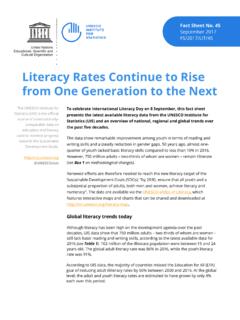
Literacy Rates Continue to Rise from One Generation to the ...
uis.unesco.orgFact Sheet No. 45 September 2017 FS/2017/LIT/45 Literacy Rates Continue to Rise from One Generation to the Next To celebrate International Literacy Day on 8 September, this fact sheet
Information and Communication Technology ICT in Education ...
uis.unesco.orgof ICT in education and how it is integrated across national education systems must be a priority for all countries. 1. Why do we measure ICT in education? The UNESCO Institute for Statistics (UIS) is mandated to administer international data collections on the availability, use and impact of ICT in education. Through the establishment of
INFORMATION AND COMMUNICATION TECHNOLOGY …
uis.unesco.org1. Why do we measure ICT in education? The UNESCO Institute for Statistics (UIS), which is the United Nation’s repository for statistics on education, science and technology, and culture and communication, is mandated to administer international data collections on the availability, use and impact of ICT in education.
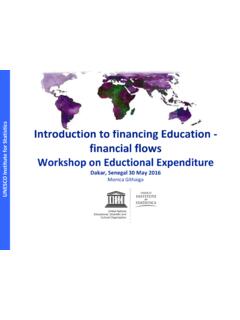
Introduction to financing Education - s financial flows
uis.unesco.orgs Typical Sources of Education Financing – multiple actors • Government/Public – often the largest contributor to the education sector and/or most sectors of the economy; • Income generated by schools; • External (grants or loans channelled …
Children Out of School - UNESCO
uis.unesco.orgout of school are counted, but they are also needed to provide a more detailed picture of these children. The global count is important for monitoring progress. Yet at the same time, it is essential to view the child and household as units of analysis in order to reassess or
New Methodology Shows that 258 Million Children ...
uis.unesco.org2008, reaching 8% in 2018, and the lower secondary out-of-school rate has been at 16% since 2012. The upper secondary out-of-school rate, which was initially at much higher levels than the primary and lower secondary out-of-school rates, has …
Related documents

Public Bodies Handbook – Part 1. Classification Of Public ...
assets.publishing.service.gov.uklandscape and aid public and internal understanding of relationships between public bodies and government ministers. It will also promote efficiency and effectiveness, helping to drive strategic reform of the landscape and the development of best …
How to note - GOV.UK
assets.publishing.service.gov.ukIt should also cover how the unit supports aid effectiveness, including a country-led approach by DFID and its funding partners; alignment with partner country development priorities and facilitating more effective use of all available development finance, including from other donors and the private sector.
Grants Manual - United States Agency for International ...
pdf.usaid.gov• Support for Journey to Self-Reliance (J2SR): The project activities were developed in the context of USAID’s J2SR framework, as well as Indonesia’s J2SR country roadmap for 2019. • More focused private sector engagement: The private sector presents a significant opportunity for leveraging resources and technical assistance.

REPUBLIC OF GHANA COUNTRY STRATEGY PAPER 2012-2016
www.afdb.orgII. COUNTRY CONTEXT AND PROSPECTS 2.1 Political, Economic and Social Context 2.1.1. Political Context. Ghana has continued to consolidate democratic rule, and now enjoys a more open society, with a vibrant media and strong public dialogue. As a result of these and other political achievements, Ghana outperforms most

Removing barriers to telehealth before and after COVID-19
www.brookings.eduRemoving barriers to telehealth before and after COVID-19 4 This crude summary of the U.S. health-care system will obviously raise additional questions, but it is pertinent to the
THE UN GUIDING PRINCIPLES ON BUSINESS AND HUMAN …
www.ohchr.orgthe UN Working Group on Business and Human Rights, which has been established to aid in their implementation. 2 BACKGROUND Preventing and Addressing the Human Rights Impacts of Businesses Business enterprises can profoundly impact the human rights of employees, consumers, and communities wherever they operate. These impacts may be positive, such as

Key features of NGO accountability systems
www.transparency.orgIn particular, their legitimacy in managing aid resources is closely associated to their accountability to their constituency (and the public at large), their adherence to their mission, the transparency of their processes, and their effectiveness in fulfilling their mandate (Chêne 2009).Yet, as “private entities”, NGOs are not submitted