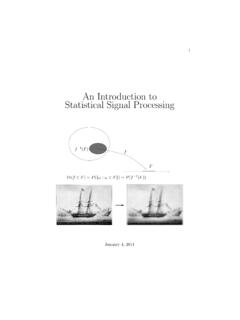
AnIntroductionto StatisticalSignalProcessing
2.3 Probability spaces 22 2.4 Discrete probability spaces 44 2.5 Continuous probability spaces 54 2.6 Independence 68 ... with measurable results. ... measure theory. A primary goal of this approach is thus to use intuitive arguments
Download AnIntroductionto StatisticalSignalProcessing

Information
Domain:
Source:
Link to this page:
Documents from same domain
Probability, Random Processes, and Ergodic Properties
ee.stanford.eduof random processes. These in turn provide the means of proving the ergodic decomposition of certain functionals of random processes and of characterizing how close or di erent the long term behavior of distinct random processes can be expected to be. Of particular interest are

Realism and Morality in Politics - ee.stanford.edu
ee.stanford.eduRealism and Morality in Politics Andrei V. Kortunov ... attendant political relations would wipe out historical modes of interactions, nationalism, cultural differences, and ideologies. Instead, it has become ... Over the Years International Relations Are Becoming More Complex.

Optical Physics of Quantum Wells - Stanford EE
ee.stanford.eduOptical Physics of Quantum Wells David A. B. Miller Rm. 4B-401, AT&T Bell Laboratories Holmdel, NJ07733-3030 ... All of the physics and devices that will be discussed here are based on properties of direct gap semiconductors near the center of the Brillouin zone. For all of the semiconductors of interest ... 3 Linear Optical Properties of ...
Entropy and Information Theory - Stanford EE
ee.stanford.eduinformation theory text include asymptotic mean stationary sources, one-sided sources as well as two-sided sources, nonergodic sources, d -continuous channels, and sliding block or stationary codes .

The Evolution of Cooperation* - Stanford EE
ee.stanford.eduThe Evolution of Cooperation** Robert Axelrod Professor of Political Science and Public Policy, University of Michigan, Ann Arbor. Dr. Axelrod is a member of the American National Academy of Sciences and the American Academy of Arts and Sciences. His honors include a MacArthur Foundation Fellowship for the period 1987 through 1992.

The Physics of Nuclear Weapons
ee.stanford.eduNatural uranium, with only 0.7% U-235, is not useful as either bomb or power plant primary fuel, with an important exception. That is the Magnox reactor, which is a gas-cooled, graphite-moderated reactor. Magnox reactors can run on natural, unenriched uranium and produce bomb-
NOVEMBER New Directions in Cryptography
ee.stanford.edu644 IEEE TRANSACTIONS ON INFORMATION THEORY, VOL. IT-22, NO. 6, NOVEMBER 1976 New Directions in Cryptography Invited Paper WHITFIELD DIFFIE AND MARTIN E. HELLMAN, MEMBER, IEEE Abstract-Two kinds of contemporary developments in cryp-
Related documents

Stochastic Processes - Stanford University
statweb.stanford.eduThis chapter is devoted to the mathematical foundations of probability theory. Section 1.1 introduces the basic measure theory framework, namely, the proba-bility space and the σ-fields of events in it. The next building block are random variables, introduced in Section 1.2 as measurable …
REAL ANALYSIS
www.cmat.edu.uy3 Measurable sets and the Lebesgue measure 16 4 Measurable functions 27 4.1 Deflnition and basic properties 27 4.2 Approximation by simple functions or step functions 30 4.3 Littlewood’s three principles 33 5* The Brunn-Minkowski inequality 34 6 Exercises 37 7 Problems 46 Chapter 2. Integration Theory 49 1 The Lebesgue integral: basic ...
Review of Probability Theory - Stanford University
cs229.stanford.edubasics of probability theory at a level appropriate for CS 229. The mathematical theory of probability is very sophisticated, and delves into a branch of analysis known as measure theory. In these notes, we provide a basic treatment of probability that does not address these finer details. 1 Elements of probability
Probability Theory: STAT310/MATH230 April15,2021
statweb.stanford.eduIn measure theory we sometimes consider signed measures, whereby µis no longer non-negative, hence its range is [−∞,∞], and say that such measure is finite when its range is R(i.e. no set in F is assigned an infinite measure). Definition 1.1.3. A measure space is a triplet (Ω,F,µ), with µa measure on the measurable space (Ω,F).

Chapter 1
www.bauer.uh.edu1 Chapter 1 Probability Theory: Introduction Basic Probability – General ... • We have two measurable spaces (Ω1, Σ1), and (Ω2, Σ2). We want to define a measure on the (product) space Ω12, which reflects the structure of the original measure spaces. Definition: ...

Theory of functions of a real variable.
people.math.harvard.eduThe course itself consists of two parts: 1) measure theory and integration, and 2) Hilbert space theory, especially the spectral theorem and its applications. In Chapter II I do the basics of Hilbert space theory, i.e. what I can do without measure theory or …
LECTURE NOTES IN MEASURE THEORY - Chalmers
www.math.chalmers.se1.2 Measure Determining Classes 1.3 Lebesgue Measure 1.4 CarathØodory™s Theorem 1.5 Existence of Linear Measure 2 Integration 2.1 Integration of Functions with Values in [0;1] 2.2 Integration of Functions with Arbitrary Sign 2.3 Comparison of Riemann and Lebesgue Integrals 3 Further Construction Methods of Measures 3.1 Metric Spaces 3.2 ...
Noncommutative Geometry Alain Connes
alainconnes.org1. Measure theory (Chapters I and V) 8 2. Topology and K-theory (Chapter II) 14 3. Cyclic cohomology (Chapter III) 19 4. The quantized calculus (Chapter IV) 25 5. The metric aspect of noncommutative geometry 34 Chapter 1. Noncommutative Spaces and Measure Theory 39 1. Heisenberg and the Noncommutative Algebra of Physical Quantities 40 2.
Measure Measure - Department of Mathematics
math.unl.edulebesgue measure • page two That is, every subset of R has Lebesgue outer measure which satisfies properties (1)–(3), but satisfies only part of property (4). Examples of disjoint sets A and B for which µ∗(A ∪ B) 6= µ∗(A) + µ∗(B) seem at first a …
Probability Theory - University of Arizona
www.math.arizona.eduProbability Theory December 12, 2006 Contents 1 Probability Measures, Random Variables, and Expectation 3 ... Definition 1.18. Let f : (S,S) → (T,T ) be a function between measure spaces, then f is called measurable if f−1(B) ∈ S for every B ∈ T . (1.6) If (S,S) has a probability measure, then f is called a random variable.