Appendix B: Teacher Self-Assessment Guide
Teachers use these forms—one for each dimension—to self-assess their effectiveness for various indicators on a 1-4 rating scale. After self-assessing their effectiveness using these indicators, teachers will have an opportunity to reflect on their practice, collect evidence, and generate ideas to improve their planning and
Download Appendix B: Teacher Self-Assessment Guide

Information
Domain:
Source:
Link to this page:
Documents from same domain
3 8 Testing Program Questions and Answers
usny.nysed.gov1 3‐8 Testing Program Questions and Answers General Questions about the State Tests 1. Do the tests measure the Common Core Learning Standards? ...
Rubrics for Enhancing - New York State Education …
usny.nysed.govRubrics for Enhancing Professional Practice: a framework for teaching The rubrics in this document are from Enhancing Professional Practice: A …

Framework for Teaching Evaluation Instrument
usny.nysed.govCharlotte Danielson developed the Framework for Teaching Evaluation Instrument in 2011 and ... 2013 Edition includes specific rubric language, ...
Principal Evaluation Rubrics - New York State …
usny.nysed.govPrincipal Evaluation Rubrics by Kim Marshall – Revised August 21, 2011 Rationale and suggestions for implementation 1. These rubrics are organized around six domains covering all aspects of a principal’s job performance:
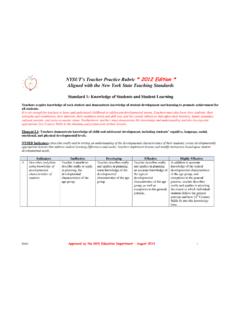
NYSUT’s Teacher Practice Rubric - New York State ...
usny.nysed.govNYSUT’s Teacher Practice Rubric * 2012 Edition * Aligned with the New York State Teaching Standards 90163 Approved by the NYS Education Department –August 2012 2
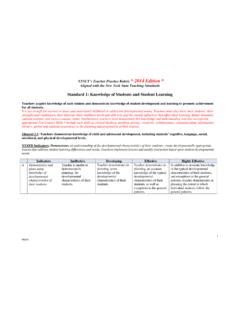
NYSUT’s Teacher Practice Rubric * 2014 Edition
usny.nysed.govNYSUT’s Teacher Practice Rubric * 2014 Edition * Aligned with the New York State Teaching Standards 3 96604 Element I.3: Teachers demonstrate knowledge of and are responsive to diverse learning needs, strengths, interests, and experiences of all

College & Career Readiness
usny.nysed.govEngageNY.org College & Career Readiness Dr. John B. King, Jr. President of the University of the State of New York and . Commissioner of Education
The for teachers of - New York State Education …
usny.nysed.govTuesday, April 19, 2012 at 2:49 PM 1 Memorandum of Understanding Between The Buffalo City School District (“District”) And

BLUEPRINT FOR ENGLISH LANGUAGE LEARNERS (ELLS) …
usny.nysed.govTHE STATE EDUCATION DEPARTMENT / THE UNIVERSITY OF THE STATE OF NEW YORK Office of Bilingual Education and Foreign Language Studies 1 | P a g e 0 4 / 16/ 2 0 1 4 BLUEPRINT FOR ENGLISH LANGUAGE LEARNERS (ELLS) SUCCESS
Bringing the Common Core to Life David Coleman · Founder ...
usny.nysed.gov“Letter from a Birmingham Jail” by Dr. Martin Luther King, Jr. David Coleman . Hopefully, some of you who prepared for this conversation today took a look at King's Letter from a Birmingham Jail and I’d like to tell you what I'm going to try to do with you over approximately the next 20
Related documents

How to Assess Student Performance in History - ed
files.eric.ed.gov2. Formative purpose for teacher: To assess student knowledge or performance on some key topic or dimension to inform instructional plans. 3. Summative purpose: To judge or evaluate student performance (i.e., give a grade). In addition, research is …

Assessment Benefits and Barriers - ed
files.eric.ed.govassessment of student learning. To learn more about the “real” issues pertain-ing to student assessment in physical education, the authors asked a group of teachers to identify the barriers to, and benefi ts of, using assessments. The purpose of this article is to discuss these teachers’ perceptions regarding assessment
2021–22 Interim Assessments Overview - SmarterBalanced
portal.smarterbalanced.orgmore experience using criteria-based rubrics to score a variety of student writing. Creating materials to share with students to illustrate strong examples of student writing as well as how less successful work could be revised to improve the quality. Sharing with parents who wish to see examples of

How to Assess Student Performance in Science
serve.uncg.edustudent progress toward desired ends. Purpose of This Manual T his publication is designed to help you do the following: 1. Consider the variety of possible student outcomes in science, andselect those that are most important for students. 2. Reflect on and choose appropriate ways to assess student performance on important outcomes. There are three

CREATIVITY AND INNOVATION RUBRIC
www.cfsd16.orgWhen using the rubrics to plan for instruction and assessment, teachers need to consider the knowledge and skills described i n the Score 2.0 column (Basic) to be embedded in the Score 3.0 (Proficient) and 4.0 (Advanced) performance. The Novice level (Score 1.0) indicates that the student does not yet
Massachusetts Model System for Educator Evaluation
www.doe.mass.eduand administering authentic and meaningful student assessments, analyzing student performance and growth data, using this data to improve instruction, providing students with constructive feedback on an ongoing basis, and continuously refining learning objectives. Indicator I-A. Curriculum & Planning

Using Student Achievement Data to Support Instructional ...
www.naesp.orghow to improve student learning. Interpreting data allows teachers to identify the strengths and weaknesses of an entire class as well as individual students. As they examine the data, teachers can develop hypotheses about factors that affect students’ learning and ways to improve instruction to help all students achieve. It is important for
Why Are Rubrics so Important
www.paulding.k12.ga.usRubrics What is a rubric? A rubric is a “guide” that states what is expected in an assignment or project, and helps to evaluate (or grade) a student's performance. A rubric is an assessment tool used to measure students' work. A rubric is a working guide for students and teachers, usually handed out before the assignment begins in order to get students to think about what is …