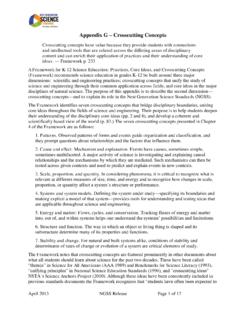
Appendix G Crosscutting Concepts
Energy and matter: Flows, cycles, and conservation. Tracking fluxes of energy and matter into, out of, and within systems helps one understand the systems’ possibilities and limitations. 6. Structure and function. The way in which an object or living thing is shaped and its substructure determine many of its properties and functions. 7.
Download Appendix G Crosscutting Concepts

Information
Domain:
Source:
Link to this page:
Documents from same domain
Appendix G Crosscutting Concepts - …
www.nextgenscience.orgApril 2013 NGSS Release Page 1 of 17 Appendix G – Crosscutting Concepts Crosscutting concepts have value because they provide students with connections
High School Earth and Space Sciences - …
www.nextgenscience.orgHigh School Earth and Space Sciences . Students in high school continue to develop their understanding of the three disciplinary core ideas in the Earth and Space Sciences.

Preparing Students for a Lifetime of Success
www.nextgenscience.orgachievement in grades K–2. A quality science education can help expand opportunities for all students. The science standards complement English/ Language Arts and mathematics standards, ... Next Generation Science Standards Grade K-2 …
APPENDIX F Science and Engineering Practices in …
www.nextgenscience.orgApril 2013 NGSS Release Page 1 of 33 APPENDIX F – Science and Engineering Practices in the NGSS A Science Framework for K-12 Science Education provides the blueprint for developing the Next
Key Definitions - nextgenscience.org
www.nextgenscience.orgApril 2013 NGSS Release Page 1 of 7 APPENDIX I – Engineering Design in the NGSS The Next Generation Science Standards (NGSS) represent a commitment to integrate ...
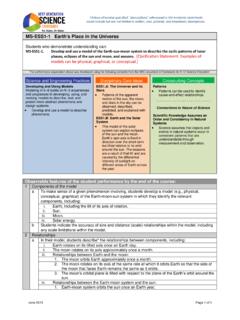
MS-ESS1-1 Earth's Place in the Universe
www.nextgenscience.orgaround the sun, for a majority of time during an Earth month, the moon is not in a position to block solar energy from reaching Earth, and Earth is not in a position to block solar energy from reaching the moon.
Science Professional Learning Standards - nextgenscience.org
www.nextgenscience.orgScience Professional Learning Standards: A Project of the Council of State Science Supervisors Brett Moulding (UT) Bill Penuel (CO) Our Effort •A project of the Council of State Science Supervisors to update the NSES Standards for Professional Learning –Representatives from three states and the
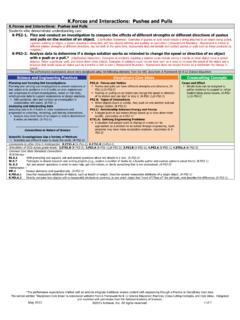
K.Forces and Interactions: Pushes and Pulls
www.nextgenscience.orgK.Forces and Interactions: Pushes and Pulls *The performance expectations marked with an asterisk integrate traditional science content with engineering through a Practice or Disciplinary Core Idea.
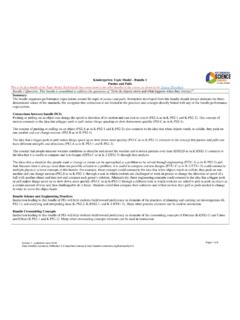
Kindergarten Topic Model - Bundle 1 Pushes and Pulls This ...
www.nextgenscience.orgKindergarten Topic Model - Bundle 1 Pushes and Pulls . This is the first bundle of the Topic Model. Each bundle has connections to the other bundles in the course, as shown in the
APPENDIX F Science and Engineering Practices in the NGSS
www.nextgenscience.orgApril 2013 NGSS Release Page 1 of 33 APPENDIX F – Science and Engineering Practices in the NGSS A Science Framework for K-12 Science Education provides the blueprint for developing the Next Generation Science Standards (NGSS). The Framework expresses a vision in science education that requires students to operate at the nexus of three dimensions of learning: Science and Engineering
Related documents

Introduction to the Electromagnetic Spectrum
fusioned.gat.comCurriculum Overview: Introduction to the Electromagnetic Spectrum ... Introduction–Visible Light 1 Instructor’s Guide to Lab No. 1: The Visible Electromagnetic Spectrum Goal ... electron energy levels and characteristic properties of elements. In physics it is a part of the
Glencoe Physical Science
glencoe.comGlencoe Physical Science vii Organize each wave characteristic in the Venn diagram to show whether it is a trait of tides, waves created by wind, or both. Model spring and neap tides in the boxes below. •Use the figure in your book to help you.

GUIDE - Dear Evan Hansen
dearevanhansen.comcurriculum. So as not to leave out the adults, we’ve also included a page for parents and teachers with links to articles that relate to many of the topics and themes covered in your show. So, get ready, Evan. The students are coming with their exuberance and energy, and they eagerly await your story. It’s time to step into the sun ...

JOHN C. MAXWELL - Salt & Light
www.iequip.churchUse this workbook as a guide, not a straightjacket. If the group responds to the lesson in an unexpected but honest way, go with that. If you think of a better question than the next one in the lesson, ask it. Take to heart the insights included in the Frequently Asked Questions pages and the Small Group Leaders section. 4.

Questions to provoke thinking and discussion - STEM
www.stem.org.ukWhat is the difference between forms of energy, for example, potential and ki netic, and sources of energy, for example, tidal and solar? When a fast-moving car brakes, where does the energy go? Is it better to describe energy as being consumed or just transferred? Some of the energy we produce is wasted, for example, heat from a light bulb .