
Applied Behavior Analysis Allowable Services and Coding Guide
Applied Behavior Analysis Allowable Services and Coding Guide: CODE and Rendering Staff Credential Service Description – All servi ces ar f-to nd 1:1 unless otherwise noted. Unit of Service Maximum Units Fee THE FOLLOWING CODES MAY BE USED IN COMBINATION OF UP TO A MAXIMUM OF 40 HOURS PER WEEK AND/OR 8 HOURS WITHIN A 24 HOUR PERIOD OF …
Download Applied Behavior Analysis Allowable Services and Coding Guide

Information
Domain:
Source:
Link to this page:
Documents from same domain
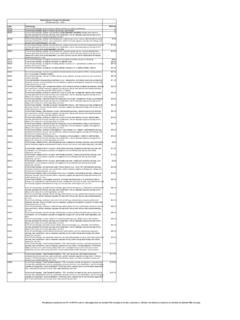
Final Home Infusion Therapy Fee Schedule 010306
chip.wv.govservices, professional pharmacy services, care coordination, and all necessary supplies and equipment ... Home Infusion Therapy Fee Schedule Effective January 1, 2006 The absence or presence of a CPT or HCPCS code on these pages does not indicate PEIA coverage of the item or procedure. Similarly, the absence or presence of a fee does not ...

Privacy Notice - WV CHIP
chip.wv.govprivacy notice effective date: april 14, 2003 1 this notice describes how medical information about you may be used and disclosed and how you can get access to this information.
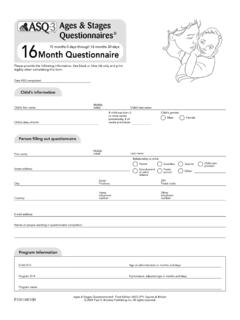
Ages & Stages Questionnaires 16 Month Questionnaire
chip.wv.govAt this age, many toddlers may not be cooperative when asked to do things. You may need to try the following activities with your child more than one time.

Ages & Stages Questionnaires 2 Month Questionnaire
chip.wv.govPERSONAL-SOCIAL 1. Does your baby sometimes try to suck, even when she’s not feeding? 2. Does your baby cry when he is hungry, wet, tired, or wants to be held?
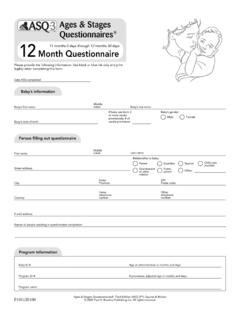
Ages & Stages Questionnaires 12 Month Questionnaire - …
chip.wv.govPROBLEM SOLVING 1. When holding a small toy in each hand, does your baby clap the toys together (like “Pat-a-cake”)? 2. Does your baby poke at or try to get a crumb or Cheerio that is inside a

Ages & Stages Questionnaires 9 Month Questionnaire
chip.wv.govPROBLEM SOLVING 1. Does your baby pass a toy back and forth from one hand to the other? 2. Does your baby pick up two small toys, one in each hand, and hold onto them for about 1 minute?
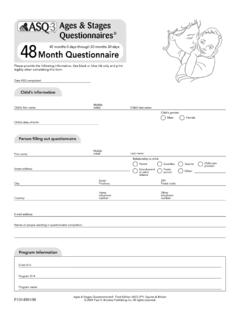
Ages & Stages Questionnaires 48 Month Questionnaire - …
chip.wv.govCOMMUNICATION (continued) 5. Without your giving help by pointing or repeating, does your child fol-low three directions that are unrelatedto one another? Give all three
Ages & Stages Questionnaires 9 Month Questionnaire
chip.wv.govPROBLEM SOLVING 1. Does your baby pass a toy back and forth from one hand to the other? 2. Does your baby pick up two small toys, one in each hand, and hold onto them for about 1 minute?
Ages & Stages Questionnaires 48 Month Questionnaire
chip.wv.gov48 Month Questionnaire page 5 of 7 E101480500 YES SOMETIMES NOT YET PROBLEM SOLVING TOTAL YES SOMETIMES NOT YET PERSONAL-SOCIAL TOTAL OVERALL Parents and providers may use the space below for additional comments. 1. Do you think your child hears well? If no, explain: YES NO

Ages & Stages Questionnaires 36 Month Questionnaire
chip.wv.govDate ASQ completed: Relationship to child: Parent Street address: Names of people assisting in questionnaire completion: Grandparent or other relative Guardian Foster parent Teacher Child care provider Other: Ages & Stages Questionnaires® Month Questionnaire 34 months 16 days through 38 months 30 days Please provide the following information.
Related documents

Glance at a - National Cancer Institute
cancercontrol.cancer.govBehavior and Health Education: Theory, Research, and Practice, 1 published by Jossey-Bass in San Francisco. Readers who want to learn more about useful theories for health behavior change and health education practice can consult this and other sources that are recommended in the References section at the end of the monograph.
Motivational Interviewing Strategies to Facilitate ...
pubs.niaaa.nih.govpected component of behavior change. The 4 principles of MI are to: (1) ex-press empathy, (2) develop discrepancy, (3) roll with resistance, and (4) support self-efficacy in each patient encounter. • Facilitate behavior change by express-• • ing empathy and accepting patient beliefs and behaviors. This is more effective than applying pressure
Motivational Interviewing (MI) Rolling with Resistance ...
health.mo.govchange. Righting reflex o As health care professionals, we use our corrective lens. o We want to change client behavior and we want to make things right, so we argue or push back with the client. o Since we are arguing for the change side of ambivalence, this usually causes the client to keep voicing sustain talk (the reasons not to change).

Behavior Change Theories and Techniques - Extension
fyi.extension.wisc.eduBehavior change theory suggests that there are three significant factors to consider when investigating the likelihood that a person will perform a behavior (intention to perform): 1. A person’s beliefs about a behavior (attitudes) 2. A person’s belief about what others believe about
Health Promotion by Social Cognitive Means
www.uky.eduone’s health behavior are taken into account, neither intentions nor perceived behavioral control add any incremental predictiveness. Most of the models of health behavior are concerned only with predicting health hab-its.Butthey do not tellyou how to change health behavior. Socialcognitive theory offers

Applied Behavior Analysis (ABA) - Nevada
www.medicaid.nv.govBehavior identification supporting assessment, each 15 minutes of technicians' time face-to-face with a patient, requiring the following components: • administered by the physician or other qualified health care professional who is on site • with the assistance of two or more technicians • for a patient who exhibits destructive behavior

THE ROLE OF MOTIVATION IN BEHAVIOR CHANGE How Do
wellcoach.comBEHAVIOR CHANGE How Do We Encourage Our Clients To Be Active? by Wendy M. Rodgers, Ph.D., and Christina C. Loitz, M.S. LEARNING OBJECTIVES • Understand the basics of self-determination theory. • Develop some ideas of how to create exercise contexts more likely to support self-determined motivation. Key words: