
Appropriate Maximum Phlebotomy Volumes
Appropriate Maximum Phlebotomy Volumes Purpose: To provide a guideline for performing safe phlebotomy procedures on our neonate, infant and pediatric population. Scope: All personnel drawing blood specimens, i.e., by direct phlebotomy or venous/arterial lines. Procedure: The following chart outlines the guidelines for blood drawing that is practiced at
Download Appropriate Maximum Phlebotomy Volumes

Information
Domain:
Source:
Link to this page:
Documents from same domain

Neuromuscular electrical stimulation - Children's …
www.childrensmn.orgNeuromuscular electrical stimulation (NMES) is a treatment using electricity to stimulate muscles and nerves. It helps improve flexibility, strength, and movement. Our bodies normally use electrical stimulation: the muscles in our body are turned on and off by small electrical impulses in our nervous system. For example, when we pick up a glass of water, our brain sends an electrical …

Kronos Workforce Central™ v8.0 Upgrade
www.childrensmn.orgKronos 8 UpgradeGuide for Timecard Approvers. 2. Getting Started . Logging On . The Workforce Central log on page provides access to all the features of the Workforce Central

2016 Changes to AHA training courses for BLS, PALS, and ACLS
www.childrensmn.org2016 Changes to AHA training courses for BLS, PALS, and ACLS . Highlights for 2016 • We are moving to PALS HeartCode and ACLS HeartCode • BLS and ACLS now use Voice Assisted Manikins (VAMs) for completion of hands on skills validation

Positive Discipline: A Guide for Parents
www.childrensmn.orglearn self-control, what is expected, and how to ... There are many other resources in your community and neighborhood to help you with positive discipline—your child’s doctor and teacher, the public health nurse, the Cooperative Extension office, and the early childhood and family educator through the public school to name a few.
Transfusion Blood Administration - Children's Minnesota
www.childrensmn.orgTransfusion Service personnel will notify patient unit personnel by telephone when ordered blood is ready for transfusion. The risks of transfusion, including adverse symptoms and alternatives to homologous (allogeneic) transfusion, must be discussed with the patient well before transfusion. This discussion should be

Hepatitis C (HCV) RNA Quantitative PCR
www.childrensmn.orgLimitations: The quantification range of this assay is 15 to 100,000,000 IU/mL (1.18 log to 8.00 log IU/mL) Except for immunocompromised patients or patients with suspected acute hepatitis, laboratory evaluation of hepatitis C (HCV) infection status should

Nasogastric/Orogastric Tube Insertion, Verification, and ...
www.childrensmn.orgpharynx, flex the child's head forward and, if the child is cooperative, ask the child to swallow. Advance the tube as the child swallows. Infants may be offered a pacifier. ii. For oral placement: Position the end of the tube downward and insert the tube into the oral cavity over the tongue. Aim the tube back and down toward the pharynx.

Sign language - Children's Minnesota
www.childrensmn.org• routine games and finger plays (“Itsy bitsy spider,” “Peek -a-boo,” “Pat-a- cake”) Several simple signs are pictured on the next pages. Choose only a few signs to start with, ones that are important for your child. For example, if your child loves balls, start with the sign for “ball.” Generally, signs for “more” and

Breast Milk: Fortified (using 20 cal/oz Standard Formula)
www.childrensmn.orgpowder may clump if the breast milk is cold. 3. Check the recipe chart on page 2. Using a clear liquid measuring cup, measure the desired amount of breast milk. Set the measuring cup on a flat surface, and check the level of the liquid at eye level. 4. Use standard measuring spoons or the

Capillary Blood Gas (CBG) - Children's Minnesota
www.childrensmn.orgTest Indications: Capillary blood gas determinations are useful in monitoring neonates or other patients when arterial collection is not practical. Arteriolization of the capillary bed yields pH and pCO2 comparabe to arterial blood. Useful for evaluating …
Related documents
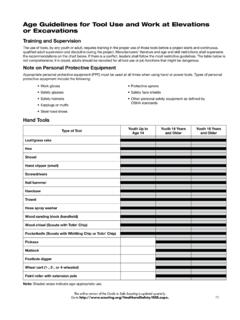
SAFE Project Tool Use
filestore.scouting.orgAGE APPROPRIATE GUIDELINES— PROJECT TOOL USE Lions / Tigers with Adult Partner Wolf / Bear Webelos Scouts BSA Older Scouts BSA* Sea Scouts Venturers Yard Tools Rakes, hoes, shovels, small clippers, handheld (gardening) shovels, trowels √ √ √ √ Pickaxes, mattocks, post-hole diggers, carts, dollies, wheelbarrows √ √
Age Appropriate Sexual Behaviours in Children and Young …
ncsby.orgAge Appropriate Sexual Behaviour in Children and Young People: 2nd Edition Page 5 of 42 Definitions The following definitions are used in this book: Children and young people generally Those aged 0 - 18 years Age of criminal responsibility 10 years and over (in Victoria) Age of consent to sexual activity 12 years and over (in Victoria) Carers Foster carers

Adult Preventive Health Care Schedule: Recommendations ...
www.aafp.org10-year CVD risk of 10% or greater, appropriate bleeding risk, and life expectancy of at least 10 years (C) Recommend individualized decision-making for patients 60 to 69 years

Age Appropriate Chores for Kids! - Free Printable Behavior ...
www.freeprintablebehaviorcharts.comAge Appropriate Chores for Kids! 4-7 year olds • set the table or help set the table • put away toys/things • help feed pets • water plants • help make bed • dust • put laundry in hamper • help put dishes in dishwasher • water the garden • help wipe up messes • help with yard work (rake with child's rake or
Developmentally Appropriate Practice in Early Childhood ...
www.naeyc.orgDevelopmentally Appropriate Practice in Early Childhood Programs Serving Children from Birth through Age 8 Note: Throughout this statement, the terms teacher, practitioner, and educator are variously used to refer to those working in the early childhood field. The word teacher is …

Obtaining Informed Consent for Children and Adolescents
www.tn.govthe age of consent to mental health treatment and/or services as 16 years of age. A “minor child” is defined at TCA §33-1-101 as a person under 18 years of age, but TCA §33-8-202 that states if a child with serious emotional disturbance or mental illness is 16 years of …