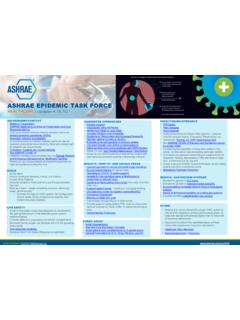
ASHRAE EPIDEMIC TASK FORCE
Apr 18, 2021 · Below are some general parameters for air changes per hour (ACH), temperature, filtration, and relative humidity for non-COVID emergency surge spaces outside of a licensed hospital. • Minimum 2ACH Outdoor air and 2 ACH Total air, though higher total air is desired (basis is patient room from FGI 1997).
Download ASHRAE EPIDEMIC TASK FORCE

Information
Domain:
Source:
Link to this page:
Documents from same domain
History in the Air Conditioning and Refrigeration …
www.ashrae.org1. Introduction. Only two classes of compressors were offered at the end of the 1950s in the . United States for large air conditioning and refrigeration applications: the posi-
Endothermic & Exothermic Reactions - ASHRAE
www.ashrae.orgexothermic reactions release heat to their surroundings (e.g. burning wood in a fireplace). This kit will demonstrate how exothermic chemical reactions can produce heat or endothermic chemical reactions can make things cold.
Risk Management For Legionellosis - ashrae.org
www.ashrae.orgstandard for legionellosis risk management of building water systems was produced. The document is written in code language, so that it can be adopted as desired by government bodies (see “NYC Responds to Outbreak” sidebar). ASHRAE standards are otherwise voluntary.
TOOL FOR ENERGY EFFICIENT BUILDING ENVELOPE ... - …
www.ashrae.orgTOOL FOR ENERGY EFFICIENT BUILDING ENVELOPE RETROFITTING Bandana Jha1 and Dr.Bishwajit Bhattacharjee2. 1. Architect and Research Scholar, Department of Civil Engineering, IIT, Delhi, India . 2. ... Walls are a prominent faction of a building envelope and are expected to provide thermal and acoustic comfort within a building, without ...
Classification of Laboratory Design Levels - ashrae.org
www.ashrae.orgASHRAE Technical Committee 9.10, Laboratory Systems Laboratory Classification Subcommittee In partnership with American Chemical Society ... This guide does not provide the means to assess the risk associated with air-borne chemical hazards, the risk of exposure to other laboratory hazards, or the
Standard Method of Test for the Evaluation of Building ...
www.ashrae.orgSociety of Heating, Refrigerating and Ai r-Conditioning Engineers (ASHRAE). Consensus is defined by the American National Standa rds Institute (ANSI), of which ASHRAE is a member and which has a pproved this standard as an ANS, as “substantial agreement reached
Addendum a to ANSI/ASHRAE/ACCA Standard 180-2008
www.ashrae.orgthe Air Conditioning Contractors of America on November 18, 2011; and by the American National Standards Institute on Janu- ary 26, 2012. This addendum was approved by a Standing Standard Project Committee (SSPC) for which the Standards Committee has estab-
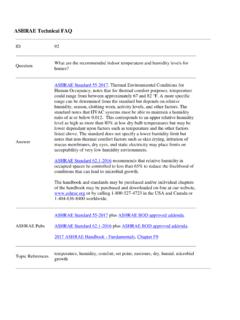
ASHRAE Technical FAQ
www.ashrae.orgASHRAE Technical FAQ ID 92 Question What are the recommended indoor temperature and humidity levels for homes? Answer ASHRAE Standard 55-2017, Thermal Environmental Conditions for
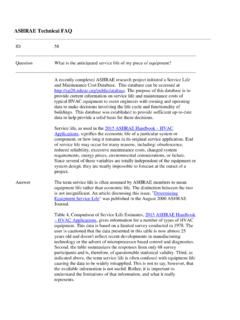
ASHRAE Technical FAQ
www.ashrae.orgASHRAE Technical FAQ ID 58 Question What is the anticipated service life of my piece of equipment? Answer A recently completed ASHRAE research project initiated a Service Life
Ammonia as a Refrigerant - ashrae.org
www.ashrae.orgThe ASHRAE Position Document on “Ammonia as a Refrigerant” was developed by the Society’s Refrigeration Committee. Position Document Committee formed on January 8, …
Related documents
Laboratory Ventilation ACH Rates Standards and Guidelines
www.aircuity.comJan 03, 2012 · “‘Air changes per hour’ or ‘air changes per minute’ is a poor basis for ventilation criteria where environmental control of hazards, heat, and/or odors is required. The required ventilation depends on the problem, not on the size of the room in which it occurs.” 5. ASHRAE 62.1 Standard on Ventilation for Acceptable Indoor Air Quality
Ventilation for Acceptable Indoor Air Quality - ASHRAE
www.ashrae.orgchanges were issued for a third public review, including a revised definition of “zone,” simplified approaches for deter-mining outdoor air intake rates for single-zone and 100% out-door air systems, revision of the tables of default values of zone and …

Guide to measuring ventilation rates in schools
schools.forhealth.orgAug 28, 2020 · multiplied by the fraction of outdoor air allowed in by the damper (e.g. multiply by 0.2 if the damper position is 20%). Step 3, Option B. Determine Outdoor Air Ventilation Rate (Central Systems) ACH = Total measured air flow (ft 3 per minute) * 60 (minutes per hour) * fraction outdoor air (based on damper position) classroom volume (ft3) 14
Calculating Combustion Air For Fuel-Burning Appliances
www.rses.orgach, or air changes per hour. There must be a constant turnover of infiltration air for the fuel burning appli-ance to utilize at all times. To confirm if the indoor method of supplying indoor combustion air is a viable option, a blower door test must be performed where
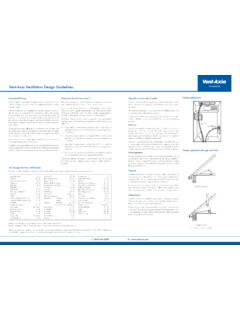
Vent-Axia Ventilation Design Guidelines
www.vent-axia.comThis volume is then multiplied by the required number of air changes per hour (ACH) given in the table to give the total air movement required per hour. Select the number of fans necessary to achieve the desired volume. The Building Regulations (Document F) require the following intermittent ventilation rates in new dwellings.
Building America Top Innovations 2014 Profile: ASHRAE ...
www.energy.govair changes per hour at 50 Pascals pressure (ACH 50) while the 2012 IECC requires homes to meet an airtightness limit of 3 ACH 50 or less in most climates (CZ3 and higher) and the Passive House program sets the limit at 0.6 ACH 50.
Covid-19 Guide on Ventilation and CO2 monitoring
www.unitetheunion.orgAssuring a minimum ventilation rate of 4 to 6 air changes per hour (ACH) and maintaining carbon dioxide levels below 700 to 800 ppm is advised, although the ventilation type and airflow direction and pattern should also be taken into account.