
ASHRAE Technical FAQ
62.1-2016, "Ventilation for Acceptable Indoor Air Quality", plus ASHRAE BOD approved addenda. This standard specifies outside air ventilation rates and maximum levels of indoor contaminants and other chemicals for acceptable indoor air quality. Copies of the standard, the latest addenda, and other publications may be
Download ASHRAE Technical FAQ

Information
Domain:
Source:
Link to this page:
Documents from same domain
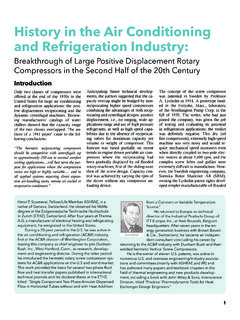
History in the Air Conditioning and Refrigeration …
www.ashrae.org1. Introduction. Only two classes of compressors were offered at the end of the 1950s in the . United States for large air conditioning and refrigeration applications: the posi-
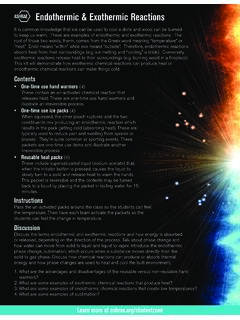
Endothermic & Exothermic Reactions - ASHRAE
www.ashrae.orgexothermic reactions release heat to their surroundings (e.g. burning wood in a fireplace). This kit will demonstrate how exothermic chemical reactions can produce heat or endothermic chemical reactions can make things cold.
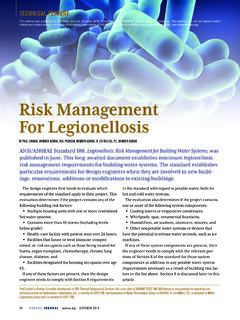
Risk Management For Legionellosis - ashrae.org
www.ashrae.orgstandard for legionellosis risk management of building water systems was produced. The document is written in code language, so that it can be adopted as desired by government bodies (see “NYC Responds to Outbreak” sidebar). ASHRAE standards are otherwise voluntary.
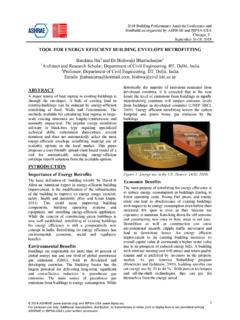
TOOL FOR ENERGY EFFICIENT BUILDING ENVELOPE ... - …
www.ashrae.orgTOOL FOR ENERGY EFFICIENT BUILDING ENVELOPE RETROFITTING Bandana Jha1 and Dr.Bishwajit Bhattacharjee2. 1. Architect and Research Scholar, Department of Civil Engineering, IIT, Delhi, India . 2. ... Walls are a prominent faction of a building envelope and are expected to provide thermal and acoustic comfort within a building, without ...
Classification of Laboratory Design Levels - ashrae.org
www.ashrae.orgASHRAE Technical Committee 9.10, Laboratory Systems Laboratory Classification Subcommittee In partnership with American Chemical Society ... This guide does not provide the means to assess the risk associated with air-borne chemical hazards, the risk of exposure to other laboratory hazards, or the
Standard Method of Test for the Evaluation of Building ...
www.ashrae.orgSociety of Heating, Refrigerating and Ai r-Conditioning Engineers (ASHRAE). Consensus is defined by the American National Standa rds Institute (ANSI), of which ASHRAE is a member and which has a pproved this standard as an ANS, as “substantial agreement reached
Addendum a to ANSI/ASHRAE/ACCA Standard 180-2008
www.ashrae.orgthe Air Conditioning Contractors of America on November 18, 2011; and by the American National Standards Institute on Janu- ary 26, 2012. This addendum was approved by a Standing Standard Project Committee (SSPC) for which the Standards Committee has estab-
ASHRAE Technical FAQ
www.ashrae.orgASHRAE Technical FAQ ID 92 Question What are the recommended indoor temperature and humidity levels for homes? Answer ASHRAE Standard 55-2017, Thermal Environmental Conditions for
ASHRAE Technical FAQ
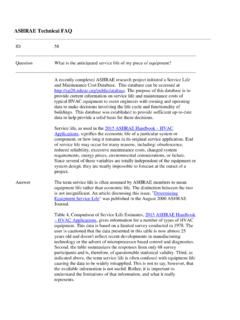
www.ashrae.orgASHRAE Technical FAQ ID 58 Question What is the anticipated service life of my piece of equipment? Answer A recently completed ASHRAE research project initiated a Service Life
Ammonia as a Refrigerant - ashrae.org
www.ashrae.orgThe ASHRAE Position Document on “Ammonia as a Refrigerant” was developed by the Society’s Refrigeration Committee. Position Document Committee formed on January 8, …
Related documents
Guidelines on ventilation, thermal comfort and indoor air ...
consult.education.gov.uk3.1 Indoor and outdoor air quality guidelines and UK air quality standards 34 3.2 Indoor air pollutants 37 3.3 Sources of indoor pollutants 40 3.4 Minimising sources 41 3.4.1 Indoor source control 41 3.5 Outdoor air pollutants and sources 44 3.5.1 Minimising ingress of polluted outdoor air into buildings 44 3.5.2 Filtration 46 3.5.4 Location of ...
Indoor Environmental Quality Standard Second version: 2018 ...
ishrae.in4 45 Introduction 46 Indoor Environmental Quality (IEQ) refers to the environmental conditions inside regularly occupied space 47 that is determined by many factors, including indoor air quality (IAQ), thermal comfort, visual comfort, 48 acoustic comfort as well as ergonomics. IEQ has an impact on health, comfort, and safety, which in turn 49 affects productivity of occupants.
Ventilation for Acceptable Indoor Air Quality
www.ashrae.orgto all aspects of indoor air quality, the committee believes that additivity is the predominant effect when considering multiple contaminant sources that impact occupant perception with respect to odor and irritation. While important questions remain regarding additivity, the majority of research data sup-port its use in this context.

Ventilation and Air Quality for Reducing Transmission of ...
www.doh.wa.govventilating, and air-conditioning systems is not a recommended measure to reduce the transmission of the virus.” (Source: ASHRAE) The main goal in reducing airborne transmission of viruses is to decrease the number of viral particles that accumulate in indoor air, by increasing the intake of outdoor air as much as