
ASHRAE Technical FAQ
concentrations in outdoor air typically range from 300 to 500 ppm. Thus indoor CO 2 concentrations of 1000 to 1200 ppm in spaces housing sedentary people is an indicator that a substantial majority of visitors entering the space will be satisfied with respect to human bioeffluents (body odor). Note however that CO 2 concentration is
Download ASHRAE Technical FAQ

Information
Domain:
Source:
Link to this page:
Documents from same domain
History in the Air Conditioning and Refrigeration …
www.ashrae.org1. Introduction. Only two classes of compressors were offered at the end of the 1950s in the . United States for large air conditioning and refrigeration applications: the posi-

Endothermic & Exothermic Reactions - ASHRAE
www.ashrae.orgexothermic reactions release heat to their surroundings (e.g. burning wood in a fireplace). This kit will demonstrate how exothermic chemical reactions can produce heat or endothermic chemical reactions can make things cold.

Risk Management For Legionellosis - ashrae.org
www.ashrae.orgstandard for legionellosis risk management of building water systems was produced. The document is written in code language, so that it can be adopted as desired by government bodies (see “NYC Responds to Outbreak” sidebar). ASHRAE standards are otherwise voluntary.
TOOL FOR ENERGY EFFICIENT BUILDING ENVELOPE ... - …
www.ashrae.orgTOOL FOR ENERGY EFFICIENT BUILDING ENVELOPE RETROFITTING Bandana Jha1 and Dr.Bishwajit Bhattacharjee2. 1. Architect and Research Scholar, Department of Civil Engineering, IIT, Delhi, India . 2. ... Walls are a prominent faction of a building envelope and are expected to provide thermal and acoustic comfort within a building, without ...
Classification of Laboratory Design Levels - ashrae.org
www.ashrae.orgASHRAE Technical Committee 9.10, Laboratory Systems Laboratory Classification Subcommittee In partnership with American Chemical Society ... This guide does not provide the means to assess the risk associated with air-borne chemical hazards, the risk of exposure to other laboratory hazards, or the

Standard Method of Test for the Evaluation of Building ...
www.ashrae.orgSociety of Heating, Refrigerating and Ai r-Conditioning Engineers (ASHRAE). Consensus is defined by the American National Standa rds Institute (ANSI), of which ASHRAE is a member and which has a pproved this standard as an ANS, as “substantial agreement reached
Addendum a to ANSI/ASHRAE/ACCA Standard 180-2008
www.ashrae.orgthe Air Conditioning Contractors of America on November 18, 2011; and by the American National Standards Institute on Janu- ary 26, 2012. This addendum was approved by a Standing Standard Project Committee (SSPC) for which the Standards Committee has estab-
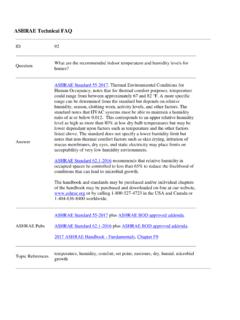
ASHRAE Technical FAQ
www.ashrae.orgASHRAE Technical FAQ ID 92 Question What are the recommended indoor temperature and humidity levels for homes? Answer ASHRAE Standard 55-2017, Thermal Environmental Conditions for
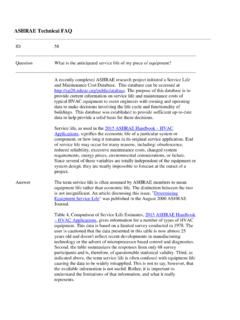
ASHRAE Technical FAQ
www.ashrae.orgASHRAE Technical FAQ ID 58 Question What is the anticipated service life of my piece of equipment? Answer A recently completed ASHRAE research project initiated a Service Life
Ammonia as a Refrigerant - ashrae.org
www.ashrae.orgThe ASHRAE Position Document on “Ammonia as a Refrigerant” was developed by the Society’s Refrigeration Committee. Position Document Committee formed on January 8, …
Related documents
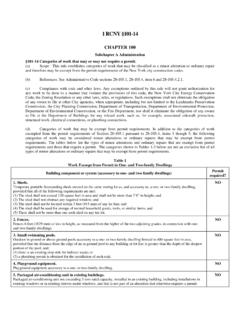
1 RCNY §101-15
www.nyc.govOutdoor in-ground or above-ground pools accessory to a one- or two-family dwelling limited to 400 square feet in area, provided that the distance from the edge of an in-ground pool to any building or lot line is greater than the depth of the deepest portion of the pool, and: (1) there is an existing slop sink for indirect waste; or
Applying ASHRAE Standard 62.1: Ventilation for Acceptable ...
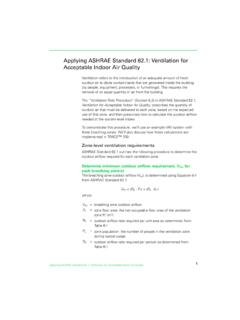
software.trane.comThe primary outdoor air fraction is the amount of outdoor air that must be supplied to each breathing zone as a percentage of the minimum expected primary airflow (outdoor air and recirculated air), at design conditions, delivered to the breathing zone. It is calculated using Equation 6-5. Zp = Voz / Vpz - min where Zp = primary outdoor air ...

Guide to measuring ventilation rates in schools
schools.forhealth.orgAug 28, 2020 · outdoor air flow coming into the classroom is the sum of the supply cfm measurements (indoor diffusers) multiplied by the fraction of outdoor air allowed in by the damper (e.g. multiply by 0.2 if the damper position is 20%). Step 3, Option B. Determine Outdoor Air Ventilation Rate
Trane Product Data Convertible Air Handlers 1-1/2-5 Ton TEM6
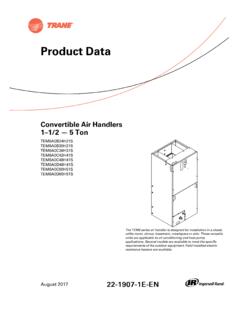
www.trane.comtable 1. air flow performance tem6a0b24, tem6a0b30 cooling airflow performance, wet coil, no filter, no heater outdoor unit size (tons) speed setting airflow setting dip switch setting airflow power external static pressure sw1 sw2 sw3 sw4 0.1 0.3 0.5 0.7 0.9 1.5 low 353 cfm/ ton on on off on cfm watts 533 52 497 78 461 104 425 130 390 157 ...

What Employers and Workers Need to Know About COVID-19 ...
www.dir.ca.govWhat Employers and Workers Need to Know About COVID-19 Isolation and Quarantine January 19, 2022 . This fact sheet provides employers and workers not covered by the Aerosol Transmissible Diseases