
Atomic Structure Notes - shakopee.k12.mn.us
Atomic Structure Notes Atoms: -Smallest particle of an element that has all the properties of that element. --Atoms are the basic building blocks of matter that make up everyday objects. -2 main parts of an atom: Nucleus-99.9% of the atom’s massElectron cloud or energy rings
Download Atomic Structure Notes - shakopee.k12.mn.us

Information
Domain:
Source:
Link to this page:
Documents from same domain

CHAPTER Solutions Key 3 Parallel and Perpendicular Lines
www.shakopee.k12.mn.usSolutions Key 3 Parallel and Perpendicular Lines CHAPTER ARE YOU READY? PAGE 143 1. F 2. D 3. B 4. E 5. A 6. Hypothesis: E is on AC . Conclusion: E lies in plane P. 7. Hypothesis: A is not in plane Q. Conclusion: A is not on BD . 8. Hypothesis: Plane P and plane Q intersect.
Sequences and Series - shakopee.k12.mn.us
www.shakopee.k12.mn.us12B Exploring Geometric Sequences and Series 12-4 Geometric Sequences and Series Lab Explore Infinite Geometric Series 12-5 Mathematical Induction and ... A2.7.2 Write the formula for the general term for arithmetic and geometric sequences and …
Newton’s Laws of Motion Questions
www.shakopee.k12.mn.usdirection of the force since he has more mass. 4. Describe why you hold your gun next to your shoulder while deer hunting. 3rd Law When you pull the gun’s trigger, it forces the bullet out of the gun, but at the same time, the gun is forced in the opposite direction of the bullet (towards you).

CHAPTER Solutions Key 4 Triangle Congruence
www.shakopee.k12.mn.usSolutions Key 4 Triangle Congruence CHAPTER ARE YOU READY? PAGE 213 1. F 2. D 3. B 4. A 5. E 6. 35 ... ∠BAC and ∠CAD are supp., and ∠CAD is acute; so
CHAPTER Solutions Key 11 Circles - shakopee.k12.mn.us
www.shakopee.k12.mn.usare both radii of circle P, and PA −− PA −− by Reflex. Prop. of . Therefore, ABP ACP by HL and AB −− AC −− by CPCTC. 31. QR = QS = 5 QT 2 = QR 2 + RT 2 (ST + 5 ) 2 = 5 2 + 12 2 −− ST + 5 = 13 ST = 8 32. AB = AD 23 = x AC = AE 23 + x-5 = x + DE 23 + 23 -5 = 23 + DE 41 = 23 + DE DE = 18 33. JK = JL and JL = JM, so, JK = JM JK ...
Probability and Statistics - shakopee.k12.mn.us
www.shakopee.k12.mn.ussquare root of 85p, divided by pi. How much more can be lifted with a chain 2.5 inches in diameter than by a rope 0.5 inch in diameter? 3. technicianA took a blood sample from a patient and detected a toxin concentration of 0.01006 mg/cm3. Two hours later, the technician took another sample and detected a concentration of 0.00881 mg/cm3.
Related documents
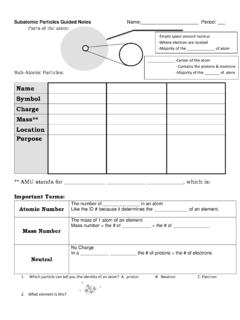
Subatomic Particles Guided Notes Name: Period: Parts of ...
accelwarriorchem.weebly.com3. What is the mass number of this atom? 4. If an atom of carbon has a mass number of 13, how many neutrons does it have?

Atom Parts and Function - blogs.rsd13ct.org
blogs.rsd13ct.orgAtom Parts and Function. Parts of the Atom We have learned: Nucleus is the center of atom that contains: Protons - positive charge Neutrons - neutral, act like glue Overall charge of nucleus is positive Electron cloud/energy levels that contain: Electrons - negative charge.

Parts of an atom - Mr. Dodd's Science Class
doddscience.weebly.comName: Parts of the Atom Section: Part 1 - Label the parts of the atom below (protons, neutrons, electrons, nucleus, quarks), Part 2 - Answer the following questions,
Chapter Outline Review of Atomic Structure
people.virginia.eduThe atomic mass of the 12C atom is 12 amu. The atomic weight of an element= weighted average of the atomic masses of the atoms naturally occurring isotopes. Atomic weight of carbon is 12.011 amu. The atomic weight is often specified in mass per mole.

LESSON PLAN: Introducing the Atom - Periodic table
periodictable.rosendigital.comLESSON PLAN: Introducing the Atom periodictable.rosendigital.com Context Elements are substances that cannot be broken down into simpler forms of matter, and they are the primary constituents of all matter. The elements are the basis of all chemical interactions, and the …

Atoms and Their Parts - Amazon S3
s3.amazonaws.comWith the exception of hydrogen, all the atoms have three main parts. The parts of an atom are protons, electrons, and neutrons. A proton is positively charged and is located in the center or nucleus of the atom. All atoms of the same element have the same number of protons. The number of protons in the

s3.amazonaws.com
s3.amazonaws.comName Parts of the Atom ill in the ollowin table about the arts o the atom. (AMU stands or atomic mass unit.) LOCATION IN ATOM MASS (in AMU's) PART OF THE ATOM ELECTRIC CHARGE

Parts of an Atom •All matter is made of atoms. •Each and ...
ssichemistry.weebly.comParts of an Atom •All matter is made of atoms. •Each and every atom has three parts, called subatomic particles. Proton Neutron Electron. Parts of an Atom •Properties of Subatomic Particles Particle Symbol Location Relative Electric Charge Relative Mass Actual Mass (g)

List the 3 main types of ¾ subatomic particles and ...
www.austincc.edu3 13 Objective 2 Normally, the number of electrons in an atom equals the number of protons and the overall charge of the atom is zero. However, atoms may gain or lose electrons: ¾If an atom gains electrons, it will have an extra negative charge for each electron gained. ¾If an atom loses electrons, it will have an extra positive charge for each electron lost.
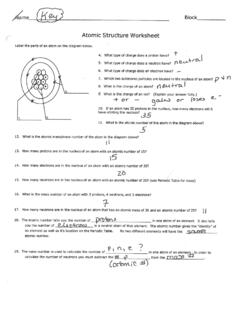
KM 654e-20150109102424
www.cpsk12.orgBohr Model Drawing Draw a Bohr model of a chlorine atom in the space below. Be sure to place the electrons in the correct orbitals and to fill out the key for the subatomic particles.