BASIC COMMUNICATION MODEL
(letters, newspapers, etc.), or through visual media (television, photographs). Verbal, written, and visual media are three examples of possible communication channels used to transmit messages between senders and receivers. Other transmission channels include touch, gestures, clothing, and physical distances between sender and receiver ...
Download BASIC COMMUNICATION MODEL

Information
Domain:
Source:
Link to this page:
Documents from same domain
THREE APPROACHES TO ORGANIZATIONAL …
home.snu.eduThe Pfeiffer Library Volume 16, 2nd Edition. Copyright © 1998 Jossey-Bass/Pfeiffer 1 THREE APPROACHES TO ORGANIZATIONAL LEARNING Anthony J. Reilly

General Introduction to the Pfeiffer Library
home.snu.eduMain Menu Introduction Credits Help About Jossey-Bass/Pfeiffer Since 1968, Jossey-Bass/Pfeiffer (formerly University Associates, Inc., and now an imprint
CONDITIONS THAT HINDER EFFECTIVE …
home.snu.eduThe Pfeiffer Library Volume 6, 2nd Edition. Copyright © 1998 Jossey-Bass/Pfeiffer 1 CONDITIONS THAT HINDER EFFECTIVE COMMUNICATION J. William Pfeiffer
Presentation and Discussion Resources: …
home.snu.eduii The Pfeiffer Library Volume 6, 2nd Edition. Copyright © 1998 Jossey-Bass/Pfeiffer Jargon: Rediscovering a Powerful Tool..... 87
STRUCTURED EXPERIENCES, ROLE PLAYS, CASE STUDIES ...
home.snu.edudeveloping individuals’ behavioral skills. We will discuss five of them in this volume: structured experiences, role plays, case studies, simulations, and games.
MISSIONS GIVING THROUGH FAITH PROMISE
home.snu.edu5.5% with Faith Promise, don’t simply make up the difference by dipping into tithe money. • Do give people opportunity to reach your Word l Evangesmil Fund goal through offerings at Thanksgiving and Easter (and Christmas and whatever other times may be necessary!)
THE COGNITIVE-STYLE INVENTORY
home.snu.eduStyle Model, these two styles had not previously been shown to reflect the entire spectrum of people’s behavior with regard to thinking, learning, and especially problem solving and decision making.
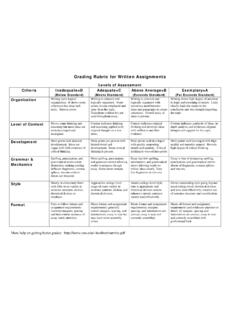
Written Communication Rubric - Southern Nazarene …
home.snu.eduGrading Rubric for Written Assignments Levels of Assessment Criteria Inadequate=D (Below Standard) Adequate=C (Meets Standard) Above Average=B
THREE APPROACHES TO ORGANIZATIONAL LEARNING
home.snu.eduskill areas—data processing, budget and accounting techniques, salary administration— are other examples of applications of management training. Originally published in The 1973 Annual Handbook for Group Facilitators by John E. Jones and J. William Pfeiffer (Eds.), San Diego, CA: Pfeiffer & Company.
MANAGEMENT BY OBJECTIVES
home.snu.eduMay 22, 1973 · organizational vitality and creativity. As a term, “Management by Objectives” was first used by Peter Drucker in 1954. As a management approach, it has been further developed by many management theoreticians, among them Douglas McGregor, George Odiorne, and John Humble. Essentially, MBO is a process or system designed for
Related documents
Letters and Sounds - GOV.UK
assets.publishing.service.gov.ukLetters and Sounds: Phase One Seven aspects and three strands Phase One activities are arranged under the following seven aspects. Aspect 1: General sound discrimination – environmental sounds Aspect 2: General sound discrimination – instrumental sounds Aspect 3: General sound discrimination – body percussion Aspect 4: Rhythm and rhyme
Order in which phonemes are introduced in ‘Letters and ...
www.stoswaldsdurham.netOrder in which phonemes are introduced in ‘Letters and Sounds’ C. Birt. Phase 1. Seven Aspects: Three strands in each 1) tuning in to sounds 2) listening and remembering sounds 3) talking about sounds . Oral segmenting and blending introduced in Aspect 7 . Continues through all Phases . Phase 2. 19 grapheme-phoneme correspondences . Set 1 ...

Letters and Sounds - GOV.UK
assets.publishing.service.gov.ukLetters and Sounds: Phase One. Seven aspects and three strands. Phase One activities are arranged under the following seven aspects. Aspect 1: General sound discrimination – environmental sounds Aspect 2: General sound discrimination – instrumental sounds Aspect 3: General sound discrimination – body percussion Aspect 4: Rhythm and rhyme
Independent review of the teaching of
dera.ioe.ac.uk1. Summary 2. The remit for the review 1 3. Evidence gathering 5 4. Background 6 5. Aspect 1:what best practice should be expected 30 in the teaching of early reading and synthetic phonics 6. Aspect 2:how this relates to the development 89 of the birth to five framework and the development and renewal of the National Literacy Strategy

Phonics Planning 3 Edition - LCP
www.lcp.co.ukIn the original Letters and Sounds document Phase 5 was always meant to be taught in Year 1 and Phase 6 was taught in Year 2. Assuming this is still the same I have included all content from the new National Curriculum for each year group in the relevant phase. For example, new content in Year 1 will be found in Phase 5 and new

Letters and Sounds, Phase 1, Aspect 1 - YorOK
www.yor-ok.org.ukLetters and Sounds, Phase 1, Aspect 1 General Sound Discrimination – Environmental Sounds Tuning into Sounds Main Purpose: To develop children’s listening skills and awareness of sounds in the environment Activity 2 play the listening game with them. Listening to sounds around the home. Preparation An quiet area with few visual distractions.

Glossary of Little Wandle Letters and Sounds Revised ...
www.littlewandlelettersandsounds.org.ukthe end of Year 1. Its sole purpose is to determine whether a child can phonically decode single words to an annually predetermined national standard. Phonics The method by which we teach children to read by recognising the connections between the sounds of spoken words (phonemes) and the letters that are used to write them down (graphemes).

Letters and Sounds - Phase 1 Aspect 4
www.yor-ok.org.ukLetters and Sounds - Phase 1 – Aspect 4 Rhythm and Rhyme Tuning into sounds Main purpose: To experience and appreciate rhythm and rhyme and to develop awareness of rhythm and rhyme in speech Preparation A quiet area with space for a circle of children Collect a selection of rhyming objects e.g. cat, hat, bat, mat or fox, box, socks.

A SCHOOL READINESS/PREPARATORY PROGRAMME (5 …
www.nied.edu.na2. Recognises some letters of the alphabet by name 3. Recognises some letter sounds 4. Tells a simple story and recounts events in sequence 5. Knows some nursery rhymes, songs and chants 6. Has early phonological awareness, e.g. rhyming and initial sound awareness 7. Is beginning to link some letters with sounds they make, e.g. m says mmm 8.