Basic Electronics - New York University
electrons are locked up in covalent bond with valence electrons of four neighboring Si atoms. However, the 5th valence electron of phosphorus atom does not find a binding electron and thus remains free to float. When a voltage is applied across the silicon-phosphorus mixture, free electrons migrate toward the positive voltage end.
Download Basic Electronics - New York University

Information
Domain:
Source:
Link to this page:
Documents from same domain
Intro to Electricity - NYU Tandon School of …
engineering.nyu.edu•A resistor is a dissipative element. It converts electrical energy into heat energy. It is analogous to the viscous friction element of mechanical system.
Introduction to Engineering
engineering.nyu.eduIntroduction to Engineering. ... • Engineering: Latin root, ingeniere, to design or to devise ... • Chemical • Civil • Computer ...
Intro to Mechanical Engineering
engineering.nyu.edumanipulation of chemical-, kinetic, potential-, and nuclear- ... surgery, tissue engineering Codes and standards: Interchangeability, interoperability,

Introduction to Robotics
engineering.nyu.edu–A robot is a reprogrammable, multifunctional manipulator designed to move material, parts, tools or specialized devices through variable programmed motions for the performance of

2020 IEEE TRANSACTIONS ON POWER DELIVERY, VOL. 27, …
engineering.nyu.edu2020 IEEE TRANSACTIONS ON POWER DELIVERY, VOL. 27, NO. 4, OCTOBER 2012 Analysis of Voltage Profile Problems Due to the Penetration of Distributed Generation in Low-Voltage
Intro to Sensors - NYU Tandon School of Engineering
engineering.nyu.eduSensors? • American National Standards Institute – A device which provides a usable output in response to a specified measurand • A sensor acquires a physical quantity and converts it into a signal
Intro to Mechatronics - engineering.nyu.edu
engineering.nyu.eduMechatronics Defined — III • “Synergistic use of precision engineering, control theory, computer science, and sensor and actuator technology to design improved products and processes.”

Introduction to Robotics
engineering.nyu.eduUniversal Robots (RUR) • Robot in Czech is a word for worker or servant Definition of robot: –Any machine made by by one our members: Robot Institute of America –A robot is a reprogrammable, multifunctional manipulator designed to move material, parts, tools or specialized devices through variable programmed motions for the performance of

FreqResponse Analysis Design
engineering.nyu.eduhappens. Mechatronics Frequency Response Analysis & Design K. Craig 8 System Frequency Response. Mechatronics Frequency Response Analysis & Design K. Craig 9 • When one has the frequency-response curves for any system and is given a specific sinusoidal input,

RLocus Analysis Design - New York University
engineering.nyu.eduRoot Locus Analysis and Design K. Craig 4 – The Root Locus Plot is a plot of the roots of the characteristic equation of the closed-loop system for all values of a system parameter, usually the gain; however, any other variable of the open - loop transfer function may be used. – By using this method, the designer can predict
Related documents

List the four major differences between ionic and covalent ...
homework.sdmesa.edu4. Ionic compounds often dissociate into ions in solution, whereas covalently bonded molecules retain their molecular identity in solution. Comparison of properties between ionic (inorganic) and covalent (organic) compounds. Property Inorganic Organic melting point High Low boiling point High Low solubility in H2O generally soluble generally ...

3.4 Covalent Bonds and Lewis Structures
www.columbia.edu•Oxygen has 4 electrons in covalent bonds. •Assign 2 of these 4 electrons to O. •Oxygen has 2 unshared pairs. Assign all 4 of these electrons to O. •Therefore, the total number of electrons assigned to O is 2 + 4 = 6. Formal charge of O

Sugar or Salt? Ionic and Covalent Bonds
uu.eduIonic and Covalent Bonds TN Standard 2.1: The student will investigate chemical bonding. Have you ever accidentally used salt instead of sugar? rinking tea that has been sweetened with salt or eating vegetables that have been salted with sugar tastes awful! Salt and sugar may look the same, but they obviously taste very different.
Lecture B1 Lewis Dot Structures and Covalent Bonding
www.chem.uci.edu4 + (the ammonium ion). Step 1: Count valence electrons: N = 5 4 x H = 4 x 1 = 4 “+” = -1 Total = 5+4-1= 8 electrons = 4 bonds and lone pairs. Step 2:!Arrange the atoms (identify a central atom, if possible). Step 3:!Place electron pairs on the atoms as either bonds or lone pairs. Step 4:!Count electrons and compare with known count.
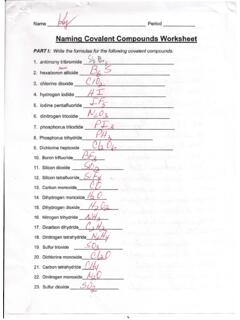
Naming Covalent Compounds Worksheet Key
www.humbleisd.netList 5 Properties of Covalent Com ounds: List 5 Properties of Ionic Compounds: List 5 Properties of Metallic Compounds: c. 00 PART IV. Determine whether the following compounds are covalent or ionic and give them their proper names or Formulas C …
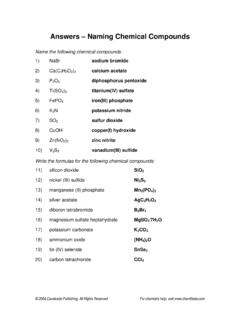
Answers – Naming Chemical Compounds
www.npsd.k12.nj.usIonic/Covalent Compound Naming Solutions . For each of the following questions, determine whether the compound is ionic or covalent and name it appropriately. 1) Na2CO3 sodium carbonate. 2) P2O5 diphosphorus pentoxide. 3) NH3 ammonia. 4) FeSO4 iron (II) sulfate. 5) SiO2 silicon dioxide. 6) GaCl3 gallium chloride. 7) CoBr2 cobalt (II) bromide. 8 ...
Identifying and Comparing Properties of Ionic and Covalent ...
www.sas.upenn.edu4) Conductivity This is a measure of a materials ability to conduct an electric current. Conductivity has SI units of siemens per meter (S·m-1) Metals, which tend to readily ionize, are good conductors of electricity. 5) Polar Covalent Bond This is a type of covalent bond.