Basic Electronics - New York University
locked up in covalent bonds with the valence electrons of four neighboring Si atoms. – In pure form, Si wafer does not contain any free charge carriers. – An applied voltage across pure Si wafer does not yield electron flow through the wafer. – …
Download Basic Electronics - New York University

Information
Domain:
Source:
Link to this page:
Documents from same domain

Intro to Electricity - NYU Tandon School of …
engineering.nyu.edu•A resistor is a dissipative element. It converts electrical energy into heat energy. It is analogous to the viscous friction element of mechanical system.
Introduction to Engineering
engineering.nyu.eduIntroduction to Engineering. ... • Engineering: Latin root, ingeniere, to design or to devise ... • Chemical • Civil • Computer ...
Intro to Mechanical Engineering
engineering.nyu.edumanipulation of chemical-, kinetic, potential-, and nuclear- ... surgery, tissue engineering Codes and standards: Interchangeability, interoperability,

Introduction to Robotics
engineering.nyu.edu–A robot is a reprogrammable, multifunctional manipulator designed to move material, parts, tools or specialized devices through variable programmed motions for the performance of

2020 IEEE TRANSACTIONS ON POWER DELIVERY, VOL. 27, …
engineering.nyu.edu2020 IEEE TRANSACTIONS ON POWER DELIVERY, VOL. 27, NO. 4, OCTOBER 2012 Analysis of Voltage Profile Problems Due to the Penetration of Distributed Generation in Low-Voltage

Intro to Sensors - NYU Tandon School of Engineering
engineering.nyu.eduSensors? • American National Standards Institute – A device which provides a usable output in response to a specified measurand • A sensor acquires a physical quantity and converts it into a signal
Intro to Mechatronics - engineering.nyu.edu
engineering.nyu.eduMechatronics Defined — III • “Synergistic use of precision engineering, control theory, computer science, and sensor and actuator technology to design improved products and processes.”

Introduction to Robotics
engineering.nyu.eduUniversal Robots (RUR) • Robot in Czech is a word for worker or servant Definition of robot: –Any machine made by by one our members: Robot Institute of America –A robot is a reprogrammable, multifunctional manipulator designed to move material, parts, tools or specialized devices through variable programmed motions for the performance of

FreqResponse Analysis Design
engineering.nyu.eduhappens. Mechatronics Frequency Response Analysis & Design K. Craig 8 System Frequency Response. Mechatronics Frequency Response Analysis & Design K. Craig 9 • When one has the frequency-response curves for any system and is given a specific sinusoidal input,

RLocus Analysis Design - New York University
engineering.nyu.eduRoot Locus Analysis and Design K. Craig 4 – The Root Locus Plot is a plot of the roots of the characteristic equation of the closed-loop system for all values of a system parameter, usually the gain; however, any other variable of the open - loop transfer function may be used. – By using this method, the designer can predict
Related documents

© www.CHEMSHEETS.co.uk 10-Mar-2016 Chemsheets A2 …
mchem.weebly.comBond enthalpy is the enthalpy change to break one mole of covalent bonds in the gas phase. For most bonds (e.g. C -H, C C, C=O, O H, etc.) the value for the bond enthalpy is an average taken from a range of molecules as the exact value varies from compound to compound. For some bond enthalpies (e.g.
The Free High School Science Texts: Textbooks for High ...
nongnu.askapache.comNov 09, 2008 · FHSST Authors The Free High School Science Texts: Textbooks for High School Students Studying the Sciences Chemistry Grades 10 - 12 Version 0 November 9, 2008

Covalent Bonding - Save My Exams
cdn.savemyexams.co.ukOxygen atoms form both covalent and ionic bonds. (a) Water is formed when two atoms of hydrogen combine with one atom of oxygen. (i) Draw a dot and cross diagram of a molecule of water. You need only show the electrons in the outer shells. (2) (ii) Explain how the covalent bonds in the water molecule hold the hydrogen and oxygen atoms together. (2)
Ionic and Covalent Compounds Name: KEY
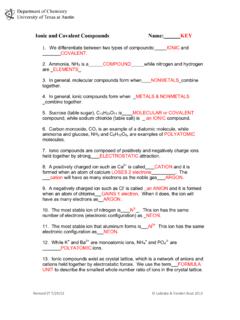
ch301.cm.utexas.eduCOVALENT. ! 2. Ammonia, NH3 is a COMPOUND while nitrogen and hydrogen are _ELEMENTS_. ! 3. In general, molecular compounds form when NONMETALS_combine together. ! 4. In general, ionic compounds form when _METALS & NONMETALS _combine together. ! 5. Sucrose (table sugar), C12H22O11 is MOLECULAR or COVALENT

Sugar or Salt? Ionic and Covalent Bonds - Union University
uu.eduthe other hand, is composed of carbon, oxygen, and hydrogen and has covalent bonds. D Introduction A salt molecule is made up of one sodium atom and one chlorine atom. For salt to be made, the sodium atom must lose an electron and become a sodium ion. When sodium loses an electron it becomes a Na+ and is called a cation. Na → Na+ + e-
CHAPTER 14 COVALENT BONDING: ORBITALS
web.chem.ucsb.eduCHAPTER 14 COVALENT BONDING: OR BITALS 543 Assuming all atoms are hybridized, the carbon and oxygen atoms are sp2 hybridized, and the two chlorine atoms are sp3 hybridized. The two C‒Cl σ bonds are formed from overlap of sp2 hybrids from C with sp3 hybrid orbitals from Cl. The double bond between the carbon and
Polar Covalent Bonds: ElectronegativityPolar Covalent ...
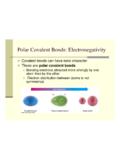
www.csus.eduPolar Covalent Bonds: ElectronegativityPolar Covalent Bonds: Electronegativity Covalent bonds can have ionic character These are polar covalent bonds Bonding electrons attracted more strongly by one atom than by the otheratom than by the other Electron distribution between atoms is not symmetrical