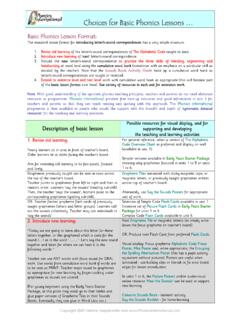
Basic Phonics Lesson Format
When people interested in finding out about the Phonics International programme have read the two simple documents ‘In a Nutshell…’ and ‘Choices for Basic Phonics Lessons’ available to download direct from the homepage of . www.phonicsinternational.com, the next steps …
Download Basic Phonics Lesson Format

Information
Domain:
Source:
Link to this page:
Documents from same domain

Letters, Sounds and Pictures Matching Game
phonicsinternational.comsounds (phonemes) in their different positions of a spoken word or picture word and to link these with the corresponding letters or letter groups (graphemes); 3) The teacher says a sound (phoneme) and the learner can select the corresponding letter shape or letter group (grapheme).

Pronunciation Guide for English - Phonics International
phonicsinternational.comphonics skills of decoding for reading and encoding for spelling very explicitly, systematically and comprehensively – providing reading, spelling and writing activities which match the code that has been taught to date. This approach serves all learners of all ages and is essential for many learners whatever their age.

/p/ p -pp gn ne - Phonics International
phonicsinternational.comDebbie’s programme introduces a simple code of at least one letter/s-sound correspondence for each of the 44+ sounds of speech of the English language. The programme then expands to teach further spelling and pronunciation variations of the complex Alphabetic Code.
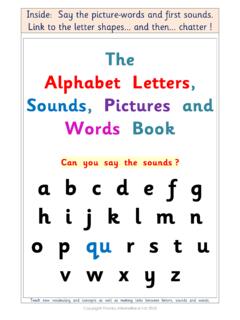
The Alphabet Letters, Sounds, Pictures and Words Book
phonicsinternational.comInside: Say the picture-words and first sounds. Link to the letter shapes... and then... chatter !
Related documents
Common Core State StandardS for english Language arts ...
www.corestandards.orgIntroduction 3 Standards for english Language arts & Literacy in History/ Social Studies, Science, and technical Subjects K–5 9 College and Career Readiness Anchor Standards for Reading 10 Reading Standards for Literature K–5 11 Reading Standards for Informational Text K–5 13 Reading Standards: Foundational Skills K–5 15
Principles and Practice - Stephen Krashen
www.sdkrashen.comIntroduction: The Relationship of Theory to Practice The purpose of this book is to take a new look at an old question: the relationship between second language teaching practice and what is known about the process of second language acquisition. The usual way to do this is to discuss some research results first, outline a
Reading: the next steps - GOV.UK
assets.publishing.service.gov.ukphonics is the most effective method for teaching all children to read. Progress has been made since the introduction of the phonics screening check in 2012 and the funding for phonics training and resources provided by the government. To build on this, we have announced a phonics partnership grant programme that will enable excellent schools to

Phoneme Sequence Chart and Word List
kelseyrobohn.weebly.comPhoneme Sequence Chart and Word List as presented in School Phonics Phonemes A phoneme is a basic unit of sound that can change the meaning of a word. The words in the English language are made from 44 phonemes.
A Handbook on Learning Disabilities - Child Develop
childdevelop.cato book a workshop or training series for your school or agency, please contact Integra (416 486 8055, info@integra.on.ca) or visit our website (www.integra.on.ca) Helen Hargreaves, MSW Community Consultation Coordinator Melissa Rowbotham, M.Ed. Manager of Community Consultation Marjory Phillips, Ph.D., C.Psych.
Bridging the Gaps to Improve Teaching and Learning
www.education.ne.gov8 Core Phonics: “The CORE Phonics Survey assesses the phonics and phonics related skills that have a high rate of application in beginning reading. Each survey presents a number of lists of letters and words for the student to identify or decode.
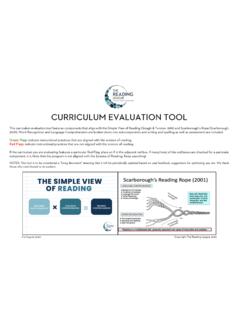
Curriculum Evaluation Tool August 2020 - TRL National
www.thereadingleague.orgInstruction includes recursive review of phonics/encoding skills. Instruction is typically “one and done”; phonics/encoding skills are introduced but with very little or very short-term review. Phonics skills are practiced by applying letter-sound knowledge in decodable texts that match the phonics elements taught, securing phonic decoding.
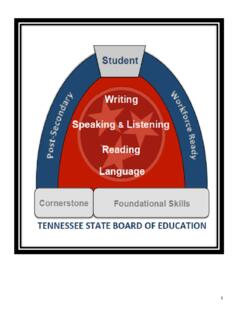
Tennessee English Language Arts Standards
www.tn.govconnected to letter sounds. Phonics instruction is a key component to children’s success in reading and decoding unknown words. According to Chall (1987), “Research evidence over the past 70 years indicates overwhelmingly that direct, explicit instruction in phonics is needed and contributes to better