
Behavior Contracts - Intensive Intervention
A clause that identifies specific consequences that will be delivered if students do not meet goals/success criteria. 6. Replacement Behavior: An appropriate behavior that a student is taught to use to replace a challenging behavior. The replacement behavior should serve the same function as the challenging behavior. 7. Consequence Modification:
Download Behavior Contracts - Intensive Intervention

Information
Domain:
Source:
Link to this page:
Documents from same domain
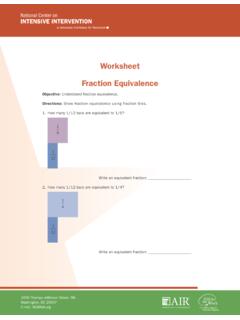
Worksheet Fraction Equivalence - Intensive Intervention
intensiveintervention.orgStudent Worksheet: Fraction Equivalence. 3. How many 1/10 bars are equivalent to 1/5? Write an equivalent fraction: _____ 4. How many 1/12 bars are equivalent to 1/2? ... 3. Compare the fractions using the greater than (>), less than (<), or equal to (=) symbol. 4. Check your work with the fraction tiles. a. If your answer is correct, draw a ...

Hide and Seek - Intensive Intervention
intensiveintervention.orgNational Center on Intensive Intervention Hide and Seek—1 8593_02/17 Hide and Seek Adapted with permission from The University of Texas Center for Reading and Language Arts.
Graphic Organizers for Text Structures
intensiveintervention.orgof a graphic organizer for that text structure type. Earlier I told you that we could use different graphic organizers to represent the information from the text.

Identifying Narrative and Expository Text Structures
intensiveintervention.orgNational Center on Intensive Intervention Identifying Narrative and Expository Text Structures—5 Text Structure Cue Sheet This handout should serve as a guide for students as they learn about text …

Phonemic Awareness: Phoneme Segmentation
intensiveintervention.orgwords, syllables, and sounds (phonemes). Blend and segment onsets and rimes of single-syllable spoken words Objective: Students will learn to segment words into individual phonemes (sounds). Materials OPTIONAL: Manipulatives, such as blocks, magnetic letters, Elkonin boxes (see page 4), practice word lists (see supplemental materials).

Point Sheets/Behavior Report Cards - Intensive Intervention
intensiveintervention.orgNational Center on Intensive Intervention Point Sheets—3 . Point Sheets/Behavior Report Cards . Purpose and Overview: Students earn points throughout the day that can later be redeemed for access to preferred reinforcers or activities. When implementing any system, a teacher needs to be clear about the

Place-Value Concepts - Intensive Intervention
intensiveintervention.orgStandard notation: Writing a number with one digit in each place value 42,103. Place: The position of a digit relative to the decimal Ones, tens, hundreds, etc. Expanded notation: Writing a number and showing the place value of each digit 40,000 + 2,000 + 100 + 3 . 2

Data-Based Individualization - Intensive Intervention
intensiveintervention.org2 Data-Based Individualization: A Framework for Intensive Intervention In terms of multi-tiered intervention frameworks, students with disabilities and other students referred for intensive intervention have been insufficiently responsive to the core instruction afforded all students (Agodini et al., 2009) and have also responded inadequately to
Teaching Counting - Intensive Intervention
intensiveintervention.org¡ Compare two numbers between 1 and 10 presented as written numerals. (K) Extend the counting sequence. ¡ Count to 120, starting at any number. (1) ¡ Read and write numerals (to 12), and represent a number of objects with a written numeral. (1) ¡ Count within 1,000. (2) ¡ Skip count by 5s, 10s, and 100s. (2) Add and subtract within 20.

User Guide for Sample Reading Lessons - Intensive Intervention
intensiveintervention.orgstruggling students (Gersten et al., 2008; National Reading Panel, 2000). In an explicit instruction lesson, teachers provide modeling, scaffolding, and prompting until students are able to apply a skill independently (Archer & Hughes, 2011). Although there are no speciic guidelines concerning how much time should be
Related documents
Learning: Theory and Research
gsi.berkeley.edulearners to make the desired connections between specific stimuli and the appropriate responses. For example, a student who receives verbal praise and good grades for correct answers (positive reinforcement) is likely to learn those answers effectively; one who receives little or no positive feedback for the same answers (negative
Daily Behavior Report Card Full Set - jimwrightonline.com
www.jimwrightonline.comEncourage positive behavior and decrease negative behavior; Evaluate whether interventions are working or not. Ongoing communication between home and school is an important part of behavior plans. Rewards for behavior plans may be given at home, but some students benefit simply from praise and attention for their good behavior.
The Importance of Praise and Encouragement - Parenting NI
www.parentingni.orgPraise that is specific and acknowledges the processes of completing an activity or solving a problem helps develop children’s learning and motivation. Examples of specific praise are ‘You put away your toys so nicely’ or ‘well done for eating
Evidence-based Classroom Behaviour Management Strategies
files.eric.ed.govand praise for compliance. Precise, specific, direct and paced (one-at-a-time) instructions delivered in a calm and quiet voice, followed by praise for compliance have been found most effective. • Sequencing of activities, so that easy and brief tasks are interspersed with longer and more demanding ones, enhances engagement and learning as

Behavior Specific Praise - Positive Descriptive Feedback
sde.ok.govAug 18, 2020 · Behavior Specific Praise - Positive Descriptive Feedback. Recommendations and Considerations for Positive Descriptive Feedback Positive descriptive feedback is an evidence-based practice that is meant to be part of the teaching process. It encourages learning. We use the word

Verbal Behavior Milestones Assessment and Placement ...
storage.outreach.psu.edubehavior (person performs an action, etc.) Non-verbal behavior with point to point correspondence (person imitates same action) Non-specific reinforcement (example: praise; ‘you’re right!’, ‘’great job!’ high five, pat on back, etc.) Match to sample Non-verbal behavior (presentation of stimuli) Non-verbal behavior (in presence of one