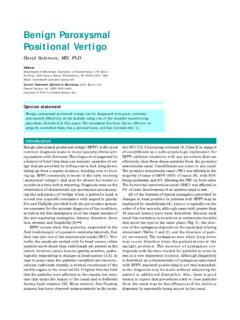
Benign Paroxysmal Positional Vertigo
Benign Paroxysmal Positional Vertigo Solomon 421 Figure 2. The Epley maneuver. A, Turn the head 45 degrees toward the affected ear. B, Deliberately move the patient into the supine position, maintaining the head turn. Extend the neck just enough so that the downward ear is below the shoulder.
Download Benign Paroxysmal Positional Vertigo

Information
Domain:
Source:
Link to this page:
Documents from same domain

Cross Cultural Communication in Medicine
www.med.upenn.eduCross Cultural Communication in Medicine: Looking Within To See The Outside Better Jerry Johnson, MD

DEPARTMENT OF BIOCHEMISTRY AND BIOPHYSICS …
www.med.upenn.eduprotein form and function friday research discussions department of biochemistry and biophysics spring 2014 from the shorter lab department of biochemistry and biophysics
Symptom Management at the End of Life
www.med.upenn.eduSymptom Management at the End ... • Employ existing knowledge base to provide excellent symptom management to patients • Support skill set of geriatrics fellow on call. Symptoms and Symptom Management ... Smith. Management of hiccups in the palliative care population.
Pennsylvania Department of Health - Cancer Evaluation ...
www.med.upenn.eduThe Pennsylvania Department of Health (PADOH) and the federal Agency for Toxic Substances and Disease Registry (ATSDR) conclude that, based on available data, residents are not currently being exposed to asbestos at a
SEDATION AND PAIN MANAGEMENT/ORIGINAL RESEARCH …
www.med.upenn.eduSEDATION AND PAIN MANAGEMENT/ORIGINAL RESEARCH Randomized Clinical Trial of Etomidate Versus Propofol for Procedural Sedation in the Emergency Department

NIST SP 800-66
www.med.upenn.eduThis Special Publication 800 series reports on ITL’s research, guidelines, and outreach efforts in information system security and its ... SP 800-66 Page 1. DRAFT 2. DRAFT 800-66 assists all agencies seeking further information on the security safeguards discussed in the HIPAA . • • ...

Pain Management for the Geriatric Patient
www.med.upenn.eduAmerican Geriatrics Society, Pharmacologic Management of Persistent Pain in Older Persons. JAGS 2009. Patient controlled analgesia •Barriers •The built in safety • Negated by proxy dosing • Consider provider administered bolus •Hospital • Post op • Pain crisis ...

Cold Weather Outdoor Play Boosts Immune System!
www.med.upenn.eduEmpty water bottle 2 spoonfuls of baking soda 1 spoonful dish soap A few drops of food coloring (red makes it look like lava) 1 ounce of vinegar Next steps: Make a volcano in the snow with hole in the center to hold the water bottle. Add everything except the vinegar to the water bottle.
Coping With and Responding to Psychosis Symptoms
www.med.upenn.edu• Show understanding of the persons feelings about the hallucinations • Can ask about the experience if the person wants to talk about what they are seeing/hearing • Can say when something is not real, while acknowledging they seem real to your relative • Can help him/her tell the difference between real and imaginary (e.g., “it’s your
5.2 Protein purification
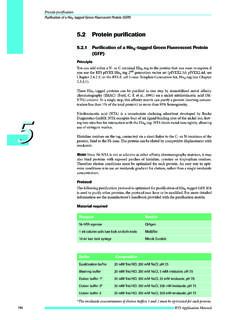
www.med.upenn.eduNTA) column. In a single step, this affinity matrix can purify a protein (starting concen-tration less than 1% of the total protein) to more than 95% homogeneity. Nitrilotriacetic acid (NTA) is a tetradentate chelating adsorbent developed by Roche Diagnostics GmbH. NTA occupies four of six ligand binding sites of the nickel ion, leav-
Related documents

EAR CONDITIONS (INCLUDING VESTIBULAR AND …
www.benefits.va.govApr 16, 2020 · Benign Paroxysmal Positional Vertigo (BPPV) Chronic otitis externa Chronic suppurative otitis media. Chronic nonsuppurative otitis media (serous otitis media) Mastoiditis . Cholesteatoma Otosclerosis. If, checked, a Hearing Loss and Tinnitus Questionnaire must be completed in lieu of this Questionnaire. Benign neoplasm of the ear (other than ...

Positional Dizziness (BPPV)
www.pat.nhs.ukPositional dizziness Positional dizziness, known as Benign Paroxysmal Positional Vertigo (or BPPV) is a disorder that usually causes spinning dizziness with certain head movements. About 20% of all dizziness is due to BPPV, and approximately 50% of dizziness in older people is due to BPPV. It occurs when loose crystals collect

Benign Paroxysmal Positional Vertigo
www.uhn.ca• what Benign Paroxysmal Positional Vertigo (BPPV) is • symptoms you can expect • how your doctor will diagnose it • treatment options Form: D-5758. 2 What is BPPV? BPPV is a balance disorder of the inner ear that causes vertigo, dizziness and other symptoms. It happens when calcium crystals inside the ear become

Benign paroxysmal positional vertigo (BPPV)
www.uhs.nhs.ukBenign paroxysmal positional vertigo (BPPV) BPPV is a common cause of dizziness. It occurs in people of all ages but is more common in middle-aged and elderly people. It causes short bursts of intense dizziness when the body or head is placed in certain positions such as lying on one side in bed or looking upwards.

Home Epley manoeuvre to treat BPPV (right ear) - patient ...
www.uhs.nhs.ukWhat is benign paroxysmal positional vertigo (BPPV)? BPPV is a common cause of dizziness. It occurs in people of all ages but is more common in middle-aged and elderly people. It causes short bursts of intense dizziness when the body or head is placed in certain positions such as lying on one side in bed or looking upwards.