
Biological Nutrient Removal Processes
1967 Excess Biological Phosphorus Removal Reported By Connell And VackerAt San Antonio, Texas, Rilling Plant. 1968 Barth Proposes Multiple Sludge Processes For Nutrient Removal. 1969 Scalf, Et. Al., Report On Excess Biological Phosphorus Removal At Baltimore, Maryland Back River Wastewater Treatment Plant ...
Download Biological Nutrient Removal Processes

Information
Domain:
Source:
Link to this page:
Documents from same domain

Nitrogen and Phosphorus: Treatment Concepts
www.acsawater.comN & P Removal: Combined Nutrient Removal • Nitrification (ammonia to nitrate) • Denitrification (nitrate to nitrogen gas) • Enhanced Biological Phosphorus Removal …
Biological Nutrient Removal Processes
www.acsawater.comBIOLOGICAL NUTRIENT REMOVAL PROCESSES December 1, 2010 Georgine Grissop PE, BCEE. grissopga@cdm.com

SELECTING THE RIGHT BLOWER TECHNOLOGY
www.acsawater.comAvailable Blower Technology Positive Displacement Two lobe or Three lobe Rotary Lobe Compressor Rotary Lobe Blower Rotary Lobe Compressor

Aerobic Digestion for the 21 Century - Main Page | …
www.acsawater.comDigestion Expertise 3 WEFTEC 1997 ‐2001 VOL III 1999 WORKSHOP DIGESTION AEROBIC Fine Tuning the Controlled Aerobic Digestion Process Class B Of Meeting

Biological Nutrient Removal Operation
www.acsawater.comBIOLOGICAL NUTRIENT REMOVAL OPERATION December 1, 2010 Georgine Grissop PE, BCEE. grissopga@cdm.com
Aerobic Digestion for the 21 Century - Main Page | …
www.acsawater.comBellefonte M‐TAD Process 59 Rotating Biological Contactor followed by M‐TAD Process Engineer: Nittany Engineering History: • Objective was to produce Class B
BNR Presentation FINAL - Augusta County Service Authority
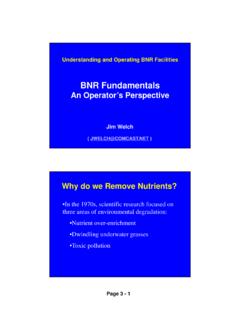
www.acsawater.comPage 3 - 9 Conditions Necessary to Achieve Nitrification in Activated Sludge • Aerobic Mean Cell - Residence Time • pH - • Temperature - • Dissolved Oxygen - 4 to 15 days 6.5 to 8 optimal 25°C for optimal nitrification
Related documents
Wastewater Effluent Discharge: Effects and Treatment …
ipcbee.comThe general purpose of phosphorus removal from wastewater is to eliminate excess phosphorus content discharge to receiving waters and then utilize this excluded phosphorus load in the way which is the most proper for the natural phosphorus cycle in nature. Usually, phosphorus is present in wastewater in soluble form.
Information on Phosphorus Amounts & Water Quality
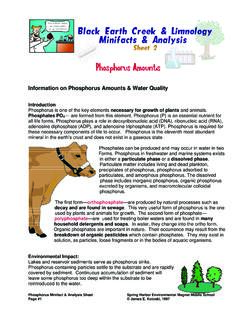
osse.ssec.wisc.eduTertiary treatment is required to remove additional phosphorus from the water. The amount of additional phosphorus that can be removed varies with the success of the treatment technologies used. Available technologies include biological removal and chemical precipitation.
CHAPTER 6 WASTEWATER TREATMENT PROCESSES
web.deu.edu.trCPR = Phosphorus Removal dSSOR =Suspended Solids and Organics Removal eEnvironmental Protection Agency, Secondary Treatment Information, 40 CFR, Part 133,Federal ... biological or physical-chemical processes. A prop-erly designed facility dampens the wide swings of flow, pH, BOD, and other parameters to levels ...
What is Phosphorus?
www.ohiowea.orgPhosphorus occurs naturally at low levels in water, plants, and animals. Phosphorus occurs unnaturally in fertilizers (used in agriculture), cleaners (used in industry) and wastewater (from household sewage). Phosphorus is found in water, solids (detritus), and in the bodies of biological organisms.

Phosphorus Fertilizer Production and Technology
www.ipni.netPhosphorus (P) Cycling in Crop Production Systems. Phosphorus is an essential element for all forms of life. Phosphorus in the earth’s crust is mostly contained in soils and sed\൩ments. Soils contain both organic and inorganic P containing compounds. Phosphorus reactions in soils can be quite complex.
Biological Treatment - Attached-Growth Processes Study Guide
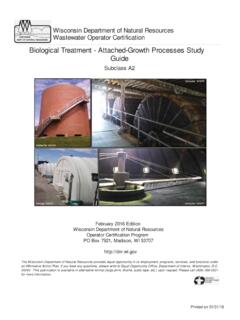
dnr.wi.govSecondary treatment is the biological treatment of wastewater. It provides a high level of biodegradable organic pollutant removal to protect receiving water quality that clarification alone cannot provide. Attached growth is one type of secondary treatment. Shock loads are usually short-term discharges to a treatment system. These discharges
Nutrient Removal - Total Nitrogen Study Guide
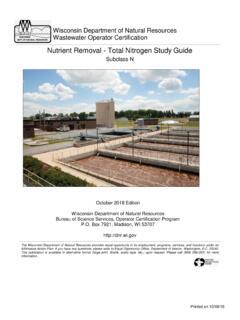
dnr.wi.govBNR is the biological reduction of nitrogen and/or phosphorus in the final effluent using microorganisms. (Standard Method 5210B) The cBOD test is used to measure the oxygen demand of carbonaceous organic material in a wastewater sample as cBOD (mg/L). This test includes the use of a nitrogenous demand inhibitor to exclude the oxygen demand of

Biological Nutrient Removal manual
www.pca.state.mn.usEnhanced biological phosphorus removal (EBPR) The process of phosphorus removal in wastewater that relies on the proliferation and selection of a microbiological population capable of storing phosphorus in excess of their normal growth requirements. Also called Biological Nutrient Removal (BNR).

ABSTRACTS
www.weftec.orgNutrients: Mainstream Phosphorus Removal (Not stormwater/watershed issues) • Biological Phosphorus Removal • Chemical Phosphorus Removal • Fermentation to Aid Biological Phosphorus Removal • Kinetic and Modeling Studies of Biological Phosphorus Removal •
Wastewater Technology Fact Sheet: Oxidation Ditches
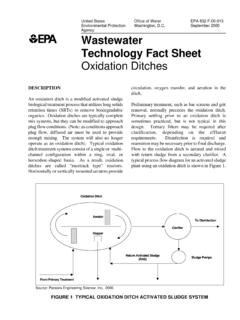
www3.epa.govenhance biological phosphorus removal. An oxidation ditch may also be operated to achieve partial denitrification. One of the most common design modifications for enhanced nitrogen removal is known as the Modified Ludzack-Ettinger (MLE) process. In this process, illustrated in Figure 2, an anoxic tank is added upstream of the ditch along