
Border Gateway Protocol
Once BGP peers form a neighbor relationship, they share their full routing table. Afterwards, only changes to the routing table are forwarded to peers. By default, BGP assumes that eBGP peers are a maximum of one hop away. This restriction can be bypassed using the ebgp-multihop option with the neighbor command (demonstrated later in this guide).
Download Border Gateway Protocol

Information
Domain:
Source:
Link to this page:
Documents from same domain
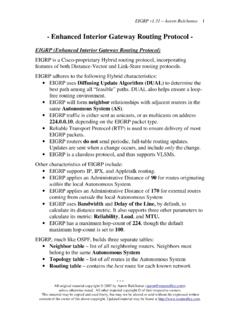
Enhanced Interior Gateway Routing Protocol
routeralley.comfree routing environment. • EIGRP will form neighbor relationships with adjacent routers in the same Autonomous System (AS). • EIGRP traffic is either sent as unicasts, or as multicasts on address 224.0.0.10, depending on the EIGRP packet type. • Reliable Transport Protocol (RTP) is used to ensure delivery of most EIGRP packets.
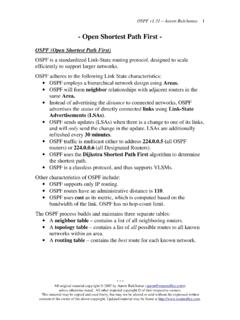
Open Shortest Path First - Router Alley
routeralley.comOSPF is a standardized Link-State routing protocol, designed to scale efficiently to support larger networks. OSPF adheres to the following Link State characteristics: • OSPF employs a hierarchical network design using Areas. • OSPF will form neighbor relationships with adjacent routers in the same Area.

Switching Tables - Router Alley
routeralley.comunless a switching loop or other issue exists. Ternary Content Addressable Memory (TCAM) tables provide high-speed lookups for two additional functions: • Filtering traffic using access-lists • Prioritizing traffic using QoS TCAM tables are covered in greater detail later in this guide.
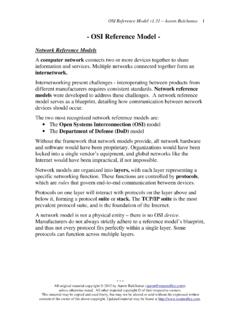
OSI Reference Model - Router Alley
routeralley.comApplication layer. http:// hardware. ...

static dynamic routing - Router Alley
routeralley.comThe following briefly outlines the advantages and disadvantages of dynamic routing: Advantages of Dynamic Routing • Simpler to configure on larger networks • Will dynamically choose a different (or better) route if a link goes down • Ability to load balance between multiple links Disadvantages of Dynamic Routing
ccnp routing studyguide - Router Alley
routeralley.comCCNP Routing Study Guide v1.22 – Aaron Balchunas * * * All original material copyright © 2013 by Aaron Balchunas ( aaron@routeralley.com ), unless otherwise noted ...
ccnp switching studyguide - Router Alley
routeralley.comCCNP Switching Study Guide v2.01 – Aaron Balchunas * * * • •)

configuring static routes - Router Alley
routeralley.comAdvanced Static Routes Parameters The Administrative Distance of a static route can be changed to form a floating static route, which will only be used if there are no other routes with a lesser AD in the routing table. A floating static route is often used as a backup route to a dynamic routing protocol.

Cisco CCNA Study Guide - Router Alley
routeralley.comPart III - Routing Section 13 The Routing Table Section 14 Static vs. Dynamic Routing Section 15 Classful vs. Classless Routing Section 16 Configuring Static Routes Section 17 RIPv1 & RIPv2 Section 18 IGRP Section 19 EIGRP Section 20 OSPF …

subnetting exercises answers - Router Alley
routeralley.comSubnetting Exercises Answers v1.10 – Aaron Balchunas * * * All original material copyright © 2006 by Aaron Balchunas ( aaron@routeralley.com ), unless otherwise ...
Related documents

Classful vs. Classless Routing - Cisco
community.cisco.comnetwork. It may also have routes from a routing protocol, also for the 10.x.x.x network. However, if the classful router receives a packet destined for a 10.x.x.x subnet that is not in the routing table, it will drop that packet, even if there is a default route. Again, a classful router believes it knows all possible destinations in a major ...

Global Electronic Approval Routing System (GEARS)
dema.az.govThe HRO has created routing lists for various personnel actions, and the document is available on the HRO web site. (*Now one list, versus two lists) Workflows to the HRO from the 161. st & 162. nd. should be routed through the HR Remotes. GLOBAL ELECTRONIC APPROVAL ROUTING SYSTEM (GEARS)
CCNA Routing and Switching - pearsoncmg.com
ptgmedia.pearsoncmg.comDefault Route Propagation 108 Fine-Tuning EIGRP Interfaces 110 Securing EIGRP Routing Updates 112 Troubleshoot EIGRP 113 Commands for Troubleshooting EIGRP 113 Troubleshoot EIGRP Connectivity Issues 114 Connectivity Issue #1 114 Connectivity Issue #2 …
Configuring Static and Default Routes
www.cisco.comparameter used to compare routes among different routing protocols. The default administrative distance for static routes is 1, giving it precedence over routes discovered by dynamic routing protocols but not directly connected routes. The default administrative distance for routes discovered by OSPF is 110.

Policy-Based Routing (PBR)
www.cisco.comChapter 1 Policy-Based Routing (PBR) Default Settings for PBR • Routing based on dedicated links PBR route maps can be configured to do the following: • Allow or deny paths based on the identity of a particular end system, an application protocol, or the size of packets or a combination of these values.

Product Catalog - Networking Academy
www.netacad.comCCNA: Switching, Routing, and Wireless Essentials (SRWE) Course Overview The second course in the CCNA curriculum focuses on switching technologies and router operations that support small-to-medium business networks and includes wireless local area networks (WLAN) and security concepts. Benefits Students learn key switching and routing concepts.
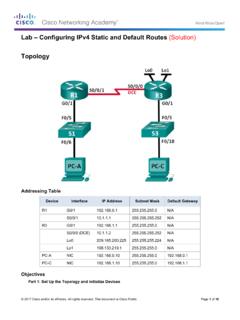
Lab – Configuring IPv4 Static and Default Routes (Solution ...
www.radford.eduPart 4: Configure and Verify a Default Route Background / Scenario A router uses a routing table to determine where to send packets. The routing table contains a set of routes that describe which gateway or interface the router uses to reach a specified network. Initially, the routing table contains only directly connected networks.