Capacity Building Series
sive to the children’s interests, provide opportunities for children to make their thinking visible and then foster further learning and engagement.” (2012, p. 67) Many futurists highlight the importance of innovation, entrepreneurship and creativity in an age of globalization and rapid technological development; others emphasize the
Download Capacity Building Series

Information
Domain:
Source:
Link to this page:
Documents from same domain

School Year Calendar 2017-2018 - Ontario
www.edu.gov.on.caThe 2017- 8 calendar provides for 195 possible school days between September 1, 2017 and June 30, 2018. The school year shall include a minimum of 194 school days of which three (3) days must be designated as professional activity days

Health and Physical Education - edu.gov.on.ca
www.edu.gov.on.ca4. THE ONTARIO CURRICULUM, GRADES 1 8 | Health and Physical Education. A variety of factors, known as the “determinants of health” (discussed in this document

Grades1-8 - Ontario
www.edu.gov.on.ca4 THE ONTARIO CURRICULUM, GRADES 1–8: MATHEMATICS This curriculum is designed to help students build the solid conceptual foundation in mathe-matics that will enable them to apply their knowledge and further their learning successfully.

Science and Technology - Ontario
www.edu.gov.on.caThis document replacesThe Ontario Curriculum, Grades 1–8: Science and Technology, 1998. Beginning in September 2008, all science and technology programs for Grades 1 to 8 will

Growing Success: Assessment, Evaluation and …
www.edu.gov.on.caGROWING SUCCESS| assessment, evaluation, and reporting in Ontario schools The Ministry of Education’s assessment, evaluation, …
CAPACITY BUILDING SERIES - Ontario
www.edu.gov.on.caThe Literacy and Numeracy Secretariat CAPACITY BUILDING SERIES The Capacity Building Seriesis produced by The Literacy and Numeracy Secretariat to support leadership and instructional

The Ontario Curriculum, Grades 1-8: The Arts, 2009 …
www.edu.gov.on.caThis document replaces The Ontario Curriculum, Grades 1–8: The Arts, 1998.Beginning in September 2009, all arts programs for Grades 1 to 8 will be based on the expectations
reading - Ontario
www.edu.gov.on.caTHINK LITERACY : Cross-Curricular Approaches, Grades 7-12 Reading Strategies Revise RRR Introduction to Reading Strategies Getting Ready to Read: Previewing a Text

The Ontario Curriculum, Grades 1-8, Language …
www.edu.gov.on.caThis document replaces The Ontario Curriculum, Grade 1–8: Language, 1997.Beginning in September 2006, all language programs for Grades 1 to 8 will be based on the expecta-
The Ontario Curriculum, Grades 9-12: English As a …
www.edu.gov.on.caEnglish as a Second Language and English Literacy Development 2007 Ministry of Education The Ontario Curriculum Grades 9 to 12 REVISED
Related documents
An introduction to attachment and the implications for ...
www.bathspa.ac.ukThe materials are informed by research and based ... This lasts into adult life. • But a significant minority struggle from an early stage ... make the most of learning opportunities, to engage in productive activities, problem-solve and explore the wider world. These children are emotionally
Early Literacy - Scholastic
teacher.scholastic.cominstruction. Providing children strong literacy education in the early years leads to better academic outcomes and reading success later on (Campbell et al., 2002). Therefore, it seems evident that involvement in rich language and literacy experiences at home and in the community creates tremendous opportunities for the child.
The Science of Early Childhood Development
developingchild.harvard.edufoundation. The first is the explosion of research in neurobiology that clari-fies the extent to which the interaction between genetics and early experience literally shapes brain architecture. The second is the increasingly recognized need for a highly skilled workforce and healthy adult population to confront
english Language arts Literacy in History/social studies ...
www.corestandards.orgResearch indicates that the demands that college, careers, and citizenship place on readers have either held steady or ... Reading levels among the adult population are also disturbingly low. The 2003 National Assessment of Adult Literacy (Kutner, Greenberg, Jin, Boyle, Hsu, & Dunleavy, 2007) reported that 14 percent of adults read prose texts ...
How digital technology can support early language and ...
cdn.literacytrust.org.ukThe Research Evidence ... Technology can play an important role in supporting early communication, language and literacy by offering new opportunities, such as interactive and intuitive story telling e-books and apps, as ... performance and adult outcomes. 9 Formby, S ...
Developing Literacy Through Play
files.eric.ed.gov(2003) conducted a study to research how families support their child’s literacy development. The participants in their study consisted of four different classes of 6 year olds in the United Kingdom. The purpose of the study was to research how literacy development occurs through social interactions within a home environment.
The Benefits of Participating in Extracurricular ...
files.eric.ed.govResearch indicates that participation in extracurricular activities positively correlates with ... who do not have adult support and guidance in their lives. Participating in extracurricular ... opportunities for students to experience the importance of community involvement.
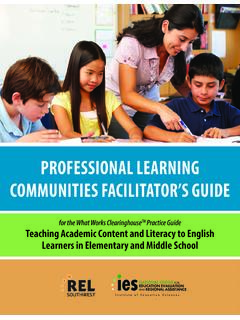
PROFESSIONAL LEARNING COMMUNITIES FACILITATOR’S …
ies.ed.govPLC facilitators. Given the rich content in literacy instruction addressed in this guide, ideally an educator with a strong literacy background and good communication skills should serve as the facilitator. It is also important that facilitators be regarded as lead ers in their schools and have the ability to relate well to adult learners.
Early Literacy and Numeracy
www.acecqa.gov.auand learn is not the same as for children of older ages. Promoting opportunities for children to explore, be exposed to and participate in literacy and numeracy is an important part of the early childhood years. Understanding what literacy and numeracy is and what it looks like is an important first step for the early childhood educator.

Digital Resources in Early Childhood Literacy Development
www.literacyworldwide.orgadult-dominated view of literacy. The meaning of reading and writing in the digital age has changed, and there is an urgent need to link play and literacy to the multimodal opportunities offered by new digital media. ... gent literacy. Educational Technology Research and Development, 60(1), 31–54.