
Cellular Respiration - Exploring Nature
Fermentation uses the pyruvate molecules made by glycolysis from glucose. The formula is: C 6 H 12 O 6 (glucose) CO 2 + 2 C 2 H 5 OH (alcohol) and some energy In the making of wine and beer (alcohol), yeast cells generate ATP by the fermentation of the sugars in fruit and grain (in the absence of oxygen).
Download Cellular Respiration - Exploring Nature

Information
Domain:
Source:
Link to this page:
Documents from same domain
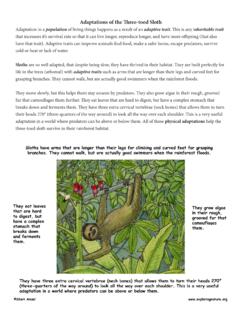
Adaptations of the Three-toed Sloth - The Exploring Nature ...
www.exploringnature.orgAdaptations of the Three-toed Sloth Adaptation in a population of living things happens as a result of an adaptive trait.This is any inheritable trait that increases it’s survival rate so that it can live longer, reproduce longer, and have more offspring (that also
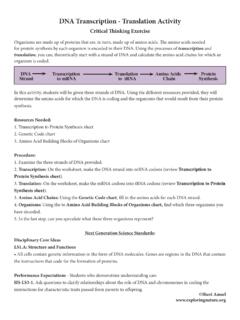
DNA Transcription - Translation Activity
www.exploringnature.orgGenes are regions in the DNA that contain the instructions that code for the formation of proteins. Performance Expectations - Students who demonstrate understanding can: HS-LS3-1. Ask questions to clarify relationships about the role of DNA and chromosomes in coding the
Digestive System - Multiple Choice Test - Exploring Nature
www.exploringnature.orgThe accessory digestive organs include all of the following, EXCEPT: A tongue B liver C pancreas D stomach The gastrointestinal tract (GI tract) includes all of the following, EXCEPT: A esophagus B liver C stomach D small intestine Mechanical digestion begins in the: A mouth B stomach C small intestine D large intestine
Circulatory System - Multiple Choice Test
www.exploringnature.orgB the heart valves opening and closing. C the blood moving in and out of the heart. D the blood moving in and out of the lungs. The heart valves do all of the following, EXCEPT: A separate the atria and the ventricles. B keep the blood flowing forward. C regulate the heart’s contractions. D include the mitral valve and bicuspid valve.
Matter Assessment and NGSS - Exploring Nature
www.exploringnature.orgScience and Engineering Practices: Developing and Using Models Modeling in 6–8 builds on K–5 and progresses to developing, using and revising models to describe, test, and predict more abstract phenomena and design systems. • Develop a model to predict and/or describe phenomena. (MS-PS1-1),(MS-PS1-4)
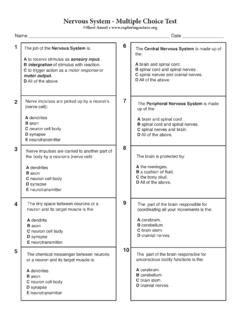
Nervous System - Multiple Choice Test - Exploring Nature
www.exploringnature.orgThe Central Nervous System is made up of the: brain and spinal cord. B spinal cord and spinal nerves. C spinal nerves and cranial nerves. D All of the above. The Peripheral Nervous System is made up of the: A brain and spinal cord. B spinal cord and spinal nerves. C spinal nerves and brain. D All of the above. The part of the brain responsible for
Bones and Features of the Skull - Cranium and Face
www.exploringnature.orgBones and Features of the Skull - Cranium and Face ©Sheri Amsel • www.exploringnature.org Bones of the Cranium The cranium is made up of 8 bones: 2 (paired) parietal bones • 2 (paired) temporal bones • frontal bone • occipital bone • sphenoid bone • ethmoid bone The frontal bone is located on the anterior cranium and includes the following features:

Phases of the Moon - Exploring Nature
www.exploringnature.org2. The moon takes the same amount of time to rotate once around on its axis as it does to revolve around the Earth - so the same side of the moon always faces the Earth. The moon looks different during its revolution around the Earth, because at each position its is getting a different amount of sunlight on its surface.
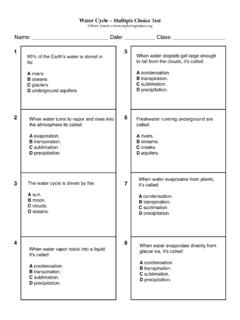
Water Cycle – Multiple Choice Test - Exploring Nature
www.exploringnature.orgC creeks. D aquifers. The water cycle is driven by the: A sun. B moon. C clouds. D oceans. When water turns to vapor and rises into the atmosphere its called: A evaporation. B transpiration. C sublimation. D precipitation. When water evaporates directly from glacial ice, it’s called: A condensation. B transpiration. C sublimation. D ...
Endocrine System - Multiple Choice Test - Exploring Nature
www.exploringnature.orgEndocrine System - Multiple Choice Test KEY ... The endrocrine system works together with the _____ system to maintain the body’s equilibrium? A digestive system B nervous system C respiratoy system D reproductive system Hormones help balance the body’s reactions differently than nerve impulses in that:
Related documents
Lab 5 Sugar Fermentation in Yeast - Green River College
www.instruction.greenriver.eduprotists, w/o Ofungi, plants, and animals) utilize aerobic respiration and/or fermentation (anaerobic respiration) to produce ATP to power their cellular processes. Note that ethanol is a by-product of alcoholic fermentation (figure 1). Ethanol, a 2-carbon alcohol, is also known as ethyl alcohol and, less correctly, simply as ―alcohol‖.

pH and Fermentation - Agriculture with Mrs. Skien
agriculturewithmrsskien.weebly.commentation and lactic acid fermentation. Alcoholic fermentation is a reaction caused by many microorganisms, includ-ing yeast, that produces alcohol and car-bon dioxide. Lactic acid fermenta-tion is a process that occurs as pyruvic acid is changed into lactic acid. Lactic acid fermentation occurs in our own muscle cells and has probably been felt
Care of the Patient Undergoing Alcohol Withdrawal
www.clevelandclinic.org• Alcohol, or ethanol, is produced by the fermentation of yeast, sugars and starches. Yeast breaks sugar down into ethanol and carbon dioxide. Ethanol is water soluble and fat soluble, which ... Alcohol Withdrawal In Hospitalized Patients, Journal of the American Academy of Physician Assistants.
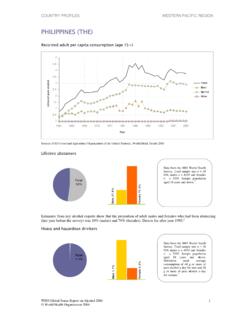
philippines - World Health Organization
www.who.intUnrecorded alcohol consumption The unrecorded alcohol consumption in the Philippines is estimated to be 3.0 litres pure alcohol per capita for population older than 15 for the years after 1995 (estimated by a group of key alcohol experts).2 Mortality rates from selected death causes where alcohol is one of the underlying risk factors

DMT Operator Manual v4 - Minnesota
dps.mn.govSep 03, 2019 · Alcohol Production Fermentation Ethyl alcohol is produced naturally through the process of fermentation of sugar or starch by yeast. Fermentation is the only process by which beer and wine are produced, and it is the first step in the product of distilled spirits. Because natural, common yeast cannot survive in high
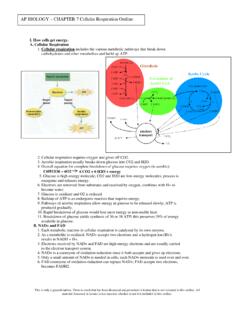
AP BIOLOGY – CHAPTER 7 Cellular Respiration Outline
bxscience.enschool.orgFeb 04, 2014 · During fermentation, glucose is incompletely metabolized to lactate or CO2 and alcohol. c. Fermentation results in a net gain of only two ATP per glucose molecule. II. Outside the Mitochondria: Glycolysis A. Glycolysis 1. Occurs in the cytosol outside the mitochondria. 2. Is the breakdown of glucose to two pyruvate molecules.

Citric acid and salts - Agricultural Marketing Service
www.ams.usda.gov122 fermentation. This process is discussed in detail under Evaluation Question #1 in the section on recovery of 123 citric acid. Current good manufacturing practice (GMP) for solvents results in residues not exceeding 16 124 parts per million (ppm) n-octyl alcohol and 0.47 ppm synthetic isoparaffinic petroleum hydrocarbons in