Ceramics: Sintering and Microstructure
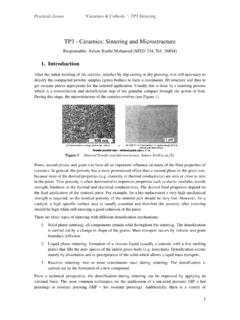
TP3 - Ceramics: Sintering and Microstructure Responsable: Aslam Kunhi Mohamed (MXD 334, Tel: 36894) 1. Introduction After the initial molding of the ceramic, whether by slip casting or dry pressing, it is still necessary to densify the compacted powder samples (green bodies) to form a continuous 3D structure and thus to
Download Ceramics: Sintering and Microstructure

Information
Domain:
Source:
Link to this page:
Documents from same domain

Perovskites: crystal structure, important compounds and ...
www.epfl.chThe Perovskite Bandgap can be tuned by Chemical Substitution The band gap can be tuned from 1.57 eV to 2.23 eV by substituting bromine for iodine in CH 3 NH 3 Pb(Br x I 1-x) 3 Noh et al., Nano Lett. 2013 For hybrid tandem with CIGS eV But the morphology is not stable!

TLC Visualization Reagents
www.epfl.chTLC Visualization Reagents This is a brief selection of the many available TLC visualization reagents. Below each title is the type of compounds or structure which can be detected with the specific reagent. When beginning work with these reagents, acquired any MSDS (material safety data sheets) to see if there are any extra precautions needed in
§ 8 (suite) Equation de Nernst
www.epfl.chEquation de Nernst 191 192 Potentiel standard et équilibre Nous avons vu au chapitre 5 que l’enthalpie libre standard de réaction ΔG r 0 est reliée à la constante d’équilibre K de la réaction par : ΔG r 0 = – n F·ΔE0 ΔG r 0 = – RT· ln K Or, il a été établi dans ce chapitre que l’enthalpie libre standard de réaction est ...

Principe de superposition – Corrigé Exercice 1
www.epfl.chPrincipe de superposition – Corrigé Exercice 1 Le principe de superposition est une méthode qui permet, dans un circuit linéaire soumis à l’action de plusieurs sources indépendantes, de déterminer le courant résultant en un point quelconque du circuit ou encore la tension aux bornes de n’importe quel élément. En effet, il
Related documents

Stainless Steels Welding Guide - Lincoln Electric
www.lincolnelectric.commicrostructure of approximately equal amounts of ferrite and austenite. They contain roughly 24% chromium and 5% nickel. Their numbering system is not included in the 200, 300 or 400 groups. Precipitation hardening stainless steels contain alloying additions such as aluminum which allow them to be hardened by a solution and aging heat treatment.

Welding Handbook - American Welding Society
pubs.aws.orgmental to the microstructure of the materials being joined. As hot metal tends to oxidize, sufficient protec-tion from oxidation must be provided by the welding process to prevent this detrimental reaction with ambi-ent oxygen. Some metals are far more sensitive than others, in which case protection from oxidation becomes more demanding.

16. THE SONIC OR ACOUSTIC LOG 16.1 Introduction
homepages.see.leeds.ac.uk16.1 Introduction The sonic or acoustic log measures the travel time of an elastic wave through the formation. This information can also be used to derive the velocity of elastic waves through the formation. Its main use is to provide information to support and calibrate seismic data and to derive the porosity of a formation. The main uses are:
COMPOSITE MATERIALS HANDBOOK - University of …
www.library.ucdavis.edupart a. introduction and guidelines part b. design and supportability part c. testing part d. data requirements and data sets appendix a. derivation of the residual strength reduction expressions for lcf and rupture loadings page
Introduction to XRPD Data Analysis
prism.mit.eduabout the sample microstructure • Peak broadening may indicate: – Smaller crystallite size in nanocrystalline materials – More stacking faults, microstrain, and other defects in the crystal structure – An inhomogeneous composition in a solid solution or alloy • However, different instrument configurations can change the peak width, too
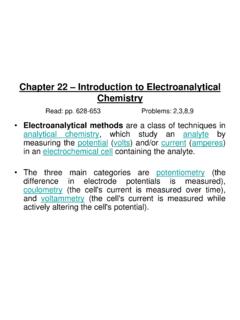
Chapter 22 – Introduction to Electroanalytical Chemistry
www2.chemistry.msu.eduChapter 22 – Introduction to Electroanalytical Chemistry • Electroanalytical methods are a class of techniques in analytical chemistry, which study an analyte by measuring the potential (volts) and/or current (amperes) in an electrochemical cell containing the analyte.

Introduction to Friction Stir Welding (FSW) - NASA
ntrs.nasa.govFSW Background Friction Stir Welding is a solid-state process that was patented in 1991 by The Welding Institute (TWI) of Cambridge, England [5]. This patent is now expired. Since its invention the process has generated significant interests in the R&D community. By 2007, 1800 patents had been issued relating to Friction Stir Welding [6].
Microstructure Analysis for Additive Manufacturing: A ...
nvlpubs.nist.govUnderstanding the microstructure of AM materials, i.e. parts made by AM processes, is important for industry to have confidence in AM parts. The focus of this report is to assess the existing microstructure standards for metals to determine if the existing standards are sufficient for characterizing AM metals.