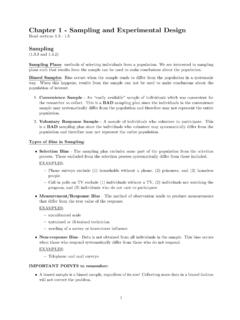
Chapter 1 - Sampling and Experimental Design
Principles of Experimental Design (1.5) Experimental Designs: methods of assigning treatments to individuals (units or cases) Unit: an individual in an experiment Subject: a human experimental unit Factor: a categorical explanatory variable …
Download Chapter 1 - Sampling and Experimental Design

Information
Domain:
Source:
Link to this page:
Documents from same domain
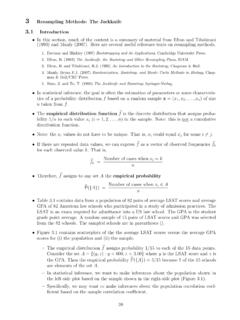
Resampling Methods: The Jackknife
math.montana.edu{ The ith jackknife replication is ˙ i = v u u t 1 \ 19 X j6=i (x j x)2 which is calculated from the 19 values (without x i) in the ith jackknife sample. The values are given in the rst SD column. 3.2.1 Jackknife Bias Estimation Let b = Xn i=1 b (i)=n. The jackknife estimate of bias is de ned as bias(d b) = (n 1)( b b ) (3) The bias-corrected ...

RANDOMIZED COMPLETE BLOCK DESIGN (RCBD)
math.montana.edu3 RANDOMIZED COMPLETE BLOCK DESIGN (RCBD) The experimenter is concerned with studying the e ects of a single factor on a response of interest. However, variability from another factor that is not of interest is expected.

6 The Literature Review - Montana State University
math.montana.edu6.2 An Outline for Preparing a Literature Review. 1. Generate a list of references: † Make a preliminary list of statistical literature that is relevant to your research topic. Your advisor can help you with this. † Now you have to ‘procure’ (get copies of) the literature on the list. How much time this takes can vary greatly. Some books and journals may be available from

Proof.
math.montana.edu2.1.2(k) The sequence a n = (1 if n is odd 1/n if n is even diverges. Proof. Assume not. Then the sequence converges to some limit A ∈ R. By definition of convergence (with = 1/4) ... We know that monotone bounded sequences converge, so there exists some limit A ∈ R. We can pass to the limit in the recursive equation to get

4.15 Three Factor Factorial Designs complete interaction …
math.montana.eduThe complete interaction model for a three-factor completely randomized design is: y ijkl = (35) { is the baseline mean, { ˝ i, j, and k are the main factor e ects for A, B, and C, respectively. { (˝ ) ij, (˝) ik and ( ) jk are the two-factor interaction e ects for interactions AB, AC, and BC, respectively. { (˝ ) ijk are the three-factor ...
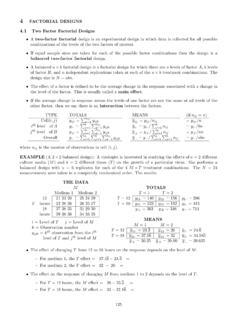
FACTORIAL DESIGNS Two Factor Factorial Designs
math.montana.edu4.1 Two Factor Factorial Designs A two-factor factorial design is an experimental design in which data is collected for all possible combinations of the levels of the two factors of interest. If equal sample sizes are taken for each of the possible factor combinations then the design is a balanced two-factor factorial design.

5.1 Ratio Estimation - Montana State University
math.montana.eduThe most common case is the population ratio Bof means or totals: B = 2. ... recently cut trees). The process begins by 1. Weighing the total amount of pulpwood ... states in the United States. By chance, this sample does not contain any counties from Alaska, Arizona, Connecticut, Delaware, Hawaii, Rhode Island, Utah, or Wyoming.

Homework 1 Solutions - Montana State University
math.montana.eduHomework 1 Solutions 1.1.4 (a) Prove that A ⊆ B iff A∩B = A. Proof. First assume that A ⊆ B. ... the two inclusions show the claimed set equality. 1.2.5 Prove that if a function f has a maximum, then supf exists and maxf = supf. ... For the following …

3.11 Latin Square Designs - Montana State University
math.montana.eduB, C, D). A plot of land was divided into 16 subplots (4 rows and 4 columns) The following latin square design was run. The responses are given in the table to the right. Treatment (peanut variety) Column Row E EC WC W N C A B D NC A B D C SC B D C A S D C A B Response (yield) Column Row E EC WC W N 26.7 19.7 29.0 29.8 NC 23.1 21.7 24.9 29.0 SC ...
Related documents
Qualitative Research Designs - University of Tennessee
biotap.utk.eduvariables (as found in experimental or correlational studies) and do not involve a treatment (found in single-subject studies and various experimental designs; e.g., Kahn, 2006 [TCP special issue, part 1]). Instead, the questions
Experimental design and sample size determination
www.biostat.wisc.edu–Average multiple measurements on each subject. 35 Final conclusions •Experiments should be designed. •Good design and good analysis can lead to reduced sample sizes. •Consult an expert on both the analysis and the design of your experiment. 36

Chapter 14. Experimental Designs: Single-Subject Designs ...
uca.eduChapter 14. Experimental Designs: Single-Subject Designs and Time-series Designs Introduction to Single-Subject Designs Advantages and Limitations Advantages of the single-subject approach Limitations of the single-subject approach Why Some Researchers Use the Single-Subject Method Procedures for the Single-Subject Design Establishing a baseline

Epidemiologic Study Designs - Hopkins Medicine
www.hopkinsmedicine.orgEpidemiologic Study Designs •Descriptive studies –Seeks to measure the frequency of disease and/or collect descriptive data on risk factors •Analytic studies –Tests a causal hypothesis about the etiology of disease •Experimental studies –Compares, for example, treatments
SUGI 27: Generating Randomization Schedules Using SAS(r ...
support.sas.comThe PLAN procedure constructs designs and randomizes plans for factorial experiments, specifically nested and crossed experiments and randomized block designs. PROC PLAN can also be used for generating lists of permutations and combinations of numbers. The PLAN procedure can construct the following types of experimental designs:

Inclusion and Exclusion Criteria
www.unm.eduExperimental Designs: Preliminary Info. It is also important to distinguish how researchers control knowledge of treatments/interventions between themselves and the subjects • Single blind = when either (not both) of the subjects or the researchers do not know the nature/specifics of the intervention(s). • Double blind = when both the

Chapter 30 Introducing Qualitative Designs
www.sfu.caexperimental and experimental designs and their accompanying threats to validity announced by Campbell and Stanley (1963). Quantitative research. then expanded into the diverse approaches that we know today, including surveys, single-subject research, and the multiple experimental research forms. I felt that it was a matter of time until ...