
CHAPTER 1. SOIL PHYSICAL PROPERTIES
Forces acting on soil particle are gravitation, buoyancy and drag forces, and all depend on particle size; The larger particles settle first à Stokes law Since soils are a mixture of different size particles, soil’s are classified using the so-called soil textural triangle.
Download CHAPTER 1. SOIL PHYSICAL PROPERTIES

Information
Domain:
Source:
Link to this page:
Documents from same domain
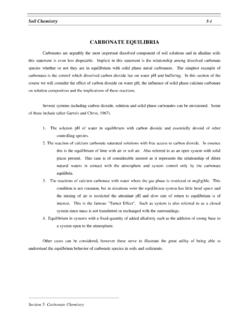
CARBONATE EQUILIBRIA - UC Davis
lawr.ucdavis.eduSoil Chemistry 5-1 Section 5- Carbonate Chemistry CARBONATE EQUILIBRIA Carbonates are arguably the most important dissolved component of …
CHAPTER 1. SOIL PHYSICAL PROPERTIES - UC Davis
lawr.ucdavis.eduSSC107-Fall 2000 Chapter 1, Page - 2 - Soils are extremely complex, hence we often simplify to study and understand soil physical
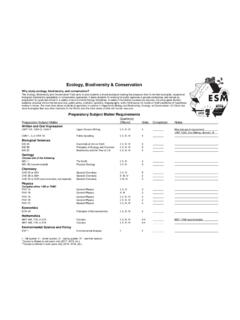
Ecology, Biodiversity & Conservation
lawr.ucdavis.eduBIS 2A Essentials of Life on Earth I, II, III, IV 5 BIS 2B Principles of Ecology and Evolution I, II, III, IV 5 BIS 2C Biodiversity and the Tree of Life I, II, III, IV 5 ... ESP 170* Conservation Biology Policy ESP 1, ECN 1A; ECN 100 or ARE 100A recommended III 4
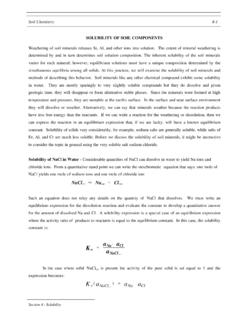
a a a - Department of Land, Air and Water Resources
lawr.ucdavis.eduSoil Chemistry 4-6 Section 4 - Solubility The Gibbsite case is a simple graphical representation of equilibrium over several values of pH. Application of this technique to any other chemical reaction is carried out in the same way.
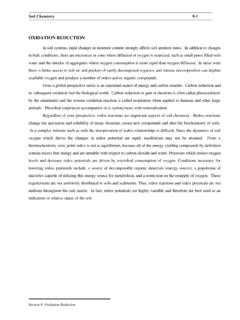
OXIDATION REDUCTION - University of California, Davis
lawr.ucdavis.eduSoil Chemistry 9-2 Section 9- Oxidation Reduction Eh -pH RELATIONSHIPS Thermochemistry background The Gibbs free energy (G) may be defined in differential form as: dG = - Sd T - V dP - w ′ (1) where w' is defined as the useful work in a chemical system ( non-pressure, volume work) in our case this will be the electrical work of the system.
CHAPTER 1. SOIL PHYSICAL PROPERTIES
lawr.ucdavis.edusubsequent weathering and recomposition into new ones (clay minerals). ... SSC107-Fall 2000 Chapter 1, Page - 11 - The following graph from Greacen (1958), shows the influence of exposure time to ... SSC107-Fall 2000 Chapter 1, Page - 17 - Water content measures: 1. Water content by mass (gravimetric water content: ...
CARBONATE EQUILIBRIA
lawr.ucdavis.eduCalcium carbonate in water with a fixed partial pressure of carbon dioxide. For the case of a fixed partial pressure of carbon dioxide and calcium carbonate dissolved in the aqueous phase one more equation is need to describe the system. This is the solubility product of calcium carbonate: = K ( CaCO ) ( Ca ) ( CO ) o CaCO 3 2 - 3 2 + 3 (19)
Related documents

Soil Particle Analysis Procedure
nctx-water.tamu.eduThe soil makes the final treatment of the wastewater. Treatment is effective when the soil holds the wastewater long enough for microbes to remove contaminants. Aerobic microbes need air to survive. The amount of air in soil depends on the size of soil particles. Soil particle analysis determines the size of soil particles and can be used to ...
Inherent Factors Affecting Soil pH - USDA
www.nrcs.usda.govSoil pH is an excellent indicator of a soil’s suitability for plant growth For most . crops, a range of 6 to 7.5 is best as shown in Table 1. Soil pH levels that are too high or too low (Figure 1.) lead to deficiency of many nutrients, decline in microbial activity, decrease in crop yield, and deterioration of soil health. ...
8 Managing Soil pH and Crop Nutrients
extension.cropsciences.illinois.edubut misleading soil test results may be obtained if samples are not taken to the proper depth. Shallow samples will Figure 8.1. How to take soil samples with a soil probe, an auger, and a spade. Soil probe Auger Spade Soil slice 1/2'' thick Figure 8.2. How to collect soil samples from a 40-acre field. Each sample (diagram a) should consist of ...

Unified Soil Classification System
dot.ca.govUNIFIED SOIL CLASSIFICATION SYSTEM . UNIFIED SOIL CLASSIFICATION AND SYMBOL CHART . COARSE-GRAINED SOILS (more than 50% of material is larger than No. 200 sieve size.) GRAVELS More than 50% of coarse fraction larger than No. 4 sieve size SANDS 50% or more of coarse fraction smaller than No. 4 sieve size Clean Gravels (Less than 5% fines) GW GP

Basic Soil Properties - Purdue Agriculture
ag.purdue.eduAgronomy 105 Soil & Water: Basic Soil Properties 15 Soil Texture and Surface Area •As particle size decreases, surface area increases –For the same volume, clay has about 10,000 times as much surface area as sand •Surface area has a big effect on: –Water holding capacity –Chemical reactions –Soil cohesion
SAND, SILT and CLAY
archive.lib.msu.eduparticle size distribution for each. Some confusion occurs between the use of these terms by many turf managers and the soil scientist. The soil scientist considers the name loam or clay to refer to a range of particle sizes in a soil. The turf manager often refers to a loam as a soil which is easy to till or is not compacted whereas a clay is ...

Soil Texture and Structure - carlisle.k12.ky.us
www.carlisle.k12.ky.usClay is the smallest size soil particle. Clay has the ability to hold both nutrients and water that can be used by plants. It creates very small pore spaces, resulting in poor aeration and poor water drainage. Clay forms hard clumps when dry and is sticky when wet. TABLE 1. Characteristics of Sand, Silt, and Clay