
CHAPTER 1. SOIL PHYSICAL PROPERTIES
Surface area of soil affects its physical and chemical properties and is largely determined by amount of clay present in soil: Specific surface area of soil particles Effective Area Specific Surface Area Particle Diameter (cm) Mass (g) (cm2) (cm2 g-1) Gravel 2 x 10⁻¹ 1.13 x 10⁻² 1.3 x 10⁻¹ 11.1 Sand 5 x 10⁻³ 1.77 x 10⁻⁷ 7.9 x 10⁻⁵ 444.4
Download CHAPTER 1. SOIL PHYSICAL PROPERTIES

Information
Domain:
Source:
Link to this page:
Documents from same domain
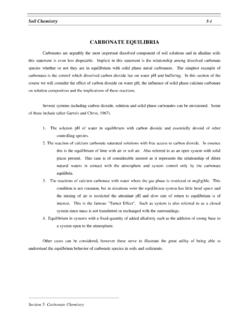
CARBONATE EQUILIBRIA - UC Davis
lawr.ucdavis.eduSoil Chemistry 5-1 Section 5- Carbonate Chemistry CARBONATE EQUILIBRIA Carbonates are arguably the most important dissolved component of …
CHAPTER 1. SOIL PHYSICAL PROPERTIES - UC Davis
lawr.ucdavis.eduSSC107-Fall 2000 Chapter 1, Page - 2 - Soils are extremely complex, hence we often simplify to study and understand soil physical

Ecology, Biodiversity & Conservation
lawr.ucdavis.eduBIS 2A Essentials of Life on Earth I, II, III, IV 5 BIS 2B Principles of Ecology and Evolution I, II, III, IV 5 BIS 2C Biodiversity and the Tree of Life I, II, III, IV 5 ... ESP 170* Conservation Biology Policy ESP 1, ECN 1A; ECN 100 or ARE 100A recommended III 4
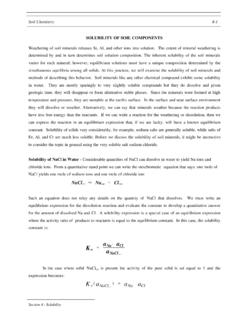
a a a - Department of Land, Air and Water Resources
lawr.ucdavis.eduSoil Chemistry 4-6 Section 4 - Solubility The Gibbsite case is a simple graphical representation of equilibrium over several values of pH. Application of this technique to any other chemical reaction is carried out in the same way.
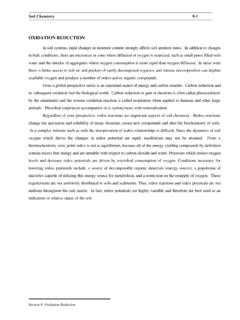
OXIDATION REDUCTION - University of California, Davis
lawr.ucdavis.eduSoil Chemistry 9-2 Section 9- Oxidation Reduction Eh -pH RELATIONSHIPS Thermochemistry background The Gibbs free energy (G) may be defined in differential form as: dG = - Sd T - V dP - w ′ (1) where w' is defined as the useful work in a chemical system ( non-pressure, volume work) in our case this will be the electrical work of the system.
CHAPTER 1. SOIL PHYSICAL PROPERTIES
lawr.ucdavis.eduForces acting on soil particle are gravitation, buoyancy and drag forces, and all depend on particle size; The larger particles settle first à Stokes law Since soils are a mixture of different size particles, soil’s are classified using the so-called soil textural triangle.
CARBONATE EQUILIBRIA
lawr.ucdavis.eduCalcium carbonate in water with a fixed partial pressure of carbon dioxide. For the case of a fixed partial pressure of carbon dioxide and calcium carbonate dissolved in the aqueous phase one more equation is need to describe the system. This is the solubility product of calcium carbonate: = K ( CaCO ) ( Ca ) ( CO ) o CaCO 3 2 - 3 2 + 3 (19)
Related documents
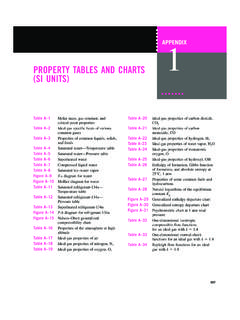
PROPERTY TABLES AND CHARTS (SI UNITS)
homepages.wmich.eduTable A–1 Molar mass, gas constant, and critical-point properties Table A–2 Ideal-gas specific heats of various common gases Table A–3 Properties of common liquids, solids, and foods Table A–4 Saturated water—Temperature table Table A–5 Saturated water—Pressure table Table A–6 Superheated water Table A–7 Compressed liquid water Table A–8 Saturated ice–water vapor

FLOW OF GASES THROUGH TUBES AND ORIFICES
atomoptics-nas.uoregon.eduProperties of Some Common Gases at 20°C Relative Molecular Viscosity Viscosity Ratio Gas Mass Pa' s x 10-6 (Air/Gas) ~ H2 2 8.8 2.07 0.543 He 4 19.6 0.929 0.345 H20 (vapor) 18 9.7 1.88 1.48 N2 28 17.6 1.93 1.02 Air 29 18.2 1 1 O2 32 20.4 0.892 0.937 Ar 40 22.3 0.818 0.959 ...

THE PROPERTIES AND STRUCTURE OF MATTER
www.nust.na2. Properties of solids, liquids and gases 3. Changes in matter Physical and chemical changes Phase changes of matter 4. Classification of matter Elements, compounds and mixtures 5. Separation of mixtures

I. Multiple Choice Questions (Type-I) 1. Which of the ...
cdn1.byjus.com8. Colligative properties depend on _____. (i) the nature of the solute particles dissolved in solution. (ii) the number of solute particles in solution. (iii) the physical properties of the solute particles dissolved in solution. (iv) the nature of solvent particles. Solution: Option …

Characterization of Polydimethylsiloxane (PDMS) Properties ...
web.mit.eduPDMS is a silicone elastomer with desirable properties that make it attractive for the development of MEMS and microfluidics components for biomedical applications (Jo et al., 2000; Mata et al., 2002b; McDonald and White-sides, 2002; Unger et al., 2000). It is chemically inert, thermally stable, permeable to gases, simple to handle
Parylene Conformal Coating Specifications & Properties
engineering.tufts.eduphysical properties plus a very low permeability to moisture and other corrosive gases. Along with its ability to provide a true pinhole free conformal insulation, Parylene C is the material of choice for coating c assemblies. ritical electronic
PHYSICAL PROPERTIES OF LIQUIDS AND GASES
booksite.elsevier.com828 PHYSICAL PROPERTIES OF LIQUIDS AND GASES TABLE C-1 Density of Liquids No. Formula Substance AB n T c T min T max 1 C 2H 3C l3 1,1,1-Trichloroethane 0.47476 0.27258 0.29333 545.00 242.75 545.00 1.330 2 C 2H 3C l3 1,1,2-Trichloroethane 0.47455 0.25475 0.31000 602.00 236.50 602.00 1.435 3 C 2H 4C l2 1,1-Dichloroethane 0.41231 0.26533 …
Thermodynamics - Basic Concepts - Durham College
durhamcollege.caRelevant concepts and definitions for gases Pressure Pressure is defined as a force applied over the surface area of an object. The formula defining

Mechanical)Properties)of) Polymers) - Harvard University
scholar.harvard.eduOct 17, 2013 · Mechanical)Properties)of) Polymers) Kamyar)Davoudi) October,2013 Materials)Science)Seminar
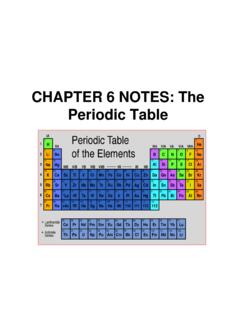
CHAPTER 6 NOTES: The Periodic Table
www.wlwv.k12.or.usmass and similar properties ... (O, Cl) are gases at room temp. others (S) are brittle solids. METALLOIDS: Characteristics: on the stair-step line that divides the metals from the nonmetals exhibit properties that are intermediate between those of metals and nonmetals