
CHAPTER 1. SOIL PHYSICAL PROPERTIES
- Hardness - Mechanical impedance (cone-penetrometer tests) - Crusting (infiltration measurements) - Compaction (bulk density measurements) Soil structure deterioration by: 1. Tillage and cultivation 2. Decrease in organic matter 3. Silt and salt in irrigation water.
Download CHAPTER 1. SOIL PHYSICAL PROPERTIES

Information
Domain:
Source:
Link to this page:
Documents from same domain
CARBONATE EQUILIBRIA - UC Davis
lawr.ucdavis.eduSoil Chemistry 5-1 Section 5- Carbonate Chemistry CARBONATE EQUILIBRIA Carbonates are arguably the most important dissolved component of …
CHAPTER 1. SOIL PHYSICAL PROPERTIES - UC Davis
lawr.ucdavis.eduSSC107-Fall 2000 Chapter 1, Page - 2 - Soils are extremely complex, hence we often simplify to study and understand soil physical
Ecology, Biodiversity & Conservation
lawr.ucdavis.eduBIS 2A Essentials of Life on Earth I, II, III, IV 5 BIS 2B Principles of Ecology and Evolution I, II, III, IV 5 BIS 2C Biodiversity and the Tree of Life I, II, III, IV 5 ... ESP 170* Conservation Biology Policy ESP 1, ECN 1A; ECN 100 or ARE 100A recommended III 4
a a a - Department of Land, Air and Water Resources
lawr.ucdavis.eduSoil Chemistry 4-6 Section 4 - Solubility The Gibbsite case is a simple graphical representation of equilibrium over several values of pH. Application of this technique to any other chemical reaction is carried out in the same way.
OXIDATION REDUCTION - University of California, Davis
lawr.ucdavis.eduSoil Chemistry 9-2 Section 9- Oxidation Reduction Eh -pH RELATIONSHIPS Thermochemistry background The Gibbs free energy (G) may be defined in differential form as: dG = - Sd T - V dP - w ′ (1) where w' is defined as the useful work in a chemical system ( non-pressure, volume work) in our case this will be the electrical work of the system.
CHAPTER 1. SOIL PHYSICAL PROPERTIES
lawr.ucdavis.edusubsequent weathering and recomposition into new ones (clay minerals). ... SSC107-Fall 2000 Chapter 1, Page - 11 - The following graph from Greacen (1958), shows the influence of exposure time to ... SSC107-Fall 2000 Chapter 1, Page - 17 - Water content measures: 1. Water content by mass (gravimetric water content: ...
CARBONATE EQUILIBRIA
lawr.ucdavis.eduCalcium carbonate in water with a fixed partial pressure of carbon dioxide. For the case of a fixed partial pressure of carbon dioxide and calcium carbonate dissolved in the aqueous phase one more equation is need to describe the system. This is the solubility product of calcium carbonate: = K ( CaCO ) ( Ca ) ( CO ) o CaCO 3 2 - 3 2 + 3 (19)
Related documents
PHYSICAL PROPERTIES OF ROCK
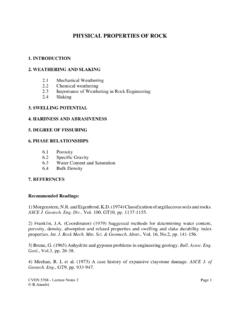
ceae.colorado.eduTests n eed to be conducted to assess ... hardness, abrasiveness, and other properties such as porosity, density, water content, etc. Most of those properties are intact rock properties. 2. WEATHERING AND SLAKING When exposed to atmospheric conditions, rocks slowly break down. This process is called

Experiment: Mechanical Testing- Impact & Hardness Testing
imechanica.orgThe main objective of this experiment is to introduce two important basic mechanical property tests; hardness (using Rockwell testing) and impact (using Charpy testing). Chauvenet’s Criterion will be applied to identify outliers and probability paper will be used to ascertain whether or not the repeated measure hardness data is normally ...
Macropoxy 646 Fast Cure Epoxy 4-53
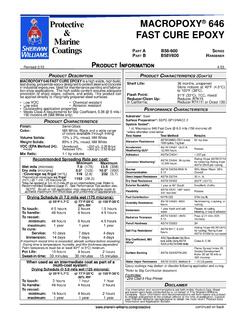
p3cdn4static.sharpschool.comPencil Hardness ASTM D3363 3H Salt Fog Resistance1 ASTM B117, 6,500 hours Rating 10 per ASTM D610 for rusting; Rating 9 per ASTM D1654 for corrosion Slip Coeffi cient, Mill White* AISC Specification for Struc-tural Joints Using ASTM A325 or ASTM A490 Bolts Class A, 0.36 Surface Burning ASTM E84/NFPA 255 Flame Spread Index 20; Smoke Development

Thermoplastic Ployurethane Elastomers (TPU) BASF
plastics-rubber.basf.comThe hardness of elastomers such as Elastollan® is measured in Shore A and Shore D according to DIN ISO 7619-1 (3s). Shore hardness is a measure of the resistance of a material to the penetration of a needle under a defined spring force. It is determined as a number from 0 to 100 on the scales A or D. The higher the number, the higher the hardness.
Standard Hardness Conversion Tables for Metals ...
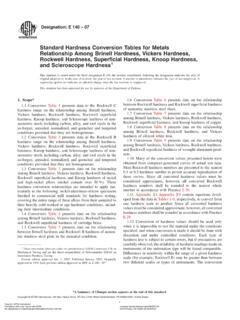
www.3ppars.com6.2 Since the various types of hardness tests do not all measure the same combination of material properties, conver-sion from one hardness scale to another is only an approximate process. Because of the wide range of variation among different materials, it is not possible to state confidence limits for the errors in using a conversion chart.