
CHAPTER 1. SOIL PHYSICAL PROPERTIES
1. Size - Particles (particle size distribution) - Aggregates (dry-sieving; water stability test by wet-sieving) - Porosity 2. Morphological - Blocky - Plately - Prismatic 3. Physical - Pore size distribution - water desorption method 1.0 Volume fraction of little structure total pore space 0.5 much structure 0.0 50 100 150 Pore diameter ...
Download CHAPTER 1. SOIL PHYSICAL PROPERTIES

Information
Domain:
Source:
Link to this page:
Documents from same domain
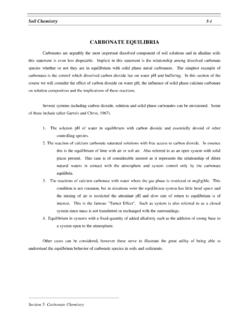
CARBONATE EQUILIBRIA - UC Davis
lawr.ucdavis.eduSoil Chemistry 5-1 Section 5- Carbonate Chemistry CARBONATE EQUILIBRIA Carbonates are arguably the most important dissolved component of …
CHAPTER 1. SOIL PHYSICAL PROPERTIES - UC Davis
lawr.ucdavis.eduSSC107-Fall 2000 Chapter 1, Page - 2 - Soils are extremely complex, hence we often simplify to study and understand soil physical
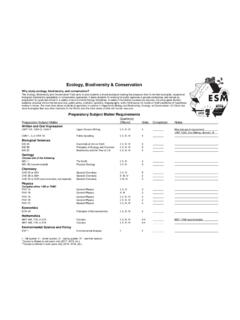
Ecology, Biodiversity & Conservation
lawr.ucdavis.eduBIS 2A Essentials of Life on Earth I, II, III, IV 5 BIS 2B Principles of Ecology and Evolution I, II, III, IV 5 BIS 2C Biodiversity and the Tree of Life I, II, III, IV 5 ... ESP 170* Conservation Biology Policy ESP 1, ECN 1A; ECN 100 or ARE 100A recommended III 4
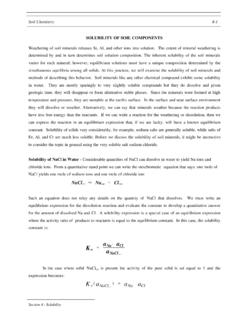
a a a - Department of Land, Air and Water Resources
lawr.ucdavis.eduSoil Chemistry 4-6 Section 4 - Solubility The Gibbsite case is a simple graphical representation of equilibrium over several values of pH. Application of this technique to any other chemical reaction is carried out in the same way.
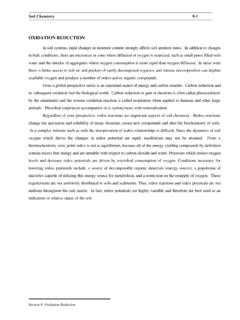
OXIDATION REDUCTION - University of California, Davis
lawr.ucdavis.eduSoil Chemistry 9-2 Section 9- Oxidation Reduction Eh -pH RELATIONSHIPS Thermochemistry background The Gibbs free energy (G) may be defined in differential form as: dG = - Sd T - V dP - w ′ (1) where w' is defined as the useful work in a chemical system ( non-pressure, volume work) in our case this will be the electrical work of the system.
CHAPTER 1. SOIL PHYSICAL PROPERTIES
lawr.ucdavis.eduForces acting on soil particle are gravitation, buoyancy and drag forces, and all depend on particle size; The larger particles settle first à Stokes law Since soils are a mixture of different size particles, soil’s are classified using the so-called soil textural triangle.
CARBONATE EQUILIBRIA
lawr.ucdavis.eduCalcium carbonate in water with a fixed partial pressure of carbon dioxide. For the case of a fixed partial pressure of carbon dioxide and calcium carbonate dissolved in the aqueous phase one more equation is need to describe the system. This is the solubility product of calcium carbonate: = K ( CaCO ) ( Ca ) ( CO ) o CaCO 3 2 - 3 2 + 3 (19)
Related documents
A GUIDEBOOK TO PARTICLE SIZE ANALYSIS - ATS Scientific
ats-scientific.comParticle size influences many properties of particulate materials and is a valuable indicator of quality and performance. This is true for powders, suspensions, emulsions, and aerosols. ... Many other size reduction operations and technologies also require lab measurements to track changes in particle size including crushing, homogenization ...
Chapter 1. Particle Size Analysis - CHERIC
www.cheric.orgParticle size/particle size distribution: a key role in determining the bulk ... size reduction process) to spheres with a diameter of 1nm, calculate the increase in surface area of the smaller sized spheres. Energy Levels in Semiconductor and Metal Particles

Basic Theory of Particle Size Analysis by Sedimentation
www.cpsinstruments.eureduction in intensity indicates the concentration of particles in the detector beam. When an X-ray beam is used, the reduction in intensity is proportional to particle concentration. When a monochromatic light source is used, Mie theory light scattering can be applied to the intensity data to calculate particle concentration.

TEST METHOD AND DISCUSSION FOR THE PARTICLE SIZE …
www.dot.ny.govTEST METHOD FOR THE PARTICLE SIZE ANALYSIS OF SOILS BY HYDROMETER METHOD 1. SCOPE 1.1 This manual describes the procedure used by the Geotechnical Engineering Bureau to determine the distribution of fine-grained particle sizes of soil. The procedure is a modification of AASHTO Test Method T-88-86. Values presented in this manual

A GUIDEBOOK TO PARTICLE SIZE ANALYSIS - Horiba
www.horiba.complace in a process environment. The most obvious example is milling (or size reduction by another technology) where the goal of the operation is to reduce particle size to a desired specifi cation. Many other size reduction operations and technologies also require lab measurements to track changes in particle size

Particle Size and Shape Analysis using Imagej with ...
www.ijert.orgsize, size distribution, shape factors, color composition of the object very fast and real time analysis is possible. The efficacy of this technique depends on the factors such as- particular powder smaller particle tends to have less flowable image quality, better noise reduction technique, and good filtration and