
CHAPTER 1. SOIL PHYSICAL PROPERTIES
b = mass dry soil / volume soil core - Extract subsequent soil samples of unknown volume and determine wet mass (mass wet soil), and then oven dry (oven dry mass) the soil sample θ g = mass of water / mass of dry soil θ v = ρ b x θ g Porosity (φ) = 1 - ρ b /ρ m J Solve the following two problems. 1.
Download CHAPTER 1. SOIL PHYSICAL PROPERTIES

Information
Domain:
Source:
Link to this page:
Documents from same domain
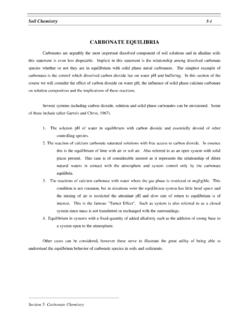
CARBONATE EQUILIBRIA - UC Davis
lawr.ucdavis.eduSoil Chemistry 5-1 Section 5- Carbonate Chemistry CARBONATE EQUILIBRIA Carbonates are arguably the most important dissolved component of …
CHAPTER 1. SOIL PHYSICAL PROPERTIES - UC Davis
lawr.ucdavis.eduSSC107-Fall 2000 Chapter 1, Page - 2 - Soils are extremely complex, hence we often simplify to study and understand soil physical
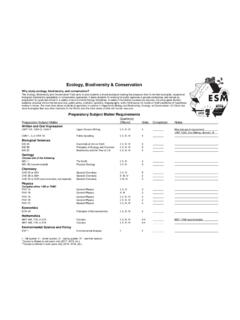
Ecology, Biodiversity & Conservation
lawr.ucdavis.eduBIS 2A Essentials of Life on Earth I, II, III, IV 5 BIS 2B Principles of Ecology and Evolution I, II, III, IV 5 BIS 2C Biodiversity and the Tree of Life I, II, III, IV 5 ... ESP 170* Conservation Biology Policy ESP 1, ECN 1A; ECN 100 or ARE 100A recommended III 4
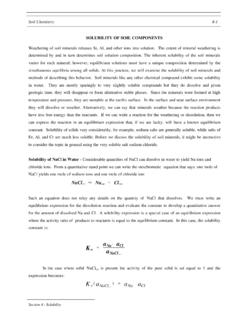
a a a - Department of Land, Air and Water Resources
lawr.ucdavis.eduSoil Chemistry 4-6 Section 4 - Solubility The Gibbsite case is a simple graphical representation of equilibrium over several values of pH. Application of this technique to any other chemical reaction is carried out in the same way.
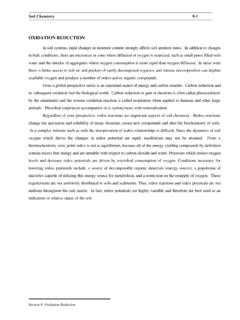
OXIDATION REDUCTION - University of California, Davis
lawr.ucdavis.eduSoil Chemistry 9-2 Section 9- Oxidation Reduction Eh -pH RELATIONSHIPS Thermochemistry background The Gibbs free energy (G) may be defined in differential form as: dG = - Sd T - V dP - w ′ (1) where w' is defined as the useful work in a chemical system ( non-pressure, volume work) in our case this will be the electrical work of the system.
CHAPTER 1. SOIL PHYSICAL PROPERTIES
lawr.ucdavis.eduForces acting on soil particle are gravitation, buoyancy and drag forces, and all depend on particle size; The larger particles settle first à Stokes law Since soils are a mixture of different size particles, soil’s are classified using the so-called soil textural triangle.
CARBONATE EQUILIBRIA
lawr.ucdavis.eduCalcium carbonate in water with a fixed partial pressure of carbon dioxide. For the case of a fixed partial pressure of carbon dioxide and calcium carbonate dissolved in the aqueous phase one more equation is need to describe the system. This is the solubility product of calcium carbonate: = K ( CaCO ) ( Ca ) ( CO ) o CaCO 3 2 - 3 2 + 3 (19)
Related documents
Chapter 5. Force and Motion - Physics & Astronomy
physics.gsu.eduYou’ve just kicked a rock, and it is now sliding across the ground about 2 meters in front of you. Which of these forces act on the ball? A. Gravity, acting downward B. The normal force, acting upward ... the mass is pulled by four rubber bands stretched the standard length. The acceleration of this second object is
STRENGTH PROPERTIES OF ROCKS AND ROCK MASSES 1 ...
ceae.colorado.eduRock mass strength is scale dependent and varies with the volume of rock under consideration. The modes of failure of intact rock are multiple. Rock can fail in tension, compression or shear. This depends on the load configuration, the geometry of the problem and how the loads are applied and distributed. A rock mass can also fail in tension ...
Vertical Stress in a Soil Mass
www.civil.uwaterloo.ca1 Vertical Stress in a Soil Mass Forces that Increase Vertical Stress in Soil Mass Weight of soil (effective stress) Surface loads Fill large area Point loads: Hydro pole, light stand, column, etc Lines loads Rack or rail loading, strip foundation Rectangular area Raft or rectangular footing Circular area tank Earth embankment Road, railway, fill, ice, etc.

Weathering, Erosion, and Mass-Wasting Processes
www.dnr.sc.govMass wasting is the transfer or movement of rock or soil down slope primarily by gravity. Deposition is the process by which weathered and eroded materials are laid down or placed in a location that is different from their source. These processes are all very important to the rock cycle because over geologic time
CLASSIFICATION // CHARACTERIZATION OF SOME ROCK …
www.rockmass.netIntact rock strength . The uniaxial compressive strength of a rock material constitutes the highest strength limit of the rock mass of which it forms a part. It is determined in accordance with the standard laboratory procedures. For the purpose of rock mass classification, the use of the well -known point load strength index can be useful as the

Lesson Plans on Density for Middle School Teachers
www.usi.edupumice floating in it. Ask students to explain in writing why this particular rock floats and other rocks sink. Explain that by the end of the lesson, they will be able to explain why this rock floats, using the terms mass, volume, and density. 3. Place the four bags next to each other on a table. Ask the students if they can tell