
CHAPTER 1. SOIL PHYSICAL PROPERTIES
GROUNDWATER SOILS: • SOURCE OF NUTRIENTS AND WATER FOR CROP AND PLANT GROWTH ... • Chemical adsorption of contaminants and nutrients, both in liquid and gas phase. SSC107-Fall 2000 Chapter 1, Page - 5 - Soil’s specific surface area (s, m2/g): Depends on shape of soil particle. For example, if spherical (r = radius and ρ = density) ...
Download CHAPTER 1. SOIL PHYSICAL PROPERTIES

Information
Domain:
Source:
Link to this page:
Documents from same domain
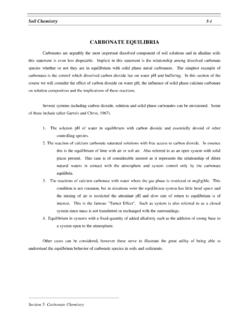
CARBONATE EQUILIBRIA - UC Davis
lawr.ucdavis.eduSoil Chemistry 5-1 Section 5- Carbonate Chemistry CARBONATE EQUILIBRIA Carbonates are arguably the most important dissolved component of …
CHAPTER 1. SOIL PHYSICAL PROPERTIES - UC Davis
lawr.ucdavis.eduSSC107-Fall 2000 Chapter 1, Page - 2 - Soils are extremely complex, hence we often simplify to study and understand soil physical
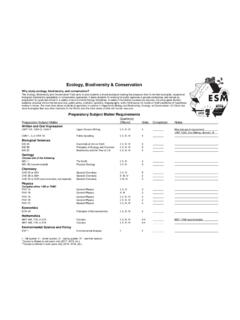
Ecology, Biodiversity & Conservation
lawr.ucdavis.eduBIS 2A Essentials of Life on Earth I, II, III, IV 5 BIS 2B Principles of Ecology and Evolution I, II, III, IV 5 BIS 2C Biodiversity and the Tree of Life I, II, III, IV 5 ... ESP 170* Conservation Biology Policy ESP 1, ECN 1A; ECN 100 or ARE 100A recommended III 4
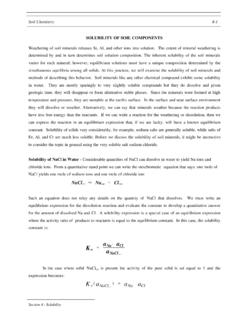
a a a - Department of Land, Air and Water Resources
lawr.ucdavis.eduSoil Chemistry 4-6 Section 4 - Solubility The Gibbsite case is a simple graphical representation of equilibrium over several values of pH. Application of this technique to any other chemical reaction is carried out in the same way.
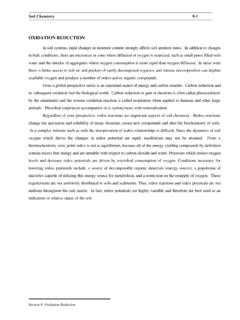
OXIDATION REDUCTION - University of California, Davis
lawr.ucdavis.eduSoil Chemistry 9-2 Section 9- Oxidation Reduction Eh -pH RELATIONSHIPS Thermochemistry background The Gibbs free energy (G) may be defined in differential form as: dG = - Sd T - V dP - w ′ (1) where w' is defined as the useful work in a chemical system ( non-pressure, volume work) in our case this will be the electrical work of the system.
CHAPTER 1. SOIL PHYSICAL PROPERTIES
lawr.ucdavis.eduForces acting on soil particle are gravitation, buoyancy and drag forces, and all depend on particle size; The larger particles settle first à Stokes law Since soils are a mixture of different size particles, soil’s are classified using the so-called soil textural triangle.
CARBONATE EQUILIBRIA
lawr.ucdavis.eduCalcium carbonate in water with a fixed partial pressure of carbon dioxide. For the case of a fixed partial pressure of carbon dioxide and calcium carbonate dissolved in the aqueous phase one more equation is need to describe the system. This is the solubility product of calcium carbonate: = K ( CaCO ) ( Ca ) ( CO ) o CaCO 3 2 - 3 2 + 3 (19)
Related documents
EFFECTS OF HUMAN ACTIVITIES ON THE INTERACTION OF …
pubs.usgs.govContaminants from point sources discharge either into ground water or surface water through an area that is small relative to the area or volume of the receiving water body. Examples of point sources include discharge from sewage-treatment plants, leakage from …
1.1 PHASES OF A MINING PROJECT - Home | ELAW
www.elaw.orggroundwater must be pumped out of the pit to allow mining to take place. A pit lake usually ... of contaminants when these particles become tailings. Tailings are what remains following milling of the ore to fine particles and extraction of the valuable metal(s).

Technical Fact Sheet – 1,4-Dioxane
www.epa.govIt may migrate rapidly in groundwater, ahead of other contaminants (DHHS 2011; EPA 2006). Where delineated, 1,4-dioxane is frequently found within previously delineated chlorinated solvent plumes and existing monitoring networks (Adamson 2014). As of …
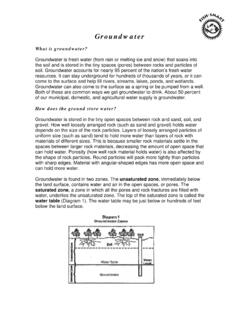
Groundwater - epa.gov
www.epa.govContaminants that can dissolve in groundwater will move along with the water, potentially to wells used for drinking water. If there is a continuous source of contamination entering moving groundwater, an area of contaminated groundwater, called a plume, can form (Diagram 3). A combination of moving
Ground Water Quality Standards (N - Government of New …
www.nj.govJun 01, 2020 · ground water supplies for microbiological contaminants and undesirable naturally occurring substances resulting in treated water that meets all the primary and secondary standards for those constituents stipulated by the New Jersey Safe Drinking Water Act regulations (N.J.A.C. 7:10-12.1 et seq.) "Criteria" means ground water quality criteria.
Sulfate in Drinking-water - World Health Organization
www.who.intin groundwater in the Netherlands were below 150 mg/litre (van Dijk-Looijaard & Fonds, 1985). In 1970, the US Public Health Service measured sulfate levels in the drinking-water sources of nine geographic areas. Sulfate was found to be present in 645 of 658 groundwater supplies and in all of the 106 surface water supplies sampled.
Total dissolved solids in Drinking-water
www.who.intthe effects on human health of the substances or contaminants examined in drinking-water. For each chemical contaminant or substance considered, a lead institution prepared a health criteria document evaluating the risks for human health from exposure to the particular chemical in drinking-water. Institutions from Canada, Denmark, Finland,

New York City Drinking Water Supply and Quality Report - …
www1.nyc.govContaminants that may be present in source water include microbial contaminants, inorganic contaminants, pesticides and herbicides, organic chemical contaminants, and radioactive contaminants. To ensure that tap water is safe to drink, the New York State Department of Health (NYSDOH) and