
CHAPTER 1. SOIL PHYSICAL PROPERTIES
J Which physical and chemical properties are largely affected by surface area??? Soil Structure: The arrangement and organization of soil particles in the soil, and the tendency of individual soil particles to bind together in aggregates; Aggregation creates intra-aggregrate and inter-aggregate pore space, thereby changing flow
Download CHAPTER 1. SOIL PHYSICAL PROPERTIES

Information
Domain:
Source:
Link to this page:
Documents from same domain
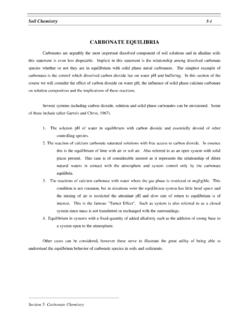
CARBONATE EQUILIBRIA - UC Davis
lawr.ucdavis.eduSoil Chemistry 5-1 Section 5- Carbonate Chemistry CARBONATE EQUILIBRIA Carbonates are arguably the most important dissolved component of …
CHAPTER 1. SOIL PHYSICAL PROPERTIES - UC Davis
lawr.ucdavis.eduSSC107-Fall 2000 Chapter 1, Page - 2 - Soils are extremely complex, hence we often simplify to study and understand soil physical
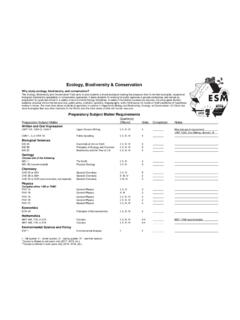
Ecology, Biodiversity & Conservation
lawr.ucdavis.eduBIS 2A Essentials of Life on Earth I, II, III, IV 5 BIS 2B Principles of Ecology and Evolution I, II, III, IV 5 BIS 2C Biodiversity and the Tree of Life I, II, III, IV 5 ... ESP 170* Conservation Biology Policy ESP 1, ECN 1A; ECN 100 or ARE 100A recommended III 4
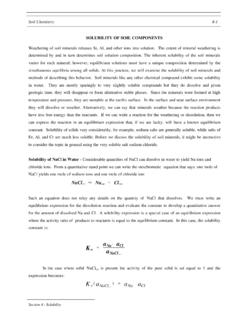
a a a - Department of Land, Air and Water Resources
lawr.ucdavis.eduSoil Chemistry 4-6 Section 4 - Solubility The Gibbsite case is a simple graphical representation of equilibrium over several values of pH. Application of this technique to any other chemical reaction is carried out in the same way.
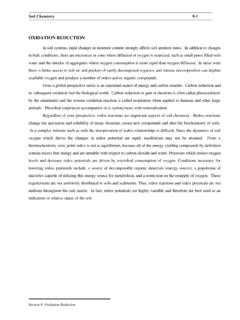
OXIDATION REDUCTION - University of California, Davis
lawr.ucdavis.eduSoil Chemistry 9-2 Section 9- Oxidation Reduction Eh -pH RELATIONSHIPS Thermochemistry background The Gibbs free energy (G) may be defined in differential form as: dG = - Sd T - V dP - w ′ (1) where w' is defined as the useful work in a chemical system ( non-pressure, volume work) in our case this will be the electrical work of the system.
CHAPTER 1. SOIL PHYSICAL PROPERTIES
lawr.ucdavis.eduForces acting on soil particle are gravitation, buoyancy and drag forces, and all depend on particle size; The larger particles settle first à Stokes law Since soils are a mixture of different size particles, soil’s are classified using the so-called soil textural triangle.
CARBONATE EQUILIBRIA
lawr.ucdavis.eduCalcium carbonate in water with a fixed partial pressure of carbon dioxide. For the case of a fixed partial pressure of carbon dioxide and calcium carbonate dissolved in the aqueous phase one more equation is need to describe the system. This is the solubility product of calcium carbonate: = K ( CaCO ) ( Ca ) ( CO ) o CaCO 3 2 - 3 2 + 3 (19)
Related documents
Irrigation Water Quality Standards and Salinity Management ...
soiltesting.tamu.edugood soil properties. Solublesodiumpercent (SSP) is also used to evaluate sodium haz - ard. SSP is defined as the ration of sodium in epm (equivalents per million) to the total cation epm multiplied by 100.A water with a SSP greater than 60 per cent may result in sodium accumulations that will cause a breakdown in the soil’s physical properties.
Chapter 4 Soil and Rock Classification and Logging ...
www.wsdot.wa.govSoil that contains enough organic particles to influence the soil properties. Soil that is composed primarily of vegetable tissue in various stages of ; Peat: decomposition usually with an organic odor, a dark brown to black color, a spongy consistency, and a …
Soil moisture content - Rausser College of Natural Resources
nature.berkeley.eduThe soil moisture content may be expressed by weight as the ratio of the mass of water present to the dry to the dry ... “Methods of Soil Analysis: Part I Physical and mineralogical properties ...
Principles of soil management - .NET Framework
projectblue.blob.core.windows.netSoil organic matter (OM) is the term used for all living or once-living materials in the soil. It adds to soil fertility and enhances the physical, chemical and biological properties of soil. It is critical to soil health, although the precise contribution of OM to soil function remains poorly understood. However, there is growing evidence

Soils, Soil Characteristics and Factors Affecting Management
www.agronomy.k-state.eduphysical properties even within fields that appear uniform zThis variability is the source of the interest in intensive soil sampling and variable rate technology zLet’s look at soil properties that affect crop production

Basic Soil Properties
ag.purdue.eduAgronomy 105 Soil & Water: Basic Soil Properties 23 Soil Aggregates •Aggregate Stability is an indicator of: –OM content –Biological activity –Nutrient cycling “soil quality” •Important for many physical properties: –Infiltration and water movement –Root penetration and growth –Resistance to erosive forces of wind and water 23
Explaining a Soil Profile - senecahs.org
www.senecahs.orgSoil scientists study the chemical, physical, biological, and mineral characteristics of soil. Their study of the soil is frequently associated with plant growth. The work of a soil scientist might include the responses of various soil types to fertilizers, soil composition, and drainage patterns.

PHYSICAL PROPERTIES: GLASS - City University of New York
academic.brooklyn.cuny.eduImportant Physical Properties • Temperature is a measure of heat intensity, or the hotness or coldness of a substance. – In science, the most commonly used temperature scale is the Celsius scale. This scale is derived by assigning the freezing point of water a value of 0°C and its boiling point a value of 100°C.