
CHAPTER 1. SOIL PHYSICAL PROPERTIES
Soil is dispersed, and mixed with water (soil suspension); ... - Mechanical impedance (cone-penetrometer tests) - Crusting (infiltration measurements) - Compaction (bulk density measurements) Soil structure deterioration by: 1. Tillage and cultivation 2. Decrease in …
Download CHAPTER 1. SOIL PHYSICAL PROPERTIES

Information
Domain:
Source:
Link to this page:
Documents from same domain
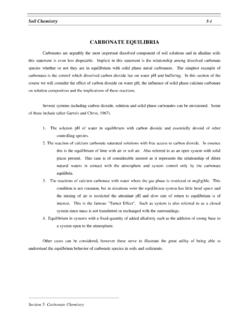
CARBONATE EQUILIBRIA - UC Davis
lawr.ucdavis.eduSoil Chemistry 5-1 Section 5- Carbonate Chemistry CARBONATE EQUILIBRIA Carbonates are arguably the most important dissolved component of …
CHAPTER 1. SOIL PHYSICAL PROPERTIES - UC Davis
lawr.ucdavis.eduSSC107-Fall 2000 Chapter 1, Page - 2 - Soils are extremely complex, hence we often simplify to study and understand soil physical
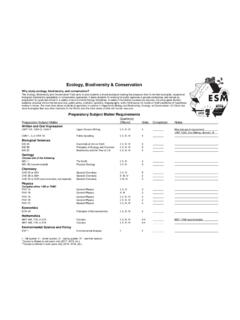
Ecology, Biodiversity & Conservation
lawr.ucdavis.eduBIS 2A Essentials of Life on Earth I, II, III, IV 5 BIS 2B Principles of Ecology and Evolution I, II, III, IV 5 BIS 2C Biodiversity and the Tree of Life I, II, III, IV 5 ... ESP 170* Conservation Biology Policy ESP 1, ECN 1A; ECN 100 or ARE 100A recommended III 4
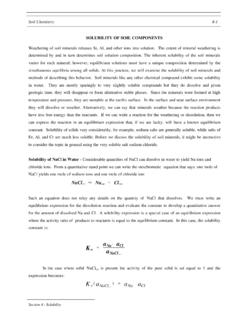
a a a - Department of Land, Air and Water Resources
lawr.ucdavis.eduSoil Chemistry 4-6 Section 4 - Solubility The Gibbsite case is a simple graphical representation of equilibrium over several values of pH. Application of this technique to any other chemical reaction is carried out in the same way.
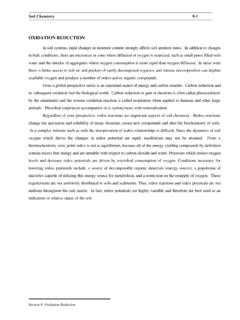
OXIDATION REDUCTION - University of California, Davis
lawr.ucdavis.eduSoil Chemistry 9-2 Section 9- Oxidation Reduction Eh -pH RELATIONSHIPS Thermochemistry background The Gibbs free energy (G) may be defined in differential form as: dG = - Sd T - V dP - w ′ (1) where w' is defined as the useful work in a chemical system ( non-pressure, volume work) in our case this will be the electrical work of the system.
CHAPTER 1. SOIL PHYSICAL PROPERTIES
lawr.ucdavis.eduForces acting on soil particle are gravitation, buoyancy and drag forces, and all depend on particle size; The larger particles settle first à Stokes law Since soils are a mixture of different size particles, soil’s are classified using the so-called soil textural triangle.
CARBONATE EQUILIBRIA
lawr.ucdavis.eduCalcium carbonate in water with a fixed partial pressure of carbon dioxide. For the case of a fixed partial pressure of carbon dioxide and calcium carbonate dissolved in the aqueous phase one more equation is need to describe the system. This is the solubility product of calcium carbonate: = K ( CaCO ) ( Ca ) ( CO ) o CaCO 3 2 - 3 2 + 3 (19)
Related documents
IS 2720-1 (1983): Methods of test for soils, Part 1 ...
law.resource.orgPreparation of dry soil samples for various tests [CED 43: Soil and Foundation Engineering] IS t 2720 ( Part 1) - 1983 Indian Standard METHODS OF TEST FOR SOILS PART 1 PREPARATION OF DRY SOIL SAMPLES FOR VARIOUS TESTS ( Second Revision ) Soil Engineering and Rock Mechanics Sectional Committee, BDC 23 ...
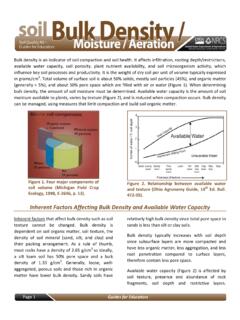
Inherent Factors Affecting Bulk Density and Available ...
www.nrcs.usda.govTotal volume of surface soil is about 50% solids, mostly soil particles (45%), and organic matter (generally < 5%); and about 50% pore space which are filled with air or water (Figure 1). When determining bulk density, the amount of soil moisture must be determined. vailable water capacityA is the amount of soil
Undrained Triaxial Compression Tests Laboratory Experiment ...
d2oqb2vjj999su.cloudfront.netThe undrained triaxial strength tests are used to determine the shear strength of a soil sample that is not allowed to drain. The test will be completed on three unsaturated soil samples. The test results will be analyzed to determine the Mohr-Coulomb failure envelope, failure angle, shearing resistance, and Young’s Modulus of Elasticity.
NOTES on the STANDARD PENETRATION TEST
web.mst.edu3) V.F.B. de Mello, 1971, The Standard Penetration Test: Proceedings of the 4th Panamerican Conference on Soil Mechanics and Foundation Engineering: San Juan, PR, v.1:1-86; and 4) Yves Lacroix and Harry Horn, 1973, Direct Determination and Indirect Evaluation of Relative Density and Its Use on Earthwork Construction Projects: in Evaluation of Relative

CHAPTER 5 SOIL CLASSIFICATION AND LABORATORY TESTING
secure.in.govThe results of sieve analyses, plotted in the form of a gradation curve, are used to estimate soil permeability. The following tests shall be performed on samples obtained to verify the field classification of the major soil types encountered during the investigation. The number of tests

Chapter 5 Engineering Properties of Soil and Rock
www.wsdot.wa.govThe two most common in-situ test methods for use in soil are the Standard Penetration Test, (SPT) and the cone penetrometer test (CPT). Section 5.4 describes these tests as well as other in-situ tests. The laboratory testing program generally consists of index tests to obtain general information or to use with correlations to estimate design